 Membership
 Network
 Regional Sites & Affiliates


 Events
 Participate
 Resources

 Training
 Credentials
 Government


 Content Channels
 Tools
Tools


 Business Overview





Learning from the Past
Why we ventilate buildings
In the built environment, the question of why ventilating buildings may seem simple; but the science, history and evolving standards behind it reveal a much deeper story. From early misunderstandings about diseases to modern challenges like energy efficiency and pandemic resilience, the role of ventilation in creating safe, comfortable and productive spaces is more critical than ever.
The primary reason to ventilate buildings is straightforward: people. Buildings are operated to keep occupants comfortable, safe and productive in a healthy indoor environment. Ventilation dilutes indoor contaminants — such as volatile organic compounds (VOCs), bioaerosols, particulate matter and odors — by replacing contaminated indoor air with cleaner outdoor air. Ventilation is a foundation for good indoor air quality (IAQ) and healthy buildings; however, maintaining proper ventilation has its challenges.
Ventilation & mass flow
Understanding ventilation means understanding the mass flow rate. Mass flow rate of air is the measure of how much quantity of a substance moves within a volume air per unit of time. In simple terms, it tells the effectiveness of the airflow.
Mass is the weight or quantity. In the context of dilution, ventilation and outside air are used to reduce contaminant concentrations. Outside air is made up of gases, and gases are impacted by density.
Why does this matter?
In HVAC applications, airflow rates are measured and reported in cubic feet per minute or liters per second (cfm or l/s) as a volumetric rate. This volumetric rate is the actual flow rate (ACFM) at current conditions. However, because of the impact of density, the amount of matter will vary at different conditions.
 A visual example of this relationship is shown here. The volume of the jars is the same. The jar on the left has a lot more balls, which means it has more mass. Hence, the density is higher in this jar than in the jar on the right. The jar on the left would have a volume that is less effective.
Temperature, pressure and elevation all affect air density, which in turn impacts its effectiveness. For example, an actual airflow rate measured at sea level would have higher density than the equivalent airflow at an elevation of 6,000 feet. This can result in 20 percent less effective outdoor airflow, meaning less dilution of indoor contaminants with cleaner outdoor air. Correction factors need to be instituted in design and in building automation airflow measurement.
Likewise, when outdoor temperatures are hot, the air density is less, and the ventilation is less effective. In locations that experience hot summers and cold winters, the density impact can lead to underventilation to ventilation rates above design.
The change in seasons can not only influence the effectiveness of ventilation but also can result in pressurization problems within the building. A smart ventilation approach would be to correct for this. This not only assists with ensuring proper ventilation and pressurization but also has the benefit of reducing actual flow rate at colder temperatures when the outdoor air is most costly to reheat.
Alternatively, airflow may be measured and controlled in terms of mass flow, also known as standard airflow (scfm or sl/s). This sets airflow rates at a standardized condition, such as those that are used by ASHRAE Standard 62.1 to set minimum ventilation rates and maintains the effective rate regardless of density. For more information on density and ASHRAE minimum ventilation rates, see addendum j.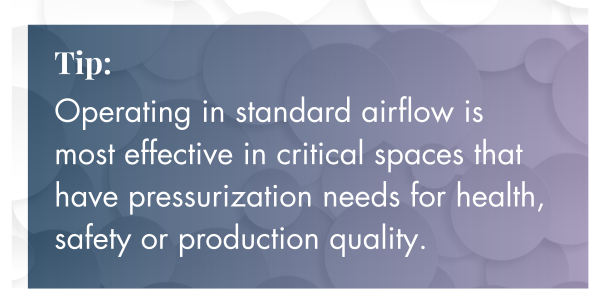
 A look back: From miasma to modern science
The concept of "bad air" has ancient roots. The Greek physician Hippocrates theorized that mysterious diseases were caused by "miasma," or night air. While misguided, this early thinking planted the seed for centuries.
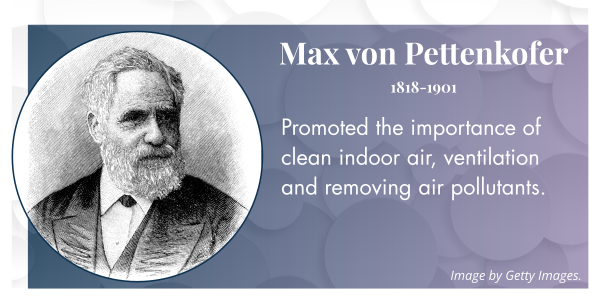
Fast-forward to the 18th and 19th centuries, when scientists like Antoine Lavoisier and Max von Pettenkofer advanced the understanding of respiration, combustion and the importance of ventilation of enclosed spaces. Lavoisier, considered the father of modern chemistry, discovered the purpose of oxygen and named the element. He identified humans as "engines of combustion," consuming oxygen and producing carbon dioxide, and noticed that this process changes with activity level. His research also led to the law of conservation of mass: the mass was neither created nor destroyed, although it may be transformed. Pettenkofer, the father of hygiene science, promoted the importance of clean indoor air. He wrote about the importance of ventilation and removing pollutants — a discovery that is foundational to IAQ.
 Pettenkofer also determined a co-dependent relationship between ventilation and indoor CO2 levels. Today indoor CO2 sensors indicate ventilation air delivered to a space or used as an energy savings means through demand control ventilation (DCV). Generally, indoor CO2 is often misunderstood, misapplied, and has many assumptions and limitations and should not be a sole indicator of IAQ. It also should not be used without the measurement of changing airflow rates into the ventilation system. As Lavoisier discovered, activity level is one of many factors that can change the human production rate of CO2. Incorrect assumptions or application can result in ventilation rates that are not correct, provide too little or way too much ventilation, and lead to either poor IAQ or wasted energy.
 Information of limitation of CO2 can be found in ASHRAE Position Document or ASTM D6345-24.
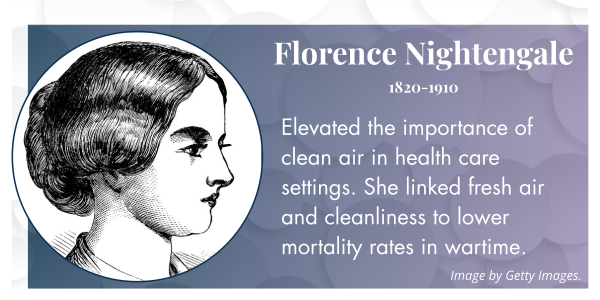
Florence Nightingale further elevated the importance of clean air in health care, linking fresh air and cleanliness to lower mortality rates during the Crimean War. Her writings remain relevant, and remarkably, the first law of nursing focused not on medications but on ventilation.
Standards, laws & evolution
The history of ventilation standards is also a story of public health awareness. Massachusetts was the first U.S. state to legislate ventilation in 1888, requiring 30 cubic feet per minute (cfm) per occupant in schools and public spaces. By the early 20th century, many other states had adopted similar laws. In 1914 the American Society of Heating and Ventilating Engineers (ASHVE – the predecessor to ASHRAE) provided minimum ventilation rates of 30 cfm in schools, 25 cfm in workspaces and 20 cfm in theaters, court rooms and other auditoriums. Today those spaces are ventilated at 14 cfm, 17 cfm, and 6 cfm or less.
What happened?
 In the post-1918 pandemic of the 1920s, as mechanical systems became more complex, incorporation of air conditioning and energy to operate them became more expensive, and there was pushback against the laws. In the 1930s, ASHVE funded research to look at ventilation rates and body odor. With laws repealed, improved personal hygiene and new recommendations primarily based on body odor, the ventilation rates started to go down.
In 1973, ASHRAE published Standard 62 establishing minimum ventilation rates for occupiable spaces. These rates were lower than they were in the past. As a result of the energy crisis of the 1970s, ventilation rates were significantly reduced in the 1980s. The consequence was the rise of sick building syndrome (SBS), as under-ventilated, tightly sealed buildings led to increased occupant complaints and health problems. They were raised again after additional research on ventilation and body odor, only to come down again in 2004, even though there was a new focus providing ventilation for building generated contaminants.
State of buildings today
Today, more buildings are constructed, finished and furnished with synthetic materials. All these materials release gas into the air, some of which create reactions with other airborne compounds or with oils on people’s skin. These gases and new compounds are inhaled unless they are diluted with ventilation or adequately absorbed by special filtration.
Additionally, many cleaning products release chemical compounds that further contribute to indoor air contamination. There is also more internal particulate matter (PM) generated, and additional outdoor PM brought into the building by people, poor pressurization control and inadequate filtration.
In 2007, the U.S. Energy Independence and Security Act triggered energy standards and codes to be more aggressive, led cities to establish benchmarking requirements, started net zero and decarbonization efforts, and initiated publicly traded companies to be scored on sustainability. The result is a singular focus on buildings to be designed, retrofitted and operated to save energy.
Buildings are sealed tighter, which causes a building to “breathe” less, trapping more air inside. Because ventilation has a cost associated with it, it is an easy target for energy savings. Many times, these decisions are made without regard to IAQ. Air cannot be seen, and many of the dangerous compounds floating in are odorless or not perceived by the nose. When odors are present, people quickly get acclimated and lose perception; however, the body is still absorbing those compounds.
Even after the COVID-19 pandemic, the course of ventilation perceptions has not changed much. Aerosol science is relatively new, and scientists were not sure about people getting sick through the airborne route. The spread of bioaerosols indoors is rising, while ventilation efforts are being reduced.
People designing buildings do not know what the air quality will be. The best they can do is choose to do better than the minimum, such as LEED®: materials are chosen for less off-gassing, and ventilation and filtration are increased. Facility managers are often unable to measure everything in the air on a real-time basis. A VOC sensor is limited and only an indicator, and bioaerosol sensor technology is a verging technology. A CO2 sensor by itself may provide false security if not incorporated with active ventilation airflow measurement.
The bottom line: It's about people
Buildings are constructed for people to work, play and live. Good IAQ improves performance, reduces absenteeism, lowers health care costs and may increase the value of the building. Occupants are generally a company’s most valuable asset and the highest cost burden. However, there is a constant drive to focus on energy, wherein operational costs are typically a smaller fraction of the budget.
Minimum ventilation rates are based on being acceptable to 80 percent of the occupants. Spanish philosopher George Santayana wrote, "Those who cannot remember the past are condemned to repeat it." Hippocrates, Lavoisier, von Pettenkofer and Nightengale led with a purpose for a better future. The solution is to break the trend and, at least, place the importance of ventilation in balance with energy, or people will suffer the results.

Darryl DeAngelis has served as director of business development for EBTRON since 2018. He holds a B.S. in Marine Engineering from the Massachusetts Maritime Academy. He has more than 40 years of experience in the HVAC industry, along with four related patents and LEED AP accreditation. A longtime ASHRAE member, DeAngelis has served on numerous technical and standards committees. Currently, he serves as chair of the 62.1 Ventilation Subcommittee and as past chair of TC 7.7 Testing and Balancing. He is a voting member of ASTM and participates in several professional organizations supporting indoor air quality, building performance and facility management.
References
Top image by Getty Images.
Read more on Facility Operations or related topics Building Systems
Explore All FMJ Topics