
 Membership
 Network
 Regional Sites & Affiliates


 Events
 Participate
 Resources

 Training
 Credentials
 Government


 Content Channels
 Tools
Tools


 Business Overview





Less Fingertips on Keyboards
Practical AI applications in FM

Artificial Intelligence (AI) has moved from concept to practical tool within facility management, reshaping how organizations maintain assets, operate buildings and plan long‑term investments. Across global markets, FM teams are navigating aging infrastructure, budget reduction pressure, sustainability expectations and rising service demands.
These operational realities have accelerated the adoption of digital tools that support decision-making while preserving the essential role of professional judgment.
 Energy consumption typically represents 20 to 30 percent of facility operating costs, while maintenance contributes another 15 to 25 percent. With such a large share of organizational expenditures tied to facility operations, leaders rely more on data‑driven approaches to improve performance. At the same time, FM teams are expected to enhance workplace experience and create environments that support productivity and well‑being. AI offers a means to manage both responsibilities by providing insights that strengthen operational precision without diminishing human contribution.
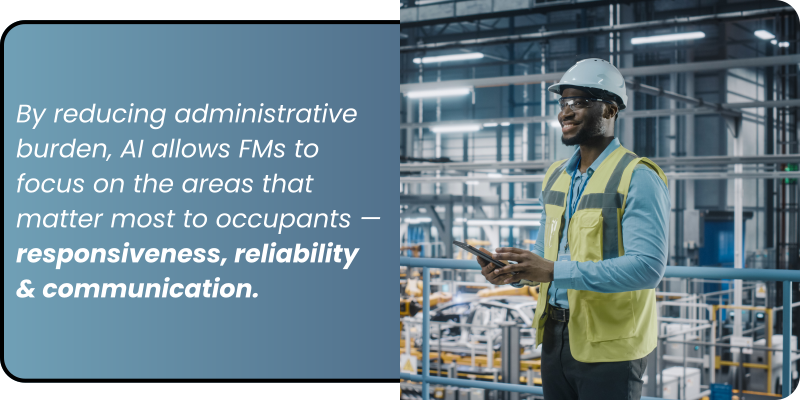
Administrative requirements have grown steadily in modern facilities environments. Recordkeeping, reporting and manual analysis often consume significant time, leaving fewer hours for direct engagement with occupants or field operations. AI reduces the amount of time professionals spend with their fingers on keyboards by automating routine tasks that once required manual input. This restored capacity allows teams to focus on service delivery, communication and operational improvements. Technology becomes a supporting tool rather than a replacement for human capability.
Predictive maintenance & asset reliability
Maintenance programs have traditionally relied on reactive or preventive methods. Reactive maintenance occurs when equipment fails, often leading to disruption, higher labor costs, and increased downtime. Preventive maintenance uses fixed schedules that do not always reflect real equipment conditions and can result in unnecessary work or overlooked degradation.
 Predictive maintenance models evaluate historical service records, sensor readings, operational run‑time and environmental conditions. These models detect anomalies that may indicate wear or inefficiency, generating alerts that allow teams to intervene before failures occur. The approach shifts maintenance from calendar‑based scheduling to condition‑based action. This improves both budget control and asset reliability.
Many organizations adopt predictive maintenance by targeting critical assets such as chillers, boilers, air handling units, elevators and electrical infrastructure. These systems often already feed data to building management systems or computerized maintenance management systems, providing a useful starting point. Over time, model accuracy improves as more data becomes available, allowing more precise prediction windows and more consistent performance.
Reported outcomes in various regions show reductions of 10 to 40 percent in maintenance costs when predictive methods are deployed effectively. Unplanned downtime decreases, emergency work orders become less frequent, and after‑hours interventions decline. Predictive approaches also allow technicians to plan work more strategically, improving both service quality and reliability.
Energy optimization & building performance
Energy management remains one of the most widely adopted and mature applications of AI in FM operations. Traditional energy strategies often rely on fixed schedules or periodic adjustments that cannot account for shifts in weather, occupancy or equipment conditions. AI enables continuous optimization by analyzing building behavior in real time.
AI-based platforms integrate historical usage data, local weather forecasts, occupancy patterns and system performance indicators. With these inputs, building controls adjust dynamically to maintain comfort while reducing consumption. Over time, the system “learns” how the building responds and refines its control strategies. This ongoing calibration leads to measurable performance improvements.
HVAC systems represent the largest share of energy use in most facilities. AI can optimize HVAC performance by adjusting setpoints based on predicted occupancy and outdoor conditions. It can detect issues such as simultaneous heating and cooling, faulty sensors, or equipment operating outside expected ranges. Early identification of these issues prevents energy waste and improves reliability.
Organizations that deploy AI-driven energy optimization frequently report savings of 10 to 25 percent. These reductions support carbon‑reduction goals and help contain rising utility costs across global markets. In addition, indoor comfort becomes more consistent, improving workplace satisfaction and supporting productivity. The combined benefits demonstrate why energy optimization remains a primary entry point for AI adoption in facilities.
Workplace experience & occupant engagement
Workplace experience has become a central measure of facility effectiveness. Occupants expect environments that support focus, comfort, collaboration and safety. Technology plays an important role in achieving these expectations, but personal interaction remains essential. FM teams influence how spaces are perceived and their availability shapes occupant confidence in the organization.
AI supports workplace experience by reducing administrative workloads. Automated categorization of service requests, predictive alerts and real‑time analytics reduce the need for manual data entry or reporting. With less time dedicated to keyboards and spreadsheets, FM professionals can engage directly with occupants, respond to concerns, and build trust through conversation. Increased visibility strengthens relationships and improves service outcomes.
More time for engagement also allows teams to address potential issues before they become complaints. By speaking with occupants about comfort, space usage, or maintenance concerns, facilities professionals can resolve issues proactively. This approach fosters a more collaborative environment and supports a positive workplace culture. AI enables the shift by managing routine data functions in the background.
Human presence remains essential to workplace experience, regardless of technological advances. AI enhances service capacity but cannot replicate empathy, judgment or interpersonal understanding.
 Space utilization & adaptive planning
Hybrid and flexible work arrangements have changed space usage patterns across global markets. Many buildings experience fluctuating occupancy, with peak and non‑peak periods differing significantly from traditional schedules. Despite these changes, operating costs remain largely fixed. AI provides a clearer understanding of utilization trends, helping organizations adapt their spaces more effectively.
AI-enabled analytics combine data from occupancy sensors, access control systems, Wi‑Fi networks, and reservation platforms. This integrated dataset reveals how spaces are actually used across time, function and location. FM teams can identify areas that are consistently underused or overbooked, allowing more informed decisions about layout changes, consolidation or repurposing. Evidence-based planning reduces uncertainty and improves accuracy.
These insights help organizations align real estate footprints with actual demand. Cleaning and maintenance schedules can be adjusted based on use, improving efficiency without reducing service quality. Space designs can be modified to support work patterns such as collaboration-focused areas or quiet zones. When used effectively, AI-powered utilization analysis strengthens both cost management and occupant satisfaction.
Underutilized space represents a significant financial opportunity in many markets. Organizations that apply AI to space planning frequently identify opportunities to reduce square footage, improve flexibility or reconfigure areas for emerging needs. These actions support broader sustainability goals by reducing energy use and resource consumption.
Work order management & service efficiency
Work order management is one of the most visible aspects of facility operations. Traditional systems often rely on static priority codes or manual routing, which can lead to delayed response times or inefficient allocation of labor. AI enhances service management by analyzing variables such as asset criticality, technician skill sets, historical performance and current workload distribution.
Natural language processing interprets free-text service requests, reducing the need for manual categorization. Automated routing assigns tasks based on capacity, location, or technical requirements. This approach improves accuracy and decreases administrative effort. Supervisors gain clearer visibility into performance trends and resource utilization, enabling better planning.
Organizations using AI-supported work order systems often see improvements in response and resolution times. Reduced backlog, increased scheduling efficiency and clearer performance visibility contribute to a more reliable service experience. Technicians spend more time addressing issues and less time navigating administrative processes. These improvements create a more responsive and transparent service model.
Direct communication remains a crucial component of service excellence. As administrative tasks decrease, technicians can explain work performed, clarify recommendations and build trust with occupants. These interactions significantly shape perceptions of service quality across global environments.
 Health, safety & compliance
Health and safety responsibilities require consistent monitoring, documentation and risk assessment. Regulations vary across markets, creating a complex compliance environment. AI supports safety programs by identifying hazards, analyzing trends and automating documentation tasks.
Computer vision tools can detect blocked exits, missing protective equipment or unsafe conditions. AI systems analyze inspection records and incident reports to identify recurring risks. These insights allow teams to implement targeted interventions that reduce future incidents. Automated documentation also helps maintain consistent records for audits and compliance reviews.
By reducing administrative pressures, AI enables safety personnel to focus on education, engagement, and prevention. Conversations with occupants and staff support stronger safety culture than checklists alone. AI enhances monitoring and analysis while human teams reinforce awareness and proper behavior. Together, they create a more resilient safety environment.
Capital planning & life cycle management
Long‑term capital planning relies on accurate information about asset conditions, performance history, and lifecycle risk. Facilities often generate extensive data, but this information may be scattered or underutilized. AI helps consolidate and analyze these datasets to support more informed planning decisions.
AI-based models forecast life cycle needs, assess repair-versus-replacement scenarios, and evaluate the financial impact of deferred maintenance. Condition-based forecasting provides a clearer picture of long‑term requirements, enabling leaders to prioritize investment more effectively. These insights are particularly valuable in multi-site portfolios where needs vary across regions and asset types.
Stronger capital planning enhances transparency and supports strategic alignment. Leaders can better understand cost drivers, operational risks and long‑term obligations. When combined with human judgment, AI-supported insights help create balanced strategies that control cost while maintaining reliability. Professional oversight remains essential to assess context, constraints and operational realities.
A practical, interactive exercise for FM leaders
AI also supports strategic planning processes when applied responsibly. One practical application is the creation of a comprehensive facility plan, an executive-level document that outlines vision, priorities and long-term needs. AI supports this exercise by helping structure information, synthesize themes and produce initial drafts.
To use AI effectively in this process, boundaries must be established. Inputs should remain high-level and non‑sensitive, such as facility types, geographic distribution, general asset age ranges and organizational priorities. No security information, personnel data, proprietary financials or contractual details should be included. Maintaining these boundaries protects organizational interests and ensures responsible use of technology.
The plan should present a clear facilities vision aligned with organizational objectives. Themes such as sustainability, resilience, service quality and cost control often guide the structure. Leadership discussions benefit from a summary of portfolio characteristics, upcoming capital considerations, operating challenges, and long-term risks. The plan should highlight strategic opportunities without functioning as an approval document.
After generating a draft, facilities professionals review and refine the content to ensure accuracy. Assumptions are validated, language is adjusted, and organizational context is incorporated. The AI‑generated draft serves as a starting point rather than a finished product. When used in this manner, AI accelerates planning while preserving professional judgment and oversight.
Conclusion
AI is becoming a well‑established component of facilities management around the world. Its value emerges from practical applications in maintenance, energy management, space utilization, safety, and long‑term planning. By reducing administrative tasks, AI gives facilities professionals more time to engage with occupants, strengthen service quality, and focus on meaningful work. Human interaction remains at the center of workplace experience and AI enhances these interactions by supporting efficiency and insight. Facilities organizations that embrace these tools with purpose and clarity position themselves for improved performance, stronger service outcomes and long‑term strategic advantage.

References
Top image via Getty Images.
Read more on Facility Technology & Data Management and Project Management or related topics Facility Technology and Project Management
Explore All FMJ TopicsRelated articles
-

Artificial Intelligence in FM
The stakeholder’s perspectiveBy Dr. Jake Smithwick & Dr. Kenneth Sullivan & Nneka Ubi05.01.2024 -

Don’t Drop the Ball
How a CMMS can make or break an FM organization’s successBy Michael Carmean09.17.2024 -

Beware of Growing Cyberthreats
Why it’s time for stronger facility cybersecurityBy Andrew Harris & Eric Headington10.30.2024