
 Membership
 Network
 Regional Sites & Affiliates


 Events
 Participate
 Resources

 Training
 Credentials
 Government


 Content Channels
 Tools
Tools


 Business Overview





Leveraging AI Data Sheet Analysis
Significance for effective FM

Facility managers require reliable access to up-to-date data from a wide range of processes, such as maintenance, security, sustainability, workplace management and energy management. Information systems such as integrated workplace management systems (IWMS), computerized maintenance management systems (CMMS), ESG performance monitoring and reporting tools and energy management systems (EMS) are available for this purpose, providing information on building components, system maintenance, network components, or inventory and presenting it in various formats. This includes text blocks, lists, tables and diagrams, which are often clearly displayed in dashboards.
Most of that data begins life in manufacturers’ data sheets. These documents carry an unusually heavy load. They must be technically precise for specialist planners, inspectors and operators, compliant with standards and approvals guidelines and certification marks, while being market-ready, concise for customers and brand-consistent.
They are essential for smooth building operations and reliable FM. Product-neutral search, comparison, and documentation are time-consuming.
 How can those varied data sheets be processed so that queries return reliable, evidence-based answers and allow for the extraction of standardized specification profiles in a similar manner.
What makes data sheets so special?
Data sheets combine continuous text, lists, tables, diagrams, drawings, footnotes and cross-references, often with multiple parameter sets referring to different product variants. Terminology, structure and layout vary significantly. As a result, product-neutral searching, comparison, and documentation are, in practice, time-consuming, costly and error-prone.
Within data sheets, tables pose a challenge. They are often the primary source of information and yet have a highly inconsistent structure. Some recurring problems make them difficult to interpret automatically:
-
Several product variants share a single table.
-
Missing dividing lines must be reconstructed.
-
Cells contain multiple pieces of information, while related elements (attributes, their typical values, ranges, units, etc.) are contained in multiple cells.
-
Regular table structures are disrupted by insertions, groups, merged cells or nested sub-tables.
-
References and footnotes contain restrictions or test conditions.
-
Related information is scattered throughout the document.
These issues are illustrated in Figure 1.
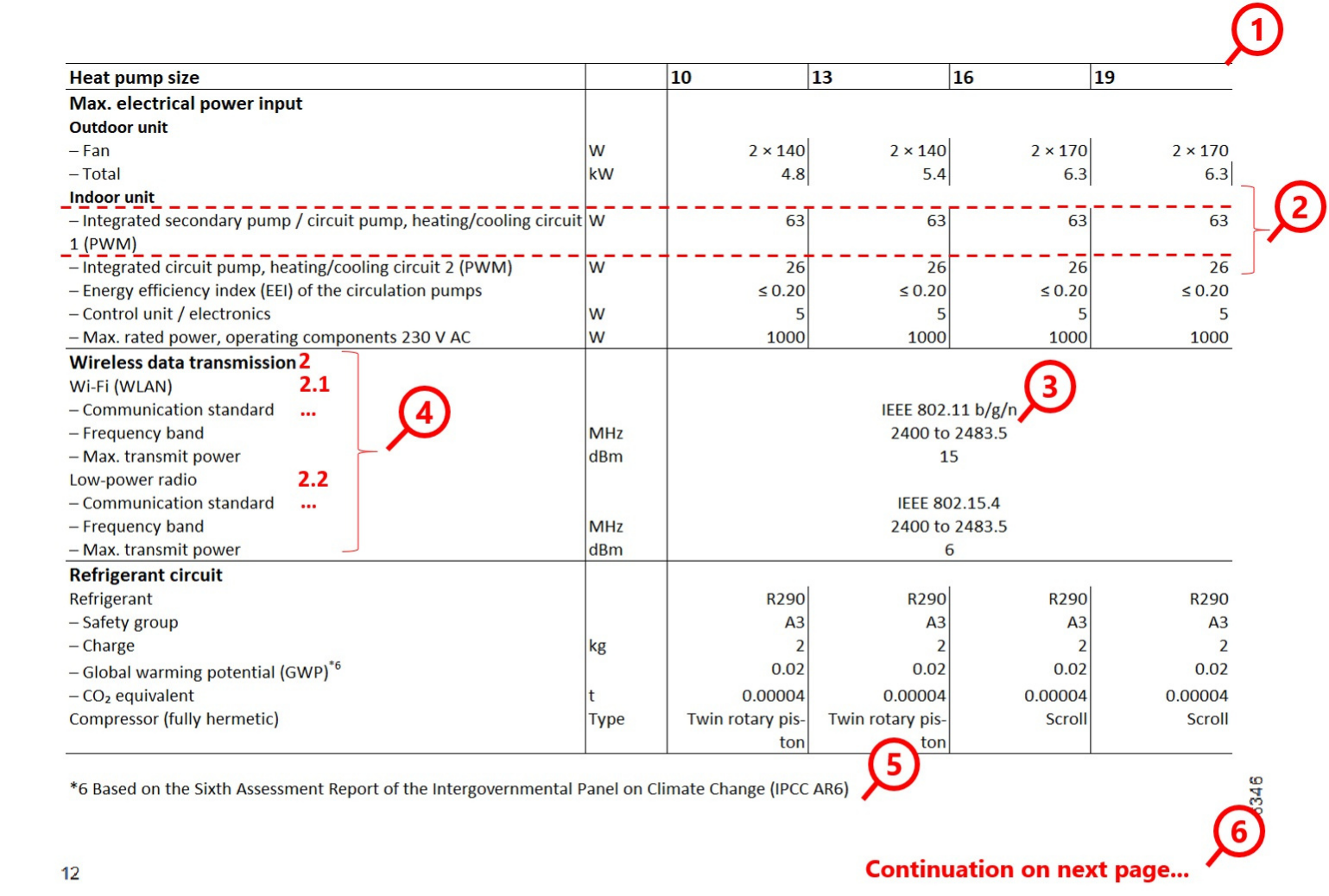 Figure 1: Challenging features in tables
But how does this kind of data get into the respective information systems? In most cases, manufacturers provide it in the form of lengthy and complexly structured product data sheets in PDF format. Manufacturers still rarely provide model-based information using standardized formats and classification schemes such as IFC and eCl@ss. Often, the only option is to manually evaluate the data sheets, convert the required information into formats such as Excel or CSV and import it via special import routines (batch) into the respective IT systems. This process is very time-consuming and prone to errors.
The example in Figure 2 clearly illustrates how information is distributed across data sheets and the various ways it is presented (lists, tables, images, symbols, etc.). Additionally, the complex content structure (footnotes, shared attributes, variant sections, table groups, etc.) can easily be recognized.
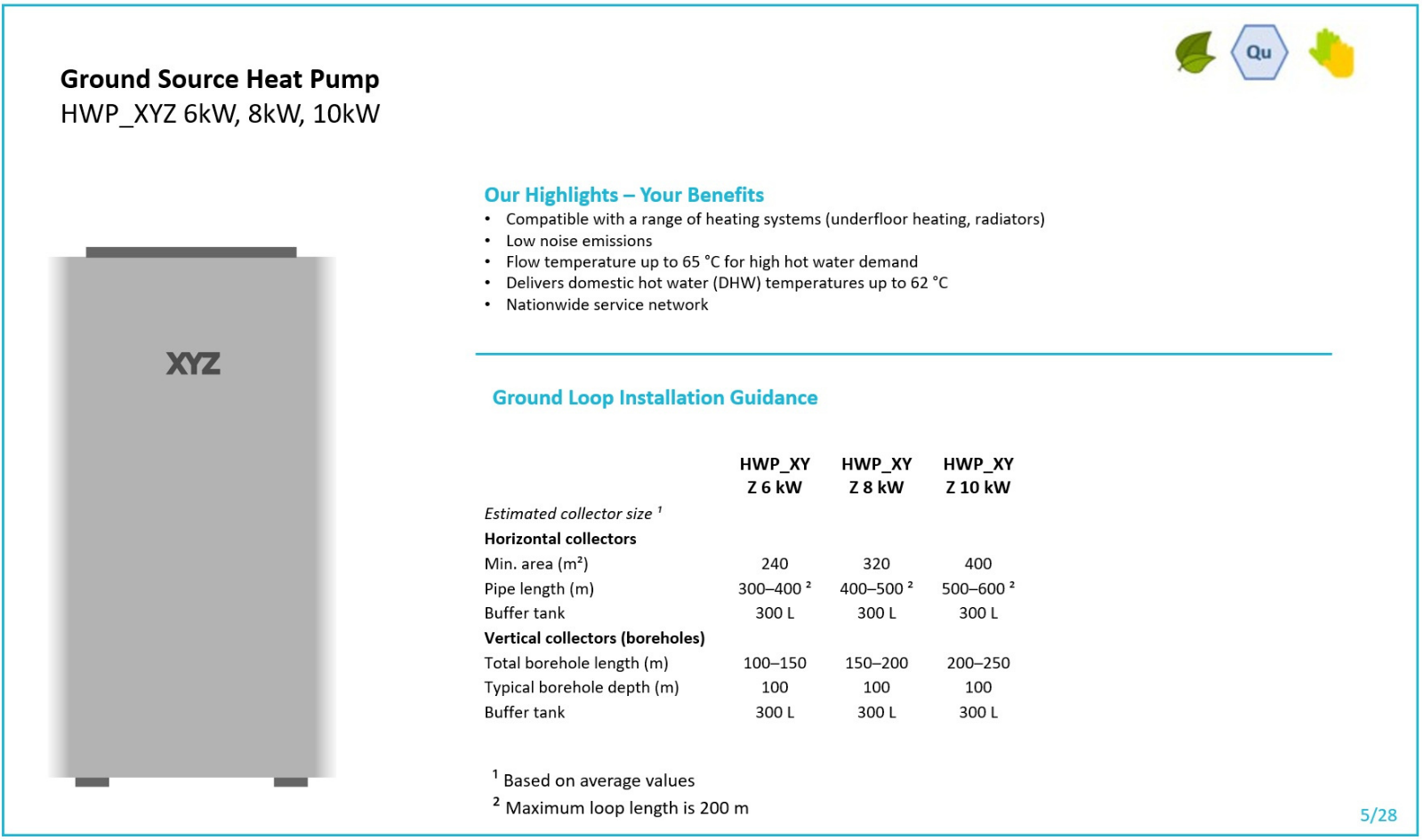 Figure 2: Example specifications for a heat pump (variants 6 kW, 8 kW, 10 kW) in a data sheet
Challenges
The goal is to automate the analysis and extraction and retrieval of relevant data and the subsequent transfer via suitable interfaces. Text recognition in documents, also known as optical character recognition, works very reliably, as does the automatic classification of documents using artificial intelligence (AI).
These approaches might be expected to succeed for data sheets as well, but there are several obstacles. A major difficulty is that data sheets are not standardized, containing heterogeneous information and layout elements in various places. The technical terms used, groupings of specifications, and document and table layouts are not subject to common rules.
The idea of feeding a complete data sheet into a large language model (LLM) and extracting relevant information using natural language processing (NLP) methods seems appealing. In specialized technical domains, however, it has become apparent that such prompt-based document analysis is not reliable. The complex structure makes it difficult to recognize semantic relationships across different organizational levels automatically. Tables are interpreted inconsistently, contextual dependencies such as footnotes, chapters and references are overlooked, and missing information is seemingly plausible, however, filled in with hallucinations.
In practical applications such as FM and related industrial contexts, there is a need for solutions that can reliably identify the desired information in documents, even when dealing with domain expert questions, and link the results as reliable evidence to their exact location in the original source.
AI- & NLP-based approach
Handing entire documents to a single chatbot model often produces unreliable results, especially in specific technical fields.
Therefore, an approach was developed aiming at a high degree of automation and utilizing modern AI methods to deliver reliable and verifiable results:
A. Analysis (once per document)
1. Specialized AI components perform structural & semantic analyses & the documents are normalized based on rules:
-
-
classification of related segments.
-
recognition & analysis of table structures.
-
identification of headings with hierarchical levels & captions.
-
identification of footnotes, cross-references & references.
-
2. All elements, along with their position in the chapter hierarchy, table/figure captions, and references/footnotes, are grouped into information units.
3. These are stored in a vector database through an embedding process. Vector databases make it easy to determine semantic similarities between information units.
B. Retrieval
The extracted information units are semantically indexed and stored together with metadata (e.g., document, page, position). Queries return the most relevant evidence points, including source references, thereby enabling quickly verifiable search.
C. Customization through expert knowledge
To improve query quality and obtain comparable standard information, an ontology can be created in collaboration with domain experts. This ontology models product classes, attribute groups, synonyms, unit conventions, and plausible value ranges in hierarchical structures. Furthermore, it defines relationships between these entities.
Crucially, this domain knowledge lives in the ontology rather than in fixed program code. The system's behavior can therefore be shaped and refined by domain experts without software development or data science skills. A well-curated ontology significantly improves the extraction results.
The system architecture developed is illustrated in Figure 3. There are two application scenarios allowing for free user input, which returns relevant positions in the document (outlined in gray), or the automated extraction of core data (outlined in purple).
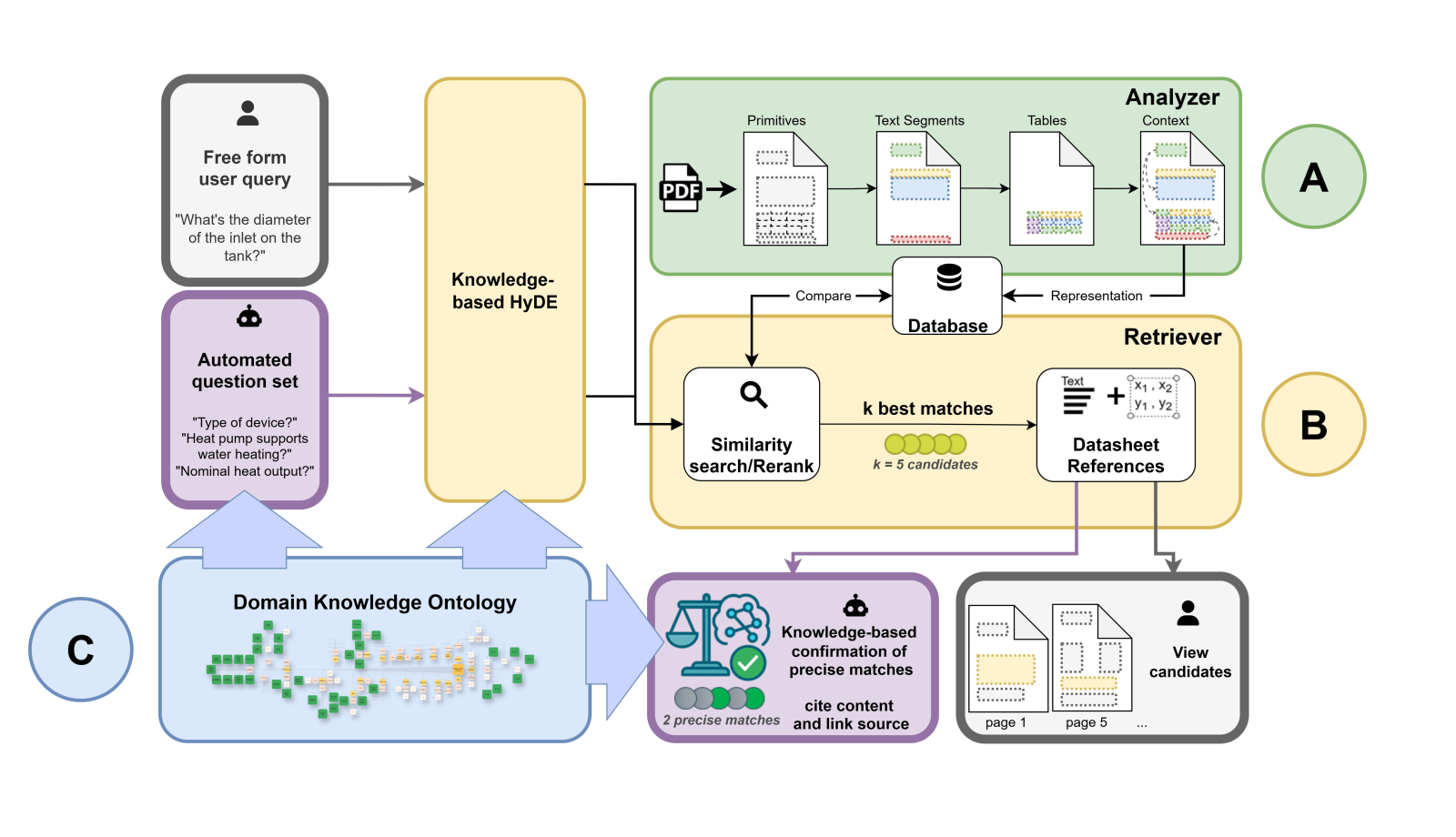 Figure 3: Overall architecture of the data sheet analysis, comprising the analyser (A), the retriever (B), and ontology-augmented query preparation (C)
D. Application in FM
With the AI-supported data sheet analysis, users can search technical documents using natural-language free-text queries. The system filters the most relevant content and compiles it into a structured response. The passages used for the response are displayed in the original document and can be transferred to information systems, such as IWMS or CMMS, for further processing.
Another use case is product search in the form of automated bulk processing of standard information. Clearly structured specification tables can be generated across manufacturers. Each generated entry remains directly linked to the source item, so that the relevant sections in the data sheets can be traced at the touch of a button.
Test & validation
A prototype software for AI-based data sheet analysis was developed and tested. Suitable test data was created to evaluate different variants of the retrieval process. This was based on a survey of experts from a specific application domain. The study identified which parameters and information from technical data sheets are particularly relevant for queries.
A set of 77 questions, including the correct answers, was compiled from data sheets with varying structure. To test different retrieval strategies, the top 15 candidates (so-called chunks) were retrieved from the vector database and a language model then checked whether the retrieved excerpts contained the correct answer.
The best overall performance was achieved by a combination of two retriever methods with a downstream reranking model while using the ontology knowledge for query and rerank refinement.
User takes control
In practice, the developed prototype provides a viewer with an automatically generated table of contents and jump links to the main specification tables. Users can also create their own search templates based on the ontology. They simply pick the features and information most relevant to their needs such as the rated heating capacity, the flow temperature or refrigerant. Using the audited ontology, suitable terms, units, synonyms, brief descriptions and further notes or restrictions are automatically identified.
Once a set of features is bundled into a search template, the extraction runs across all selected documents at once, regardless of their manufacturers, and the results are exported in a linguistically standardized comparison table.
Every finding can then be verified. As the pipeline is designed for maximum transparency, the extracted values carry confidence scores and keep the links to their sources. A click on any cell in a generated comparison table opens the relevant page of the data sheet highlighting the respective section. Consequently, any value can be checked immediately against the source. In this way, the AI tool does not generate facts but rather makes them accessible.
Results
For validation, a web application was developed that integrates two use cases – an AI-assisted PDF viewer with evidence-based semantic search and an automated capture tool for standardized extracts (see Figure 4).
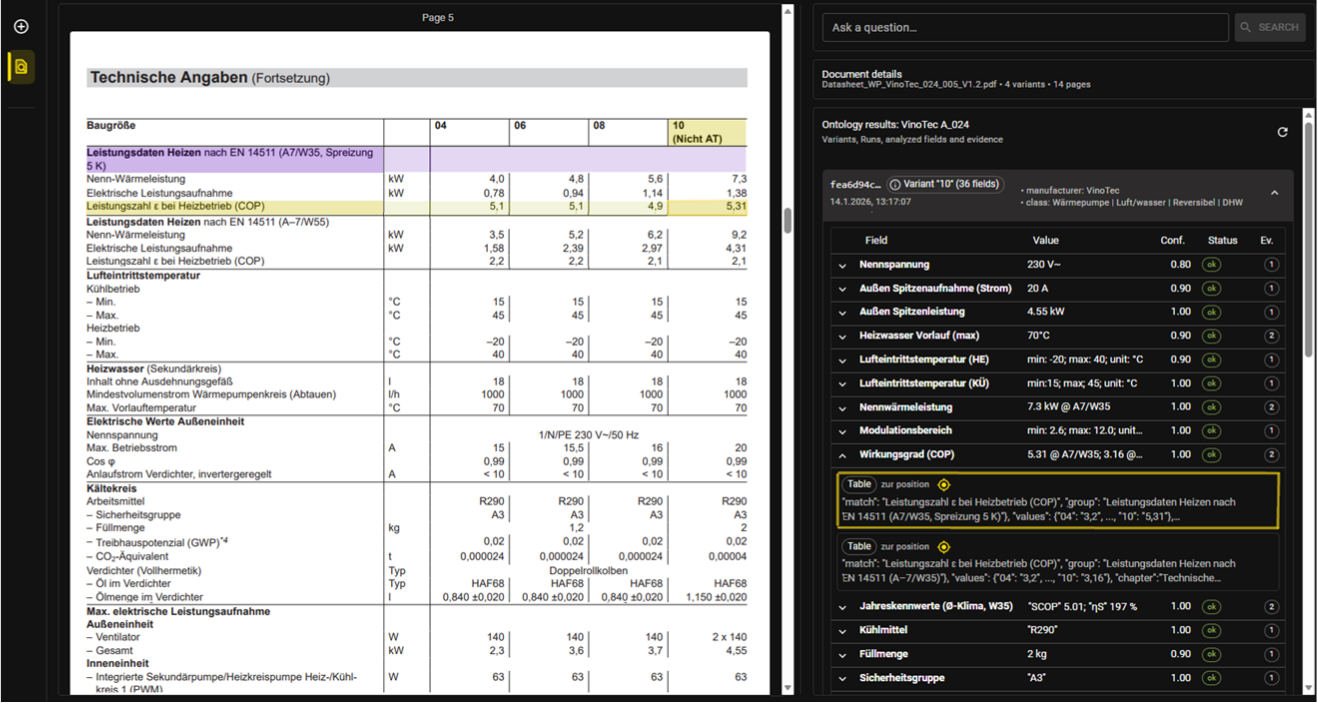 Figure 4: Prototype front end
Initial user tests indicate that the combination of direct links, quick jumps to relevant passages, and field-by-field structured extraction facilitates comparability between manufacturers and supports documentation in operational processes.
The results suggest that evidence-based document pipelines, in combination with a curated ontology, form a robust foundation for domain-specific search and extraction. A controlled comparison between ontology-based and ontology-free retrieval methods is still pending, representing the next immediate step. At the same time, several areas of research and development have emerged that can significantly strengthen the approach.
For FMs, AI-supported data sheet analysis offers several benefits:
-
Product search and comparisons can be performed significantly faster.
-
Saving search queries and data extracts with direct links allows the extracted product information to be retrieved from the original document at any time.
-
The approach ensures high traceability and transparency in decision-making processes.
The technology can easily be adapted to other fields of application. In a European project, the method was successfully applied to radar systems.

Nicholas Fromm-Kappauf is a research associate at the Society for the Advancement of Applied Computer Science GFaI and a specialist in natural language processing and machine-learning technologies.

Dr. Michael May is Professor em. of IT and FM at the University of Applied Sciences HTW Berlin. He works as research manager at the Society for the Advancement of Applied Computer Science GFaI in Berlin. He holds a Ph.D. in mathematics and a habilitation in computer science. He is the editor and author of several books including The FM’s Guide to Information Technology, CAFM Handbook, and BIM in RE Operations. He is a GEFMA ambassador for international relations, member of IFMA’s IT Community and EuroFM ambassador to Germany.

Silvia Schwochow holds a diploma in mathematics. Since 2002, she has led the Network Facility Management research group at the GFaI. She subsequently set up the Information and Natural Language Processing Research Group, which she continues to lead. Since 2012, she has also served as vice executive director.
References
Top image via Getty Images.
Figures provided by the author.
Read more on Facility Technology & Data Management , Facility Operations and Quality or related topics Work Management Systems , Quality Improvement and Operational Technology
Explore All FMJ TopicsRelated articles
-

Artificial Intelligence in FM
The stakeholder’s perspectiveBy Dr. Jake Smithwick & Dr. Kenneth Sullivan & Nneka Ubi05.01.2024 -

Don’t Drop the Ball
How a CMMS can make or break an FM organization’s successBy Michael Carmean09.17.2024 -

Beware of Growing Cyberthreats
Why it’s time for stronger facility cybersecurityBy Andrew Harris & Eric Headington10.30.2024