 Membership
 Network
 Regional Sites & Affiliates


 Events
 Participate
 Resources

 Training
 Credentials
 Government


 Content Channels
 Tools
Tools


 Business Overview





Low Visibility, High Impact
An HVAC decision that improves occupant comfort

Facility managers are responsible for a lot at once: energy efficiency, maintenance costs, code compliance, occupant comfort and the daily realities of keeping a building running. But at the center of all of that is a simple truth: the spaces FM teams manage are meant to support the people inside them.
 That is why indoor air quality (IAQ) deserves close attention. It directly affects how people feel, work and move through a space, yet it is often considered only at the system level. HVAC equipment, filtration and ductwork tend to get the most focus. The diffuser, however, is often treated as an afterthought, even though it is the point where conditioned air actually enters the room.
Most commercial office buildings are sealed environments. Occupants have no ability to self-regulate their air — no window to crack and no way to introduce fresh airflow independently. That places the full responsibility for IAQ on the building's mechanical systems, and by extension, on the FM teams who specify and maintain them. As occupancy rises throughout the day, CO2 accumulates, and cognitive performance measurably declines, which directly affects concentration, decision-making, and energy in ways occupants often cannot articulate but consistently feel.
Understanding this dynamic is the first step. The second? Recognizing where the system most commonly falls short, not at the unit or the ductwork level, but at the point of delivery itself.
 Specification discussions around HVAC tend to focus on the big-ticket components— equipment selection, filtration standards, and ductwork design. These matter, but they do not tell the whole story. The diffuser is the final step in the air delivery process, and it has a direct impact on how conditioned air moves through the occupied space.
When a diffuser is not well-suited to the environment, the effects are easy to feel. One area may be stuffy and stagnant, while another feels cold or drafty. A conference room may become uncomfortable halfway through a meeting. Open office areas may develop hot and cold spots that lead to recurring complaints. Occupants rarely identify the diffuser as the source, but they know when a space does not feel right.
Material selection can help solve the issue. Traditional metal diffusers conduct heat and are susceptible to condensation in humid or heavily air-conditioned environments, creating a maintenance liability that signals a deeper performance gap. Over time, moisture can also contribute to avoidable health and maintenance concerns, from mold risk to rust on metal components. Composite diffuser alternatives distribute air more evenly, reduce condensation by up to 95 percent, and reduce the long-term maintenance burden that FM teams are often left quietly managing in the background. Material selection affects more than air distribution and maintenance; it also has a direct bearing on another occupant experience factor that rarely comes up in diffuser conversations: noise.
 Acoustic performance is an established FM priority, especially in workplace design. FMs invest meaningfully in ceiling and wall panels, partitions, flooring materials and treatments to manage sound transmission and support occupant focus. What often goes unexamined is how the HVAC delivery system, specifically the diffuser, can contribute to the very noise problem those investment decisions are trying to solve.
Metal diffusers can generate turbulence-driven noise and whistling and can also cause annoying popping or clicking noises as metal hardware in the diffuser expands and contracts, which adds a persistent layer to the office soundscape. In open-plan environments with hard surfaces and limited absorption, that noise compounds. Occupants may not identify the source, but they feel the cumulative effect — a subtle yet constant friction that makes concentration and comfort hard.
Composite diffusers move air more smoothly, with no movable or metal parts, helping reduce turbulence that causes diffuser noise and eliminating the persistent ticking found with metal diffusers. The result is a quieter delivery system that supports the acoustic environment rather than working against it. In spaces where FMs have already invested in acoustic treatments, that distinction matters. A diffuser that adds noise at the ceiling level can quietly undermine those investments.
For FM who view the workplace as a whole, diffuser selection is a practical way to close the loop. Acoustics should not be addressed only through finishes and furniture if the air delivery system is still contributing unwanted noise.
 Diffuser selection has historically been treated as a late-stage, low-priority line item, chosen for price or availability rather than performance. That approach leaves measurable value on the table. Diffusers touch air distribution, acoustic comfort, condensation risk, health hazards and long-term maintenance burden simultaneously. They deserve to be specified with the same care applied to other building performance components.
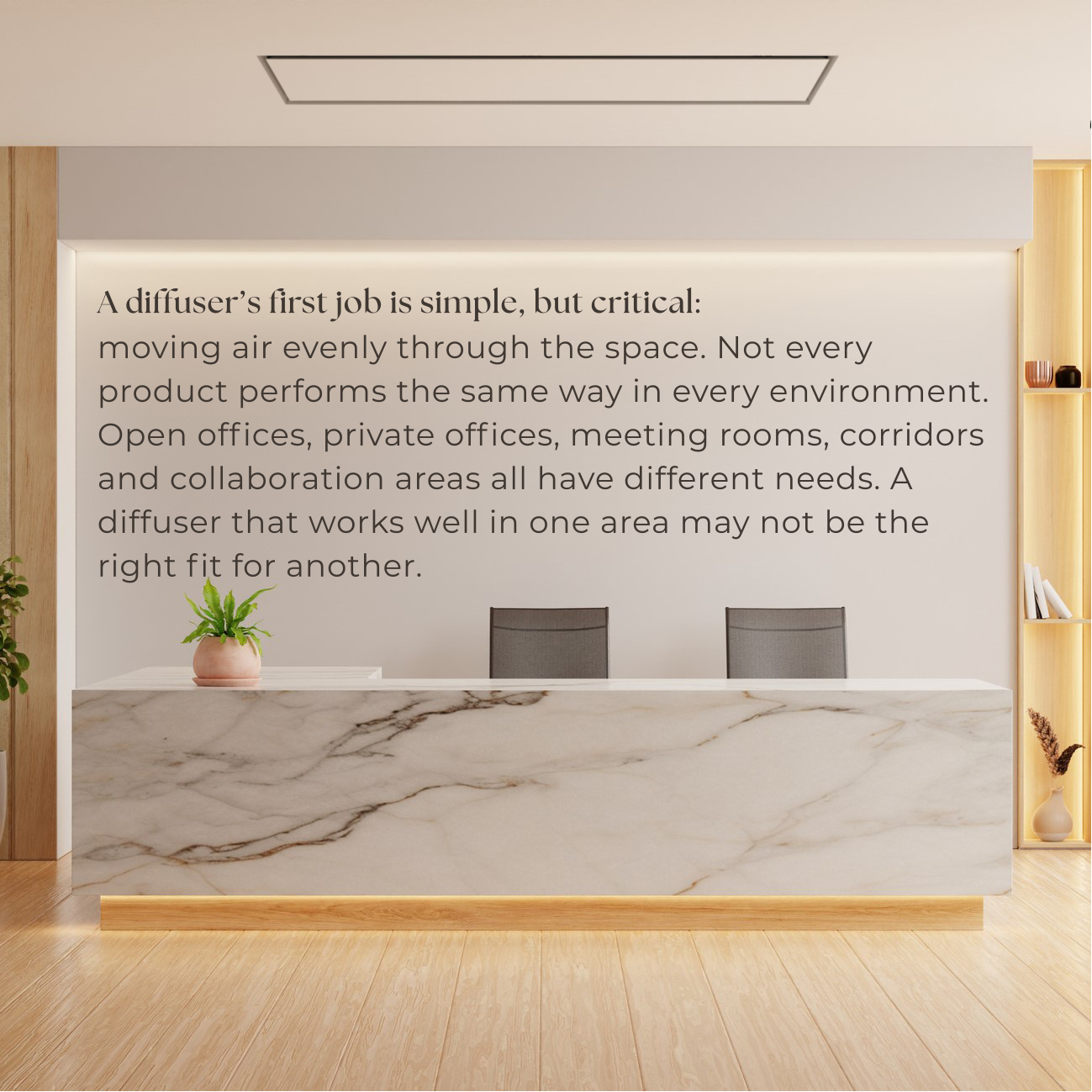
In open-plan offices, uneven air distribution can create microclimates across the same floor. One group of employees may feel cold, while another area feels stagnant. The thermostat often becomes the first thing people blame, but adjusting the temperature does not always solve the underlying issue. In some cases, it simply moves the discomfort somewhere else.
Condensation and moisture risk are underweighted until they become visible. In humid climates or heavily air-conditioned spaces, metal diffusers are prone to sweating. It is a symptom that looks cosmetic on the surface but signals a deeper performance and maintenance problem. Ceiling staining, moisture accumulation, and the perception of a poorly maintained environment all trace back to material selection at the diffuser level. Composite alternatives are significantly less susceptible to this failure, reducing both the liability and the recurring remediation costs that facility teams absorb quietly over time.
Acoustic performance should be requested, documented, and evaluated the same way FMs approach any other building component with measurable noise implications. Diffuser noise is not subjective; it is a byproduct of turbulence, and it varies meaningfully across products. Asking manufacturers for acoustic performance data and factoring it into selection decisions closes a gap that most specification processes leave open.
 Life cycle maintenance is where diffuser selection has the longest impact. The question is not just how a diffuser performs on day one, but how that performance holds across years of operation.
How frequently does it need to be cleaned or serviced? How does debris accumulation affect airflow over time? Composite diffusers tend to carry lower maintenance burdens across both metrics, an advantage that compounds significantly when applied across a large floorplate or a multi-building portfolio.
The best HVAC decisions are often the ones occupants never have to think about. Occupants do not notice when the air is distributed evenly, when the ceiling stays clean and dry, or the building’s background noise is quiet enough to let them focus. They simply experience a space that feels comfortable and works the way it should.
Getting diffusers right is one of the highest-impact, lowest-visibility decisions in the specification process. The components no one notices when they are working correctly are often the ones worth getting right, because when they fall short, occupants feel it before anyone can explain why.

Marc Mascarello is the head of design at Invi Air, where he has been working since 2018. After graduating with a Master of Architecture from Columbia University, he has more than 10 years of experience in the fields of fabrication and architecture. His broad base of knowledge and skills in these fields has allowed him to synthesize design and detail with highly engineered components.
References
Office images courtesy of Invi Air.
Read more on Facility Operations , Project Management and Workplace or related topics Occupant Health , Space design and planning and Maintenance Processes
Explore All FMJ Topics