
 Membership
 Network
 Regional Sites & Affiliates


 Events
 Participate
 Resources

 Training
 Credentials
 Government


 Content Channels
 Tools
Tools


 Business Overview





Making Metrics Work
Transforming tech real estate portfolios

In corporate sustainability, it is no longer enough to show a LEED plaque in the lobby and a glossy ESG report once a year. Investors, regulators, employees and communities are all asking a sharper question:
“How is this building actually performing today — for people, for energy and for the climate?”
For facility teams at global technology companies like Google, Amazon and Meta, that question is especially urgent. Their portfolios span energy-hungry data centers, logistics hubs and high-profile office campuses across multiple continents and climate zones. These are precisely the environments where the gap between design intent and operational reality can quietly widen — unless the right metric is in place.
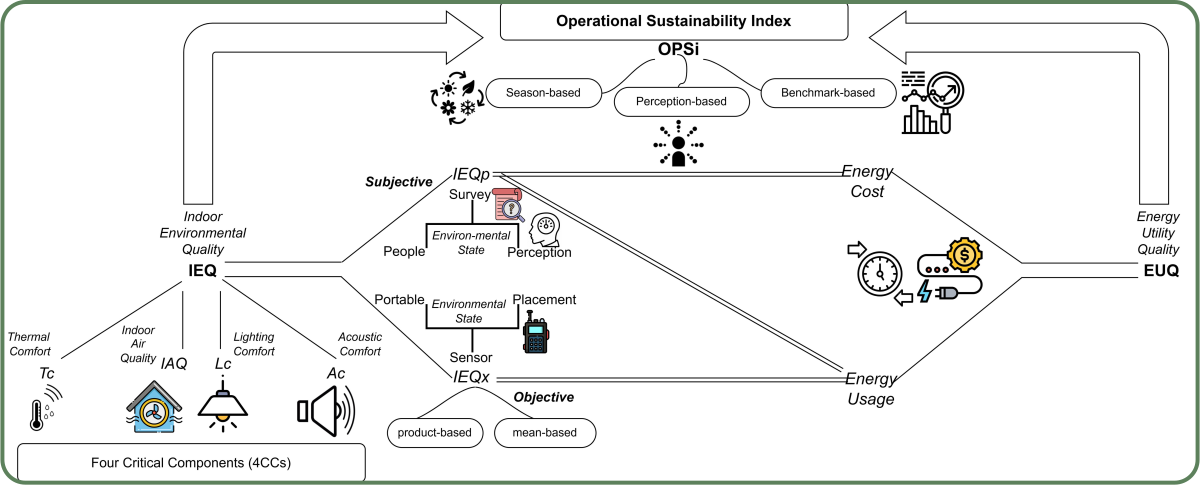
In 2025, Dr. Oluwafemi Awolesi (a sustainable facility expert) and Dr. Margaret Reams (an environmental policy expert) introduced the Operational Sustainability Index (OPSi), a multidimensional metric designed to close that gap. With insights drawn from their research, OPSi does not replace design-stage certifications like LEED or BREEAM; instead, it sits on top of day-to-day operations, integrating environmental data, energy performance and human experience into one interpretable score.
For large tech portfolios, OPSi could be applied as a unifying, portfolio-wide lens — giving FMs a consistent way to compare buildings in different regions, make targeted improvements and turn sustainability pledges into verifiable performance.
A New lens on green performance
Traditional green building certifications have done a valuable job of pushing better design. But most FM professionals know uncomfortable truths:
-
A certified building can still run inefficiently.
-
A high-tech workplace can tick design boxes while staff quietly suffer from thermal discomfort, poor acoustics or stale air.
-
Comparing energy use intensity (EUI) between spaces such as a cold-climate data center and a humid-climate office is rarely “apples to apples.”
OPSi was developed specifically to move from:
Static design compliance → Dynamic operational accountability.

Generational patterns of space use
The workforce is diverse and multigenerational. It is the system-level human reality behind why operational performance succeeds or fails. Behavioral patterns in the same space vary significantly because occupants are not homogeneous. They have different comfort expectations, risk perceptions and interaction styles.
-
Gen Z: highly sensitive to air quality and adaptive environments
-
Millennials: prefer stable temperatures and lighting
-
Older employees: lean toward warmth and steady illumination
-
Hybrid workers: generate unpredictable occupancy and load patterns
These behavioral differences demand adaptive operations, not fixed setpoints. To achieve this, occupant experience must be treated as an operational input, not an afterthought. This reframes operational sustainability as a human system as much as a mechanical one.
With this behavioral reality in view, OPSi becomes clearer: it is not just another metric, but a framework built to interpret how buildings perform in use.
Inside OPSi: 3 pillars of operational sustainability
At its core, OPSi weaves together three streams of information that FMs already touch every day but rarely see through one integrated metric.
1. Indoor environmental quality (IEQ) – including the “human sensor”
OPSi starts with measured IEQ:
-
CO2 and ventilation performance
-
Temperature and relative humidity
-
Particulate matter (e.g., PM₂.₅) or other pollutants, where relevant
-
Basic acoustics and lighting indicators
To this, OPSi adds a powerful twist: the “ω-OPSi” variant, which incorporates subjective occupant feedback:
-
How do people rate thermal comfort, air quality, acoustics and lighting?
-
Do they report headaches, fatigue or concentration issues linked to the indoor environment?
-
How satisfied are they overall with the space?
Instead of treating occupants as noise in the data, ω-OPSi treats them as sensors, weighting their responses alongside instrument readings. For a corporate campus that competes on talent and innovation, this is not just a soft factor — it is directly tied to productivity and retention.
2. Energy utility quality (EUQ) – beyond simple EUI
The second pillar, energy utility quality (EUQ), looks at:
-
EUI trends over time (monthly or seasonal)
-
Demand patterns, including peaks that strain grids or increase demand charges
-
Comparisons against appropriate baselines, not just one-size-fits-all targets
EUQ captures not only how much energy the building uses, but how intelligently and responsively it is using that energy. A site might have acceptable EUI on paper but still present:
-
Frequent comfort complaints during peak cooling demand
-
“Hidden” operational waste (e.g., simultaneous heating and cooling, overnight loads)
OPSi integrates this EUQ dimension so that buildings are judged not just on absolute consumption, but on efficiency and quality of use.
3. Climate responsiveness
The third pillar recognizes what every global FM team knows instinctively:
A kilowatt-hour in Helsinki is not the same as a kilowatt-hour in Houston.
Climate responsiveness in OPSi adjusts expectations based on:
-
Local climate conditions (heating/cooling degree days, humidity patterns)
-
Seasonal performance (winter vs. summer patterns)
-
The building’s ability to maintain comfort and efficiency under varying external stresses
This allows tech companies with distributed portfolios to compare buildings fairly, even when they sit in dramatically different climates.
Why OPSi is a natural fit for tech giants
Companies like Google, Amazon and Meta have three things in common that make them ideal candidates for OPSi-style thinking:
-
Complex, high-load operations (data centers, logistics networks, 24/7 campuses)
-
Public, detailed sustainability pledges (net-zero, 100 percent renewable operations, climate pledges)
-
Sophisticated data capabilities (advanced analytics, AI, internal dashboards)
OPSi could be overlaid on their existing data infrastructure in at least three high-impact ways.
1. Portfolio-wide benchmarking across climate zones
Imagine a global portfolio dashboard where each facility — whether it is a data center in Finland, an AWS fulfillment center in Texas, or Meta office hub in Singapore — has a single OPSi score and component scores for IEQ, EUQ and climate responsiveness.
Instead of trying to make sense of dozens of disparate metrics, portfolio leaders can:
-
rank buildings within each typology (data center vs. office vs. distribution)
-
spot regional leaders and laggards
-
assign focused technical support to sites with specific weaknesses (e.g., strong energy performance but poor occupant comfort)
This is particularly powerful for companies with extensive logistics facilities across different regions and countries. OPSi could be applied to:
-
Compare fulfillment centers in hot, humid Texas vs. temperate California
-
Identify locations where small HVAC or envelope adjustments could significantly improve comfort without major CapEx
-
Celebrate high-performing sites and turn them into internal learning labs
OPSi does not eliminate or erase local nuance; it structures it, allowing fair comparisons and focused improvement programs.

2. Targeted optimization for data centers
Data centers are the heart of the AI economy — and among most energy-intensive facilities on the planet. For global tech companies, even small relative improvements translate into enormous absolute savings.
OPSi could help data center FM teams:
-
pinpoint inefficient cooling strategies by correlating EUQ and climate responsiveness
-
detect when cooling equipment runs harder than necessary during naturally cooler periods
-
evaluate the impact of AI-driven cooling controls or hardware upgrades on overall operational sustainability
For example, an OPSi analysis might reveal that a cluster of data halls in a cool-climate region is running perpetually high-load cooling despite favorable outdoor temperatures. Instead of a costly blanket retrofit, engineers could:
-
adjust setpoints and control strategies
-
adopt free-cooling more aggressively
-
upgrade containment and airflow management in specific rooms
These operational tweaks could increase EUQ scores while preserving uptime and resilience — allowing sustainability teams to report tangible gains rooted in FM-driven change.
3. Aligning office campuses with human-centered sustainability
Corporate headquarters and innovation campuses are often the public face of tech brands. They are also where the human experience of sustainability plays out most visibly.
OPSi, especially in its ω-OPSi variant, can help tech companies:
-
monitor whether high-tech, open or biophilic designs feel comfortable and supportive to staff
-
identify mismatches between energy-efficient operation and occupant satisfaction (e.g., over-aggressive setpoint adjustments that leave staff too warm or too cold)
-
evaluate the real-world performance of design innovations (e.g., mixed-mode ventilation, smart blinds, acoustic treatments)
Consider a scenario where an office in a humid climate shows:
-
excellent EUQ (low EUI compared to similar buildings)
-
strong climate responsiveness scores
-
but low ω-OPSi scores because occupants report stuffiness or humidity discomfort.
Rather than declaring the building a sustainability success and moving on, OPSi pushes FM teams to ask questions like:
-
Are humidity targets appropriate?
-
Is the ventilation strategy truly delivering fresh air where people sit and collaborate?
-
Do we need to rebalance zones or add occupant-controlled micro-adjustments?
In other words, OPSi moves the conversation from “energy vs. comfort” to “high-performance buildings that actually work for people.”
Turning OPSi into actionable ESG & financial value
One of OPSi’s most compelling features for large corporations is its ability to translate technical FM performance into ESG-ready narratives and potentially financial incentives.
Stronger ESG reporting
Because OPSi integrates:
-
objective environmental metrics
-
energy performance against context
-
human experience data
…it offers sustainability teams a credible, auditable metric that can appear in:
-
annual sustainability and climate reports
-
green bond or sustainable finance frameworks
-
internal dashboards for executive leadership
Instead of generic statements like, “we’re improving IEQ and energy efficiency,” companies could report:
“Across our global office portfolio, our median OPSi score improved from 0.68 to 0.77 over two years, with a 15 percent increase in ω-OPSi (occupant experience) and an 8 percent improvement in climate responsiveness.”
That kind of statement is legible to investors and regulators and firmly grounded in operations.
Incentives & policy alignment
As governments experiment with performance-based codes and incentives, metrics like OPSi could form the backbone of:
-
tax credits or rebates for verified high-performing buildings
-
preferential permitting or fast-track approvals for OPSi-proven retrofit projects
-
tenant-landlord agreements that tie rent escalations or green lease provisions to sustained OPSi performance
For tech companies with large, long-term real estate footprints, OPSi-aligned performance could literally show up on the bottom line.
What FMs need to get started
OPSi is sophisticated, but it is not mystical. Most large organizations already have many of the building blocks in place:
-
BMS/BAS data for temperature, humidity and sometimes CO2
-
utility and sub-meter data for energy performance
-
periodic comfort or satisfaction surveys (which can be adapted to ω-OPSi)
-
basic climate data and benchmark information by region
For FM leaders curious about OPSi-style metrics, a practical starting roadmap might look like this:
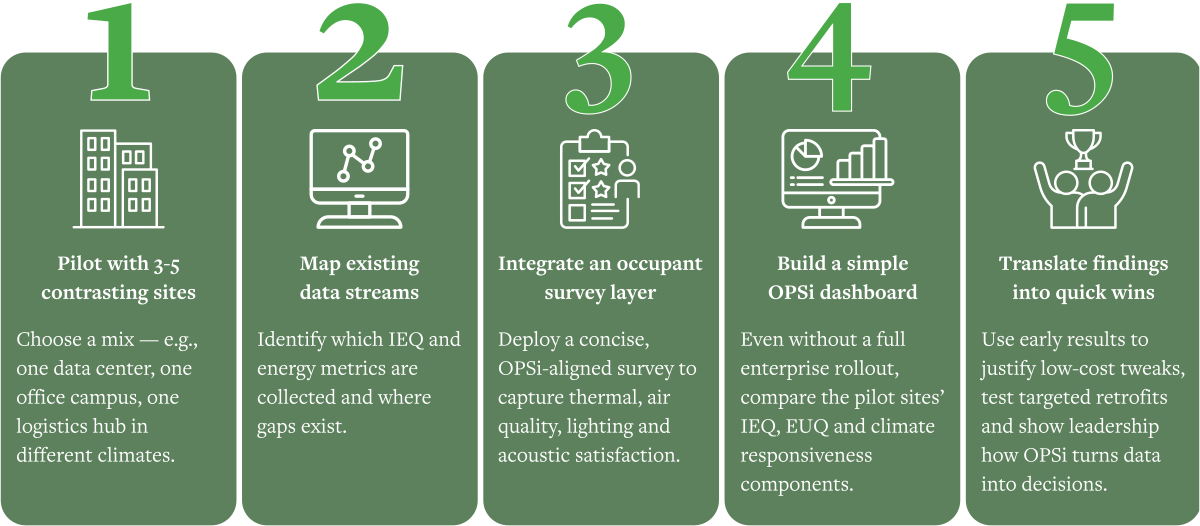 As the methodology matures — and as OPSi continues to be tested and refined in real-world case studies — tech companies could scale this approach across their portfolios.
A new standard for “proving it” in green operations
In all of these, it can be argued that tech companies have the data science firepower to create proprietary metrics. That notwithstanding, OPSi becomes important because it has value as it provides standardization, and this offers the opportunity to make apples-to-apples comparisons with industry peers. This makes them eligible for emerging performance-based incentives tied to recognized frameworks. It also gives them credibility with third-party auditors who understand this methodology and seek to apply it across the board.
Several major global tech companies have made far-reaching sustainability pledges, from net-zero operations to 100 percent renewable energy and ambitious climate timelines. The next decade will be defined less by what they promise and more by how convincingly they can prove performance.
Metrics like OPSi offers FM a way to:
-
bridge the gap between design and operations
-
align energy efficiency with occupant well-being
-
compare buildings fairly across climate zones
-
turn massive data streams into clear, credible evidence of progress
As sustainability commitments grow more ambitious and more scrutinized, the ability to measure real operational performance will define the next era of corporate real estate leadership. For FM professionals in technology and beyond, OPSi is not just another score to chase. It is a framework for operational truth-telling — one that could help the world’s most visible companies move from aspirational sustainability slides to a verifiable “one building at a time” reality.

Omotoyosi Agnes A. is a corporate lawyer, governance professional, data protection officer and partner at Corgov Services Ltd. She helps organisations improve how they work by guiding them on compliance, legal advisory, data protection, and governance practices. With her background in public management, she provides practical support to both private and public institutions, helping them strengthen accountability and operate more effectively. She is committed to promoting transparency, responsible leadership and systems that help organisations function with confidence and integrity.



Read more on Facility Technology & Data Management , Real Estate and Sustainability or related topics Analytics , Benchmarking , Environmental, Social and Governance (ESG) and Facility Improvement
Explore All FMJ TopicsRelated articles
-

Artificial Intelligence in FM
The stakeholder’s perspectiveBy Dr. Jake Smithwick & Dr. Kenneth Sullivan & Nneka Ubi05.01.2024 -

Don’t Drop the Ball
How a CMMS can make or break an FM organization’s successBy Michael Carmean09.17.2024 -

Beware of Growing Cyberthreats
Why it’s time for stronger facility cybersecurityBy Andrew Harris & Eric Headington10.30.2024