
 Membership
 Network
 Regional Sites & Affiliates


 Events
 Participate
 Resources

 Training
 Credentials
 Government


 Content Channels
 Tools
Tools


 Business Overview




Moving Beyond Reactive FM
A strategic evolution toward proactive HVACR asset stewardship

Facility management operates at the intersection of people, place and process, coordinating complex systems to support safety, comfort and productivity across diverse built environments. Managing heating, ventilation, air conditioning and refrigeration (HVACR) systems represents one of the most significant operational challenges and financial commitments for any organization.
Despite advances in building automation technology and operational strategies, many facility functions remain trapped in a reactive cycle, addressing critical issues only after a failure has occurred or a tenant has complained.
This cycle may feel like an unavoidable reality in environments with tight budgets or aging infrastructure, yet evidence suggests that it comes with measurable costs and system-level trade-offs that extend far beyond immediate labor or parts expenditures. When an organization operates primarily in response mode, it loses the ability to control its own schedule and financial predictability. The transition from a service-dependent model to a solutions-oriented stewardship model begins with a reevaluation of how maintenance strategy influences the total cost of ownership.
Research from the U.S. Department (DOE) of Energy’s Federal Energy Management Program (FEMP) indicates that organizations that shift toward proactive maintenance can realize approximately 12-18 percent annual savings compared with response-driven strategies. These savings stem from fewer emergency repairs, optimized equipment efficiency, reduced energy waste and the mitigation of secondary damage, such as water leaks or electrical surges, that often follow a primary mechanical failure. Furthermore, proactive FM extends the useful life of the asset, allowing facility leaders to defer massive capital expenditures through disciplined, incremental care.
High performing programs operate with approximately 85 percent or more of maintenance work planned. This benchmark is widely used across facility and asset management disciplines as a signal of maturity. It marks the point where a facility moves away from constant firefighting toward more predictable, intentional operation. When 85 percent of the work is known before the week begins, the FM team gains the time and administrative capacity to focus on long-term capital planning and sustainability goals rather than daily crisis management.
These patterns reveal a broader challenge for facility leaders. Environments dominated by unplanned work often require constant, high-pressure judgment calls, which inevitably compress planning horizons. When a primary chiller fails during a period of peak cooling demand, the decision-making window is measured in hours rather than weeks. This compression reduces the opportunity to address root causes, such as degraded water chemistry, neglected electrical terminations or fouled heat exchanger surfaces, leading to a culture of temporary stabilization. In this state, the primary objective is to restore system functionality as quickly as possible. This immediate pressure often comes at the expense of the systemic repairs that would prevent the same failure from recurring.
Over time, this dynamic reinforces a cycle in which teams remain focused on immediate resolution rather than long-term improvement, even when the underlying systems and talent are capable of more consistent performance.
Shifting away from a reactive posture does not require eliminating responsive maintenance entirely. Failures and unforeseen events will always occur. The objective is to reduce the proportion of time spent reacting. By strengthening decision frameworks and clarifying roles across internal teams and service partners, facilities can operate more predictably. This change transforms the HVACR system from a source of constant risk into a stable, managed asset that supports the broader mission of the organization.
Why these patterns persist
Reactive patterns in facility operations rarely stem from a lack of competence or commitment. More often, they are shaped by how accountability, decision authority and success are defined within the operating environment.
A common contributor is the absence of explicit decision thresholds. Without shared criteria that distinguish regular issues from those requiring escalation, FM teams are pulled into continuous triage. Over time, urgency becomes normalized and short-term resolution is treated as success, even when the same issues recur.
The time available for forward planning also tends to shrink under persistent unplanned work. As schedules are disrupted and priorities change daily, planned activities are postponed, fragmented or addressed in isolation. This limits opportunities to identify patterns across systems and weakens feedback loops that would otherwise inform better decisions. Teams remain active, but their ability to influence long-term outcomes, like asset health and energy efficiency, steadily diminishes.
Fragmentation between internal teams and external service partners can further entrench these dynamics. When roles are loosely defined or technical knowledge is not retained, each issue is treated as an isolated incident rather than part of a broader equipment history. Experience is repeatedly relearned instead of accumulated, making it difficult to move from resolution toward prevention. This is particularly evident in complex HVACR systems: a failure in one component, such as a variable frequency drive or a sensor, may be a symptom of a much larger systemic imbalance.
These dynamics persist not because facility leaders lack insight, but because the structures surrounding daily work consistently favor immediate response. Without addressing those structural conditions, efforts to reduce reactive work often deliver only temporary relief rather than lasting improvement.
What more predictable organizations do differently
Organizations that achieve more predictable outcomes do not eliminate disruption, nor do they rely on perfect systems or unlimited resources. Instead, they operate with clearer structures that shape how work is prioritized, how decisions are made and how learning is retained over time.
One distinguishing characteristic is clarity around decision ownership and escalation. More predictable environments define who is responsible for different categories of issues and under what conditions decisions should move beyond routine handling. This reduces unnecessary escalation and limits the number of judgment calls that must be made. When teams share a common understanding of thresholds and roles, fewer issues compete for attention, and effort can be directed where it has the greatest impact.
These organizations also protect time and space for forward planning. Planning is treated as an operational necessity rather than a discretionary activity that occurs only when time allows. Even modest, recurring planning intervals create opportunities to review patterns, reassess priorities and adjust approaches before problems recur. Over time, this practice reinforces a shift from managing individual incidents to managing entire systems.
Another defining practice is continuity of technical knowledge. Organizations with predictable facilities place value on retaining system history and operational context, whether through internal roles, documentation or long-standing partnerships.
 Performance is evaluated by responsiveness and stability. Success is measured by reduced recurrence of the same issue, improved reliability and a reduction in unexpected failures. This broader view of performance aligns daily work with long-term objectives and supports a more intentional use of both human and financial resources. By shaping the conditions where work occurs, organizations create environments where predictability becomes achievable and improvement compounds over time.
Creating more consistent operations
Organizations that achieve more consistent outcomes change not only what they value, but how work moves through the organization. The shift away from constant reaction is supported by structural choices that reduce ambiguity and limit unnecessary variation in day-to-day decisions.
One of the most consequential changes is how work is classified. Rather than treating all issues as equivalent, higher-performing organizations distinguish between scheduled work, emerging conditions and true exceptions. This classification shapes how quickly work moves, who is involved and what level of analysis is required. When work is categorized consistently, fewer situations default to urgency, and planning is less easily displaced.
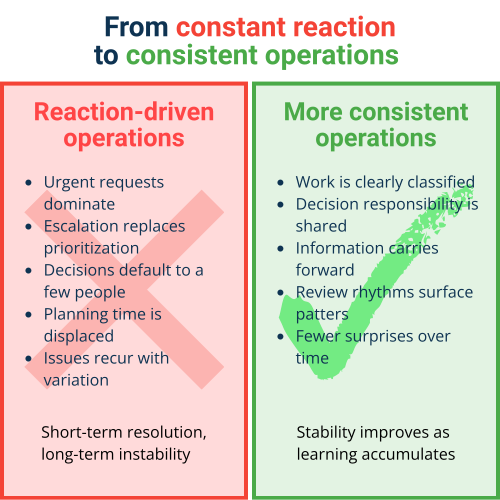
Consistency is also reinforced through clearer decision responsibility. FM teams establish shared understanding around who is expected to decide what, and under which conditions decisions should move beyond routine handling. This reduces informal escalation and prevents decision-making from defaulting to the same few people. When decision paths are clear, teams spend less time seeking direction and more time executing with confidence.
Defined information expectations further stabilize daily operations. Before certain decisions are made, organizations clarify what information should be available, whether related to system history, performance trends or risk exposure. This does not slow necessary response, but it discourages impulsive action based on incomplete context. Over time, decision quality improves and rework declines.
Learning is formalized through simple but consistent feedback loops. Rather than relying on individual memory, FM teams create mechanisms to capture recurring issues, deferred work and system vulnerabilities. These insights are carried forward into planning and review cycles, allowing experience to accumulate rather than reset with each incident.
Together, these structural choices do not remove uncertainty from facility operations. They do, however, reduce how often uncertainty disrupts outcomes. By shaping how work is classified, decisions are made and information is retained, facilities create operating conditions that support steadier performance over time.
Where to begin
There are several ways facilities can begin the shift away from constant reaction. Facilities differ in scale, complexity and maturity, and the constraints that limit predictability are not the same in every environment. For many FM leaders, progress begins with clearer understanding of where reactive pressure is being created.
One place to begin is by observing how work arrives and is labeled. When most requests are framed as urgent, it becomes difficult to distinguish between routine needs, emerging conditions and true exceptions. Understanding how urgency is assigned, and by whom, often reveals opportunities to reduce unnecessary escalation without changing the volume of work.
Another entry point is decision flow. Leaders can examine where decisions tend to slow down, concentrate or loop unnecessarily. When the same individuals are repeatedly pulled into day-to-day decisions, it may indicate unclear expectations or role definition, rather than capability gaps. Establishing a clear delegation of authority for routine repairs can immediately free up senior management for more strategic oversight.
Some FM teams discover that their greatest constraint lies in a lack of visibility over time. When system history, prior decisions or recurring issues are difficult to trace, teams are forced to rely on memory or immediate context. Identifying where information continuity breaks down, whether it is a lack of digital record-keeping or a lack of communication from a service provider, can highlight simple ways to improve consistency without requiring an investment in new software.
Other teams find that the absence of regular reflection reinforces reactive patterns. Without dedicated time to review recurring issues or deferred work, learning remains incidental rather than cumulative. Even brief, recurring review conversations between facility teams and their HVACR partners can help leaders identify patterns that daily activity obscures. These reviews should focus on specific pieces of equipment that consume a disproportionate amount of the maintenance budget to determine if a change in strategy is required.
Finally, leaders may consider how success is recognized within the organization.
When responsiveness is the primary measure of performance, reaction is reinforced. When stability, reduced recurrence of failures and improved planning capacity are also valued, behavior begins to shift toward proactive stewardship.
These are not steps to be followed in a rigid order, nor requirements to be addressed all at once. They are lenses through which facility leaders can better understand their operating environment and identify where minor changes may have the greatest impact on long-term outcomes. By focusing on clarity and accountability, FMs can transition their HVACR systems from a source of constant disruption to a predictable and managed component of a high-performing building.

Tom Roche is the chief operating officer of LC Anderson HVACR, where he oversees operations supporting complex commercial and institutional facilities. With a background in large-scale facility operations and service delivery, his work focuses on aligning maintenance strategy, decision structure and long-term asset performance.
Read more on Facility Operations and Leadership & Strategy or related topics Building Systems and Strategic Planning
Explore All FMJ Topics