 Membership
 Network
 Regional Sites & Affiliates


 Events
 Participate
 Resources

 Training
 Credentials
 Government


 Content Channels
 Tools
Tools


 Business Overview





Nothing to Sneeze At
Mitigating viral plumes with innovative air circulation

Imagine a tall building in a sprawling metropolis, packed with office workers bent over their desks or milling about, moving from office to office as they collaborate on projects and take meetings. A cough here, a sneeze there – while unpleasant, these common human actions seem harmless enough.
However, despite the productivity these environments bring, they unfortunately become breeding grounds for viral plumes, causing health issues – some serious – that should have facility operators rethinking how they approach indoor air circulation across an entire building. Colder months increase the prevalence of coughing and sneezing, potentially resulting in even denser viral plumes that could affect many.
Standard HVAC systems, while tried and true in some respects, simply are not designed to address the sophistication of viral plumes. However, innovative methods – such as improved filtration, ionization and thermal destratification – grant facility managers the ability to safeguard the health of those within a building, ensuring interactions remain positive and productive, and that the health and integrity of that building is well maintained.
Accumulation without much-needed relief
Humans spend around 90 percent of their time indoors. Unfortunately, time indoors opens a breeding ground for accumulation of viruses in the air, resulting in hazardous viral plumes (also known as airborne virus-laden particles). It has been found that breathing can release around 7,200 particles per liter of exhaled air – imagine what that might equate to over stretches of time, left unchecked.
Viral plumes are comprised of extremely fine particulate matter (5 μm or smaller) and can remain in the air in indoor spaces unless active removal efforts are conducted. Based on imaging research, human activities, such as sneezing and coughing, can contribute to viral plumes, and with particulates so small, the viral plume is more hazardous in that it is more respirable.
The implications of such viral plumes are crucial to consider, especially when thinking about the total inhabitants in a facility (imagine that same skyscraper packed with offices and individuals). Resulting health conditions can include respiratory irritation – affecting the nose, throat and respiratory tract – such as inflammation, the triggering of allergies and the exacerbation of asthma, among others.
Furthermore, the variety of viruses contained in viral plumes – including SARS-CoV, MERS-CoV, influenza, measles and the rhinoviruses – indicates just how at risk the general population is in today’s facilities.
Humidity & temperature as factors

While the specific type of virus dictates just how it behaves within a specific space, humidity and temperature do play a notable role in how a virus is affected, as well as how it is transmitted among those within that space, which should be considered in-depth when FMs learn more about the serious issue of viral plumes.
In the case of humidity, elevated levels have the potential to affect the viability of a virus – promoting it – which can result in larger viral plumes that are even more concentrated and become more protected. In the case of temperature, lower temperature can lead to the preservation of viral ribonucleic acid (or RNA), ultimately increasing its viability.
With this, it is critical that HVAC technology responds to the impact that humidity and temperature can have on indoor space and the risk of perpetuating the issue of the viral plume, if not taken into account.
Current methods fall dramatically short
Many of today’s HVAC systems are not capable of viral plume elimination because their main function is to manage temperature control and general air circulation. They are simply not equipped to capture or deactivate viral plumes, which can be very complex and dynamic, and potentially lead to the worsening of the viral spread.
There are various reasons current methods simply do not cut it. One of these is the issue of inadequate ventilation. Part of this is not bringing in nearly enough fresh air – essentially, a low air exchange rate – which is necessary for reducing the level or density of the viral plume in an indoor space. There is also the big issue of stagnant air, in which particles within the viral plume begin to collect. This is due to a lack of continuous fan operation, meaning the fan being used is set to the “auto” setting, which causes it to operate only when heating or cooling is necessary. Continuous circulation is important, as well as filtration, which is not as easily achieved in the “auto” setting.
In addition to ventilation, ineffective airflow and distribution can play a significant role in eliminating viral plumes in today’s buildings. The haphazard approach of mixing ventilation is incredibly detrimental, relying on mixing air within a space that further disperses viral plumes and increases exposure to those within a facility. Diffuse ceiling ventilation (DCV) is also a common method that can increase the risk of exposure, simply due to a lack of targeted air movement.
Amid these common HVAC approaches there are many others, which are a testament to how much knowledge needs to be shared about the modern opportunities availability to shield individuals within a space that are considerably more effective.
Modern solutions to a dire problem
Luckily, advancements in HVAC technologies are equipping FMs with effective ways of combating viral plumes across environments.
Recent research from the National Library of Medicine points to some key methods that could make a substantial difference, in addition to ventilation:
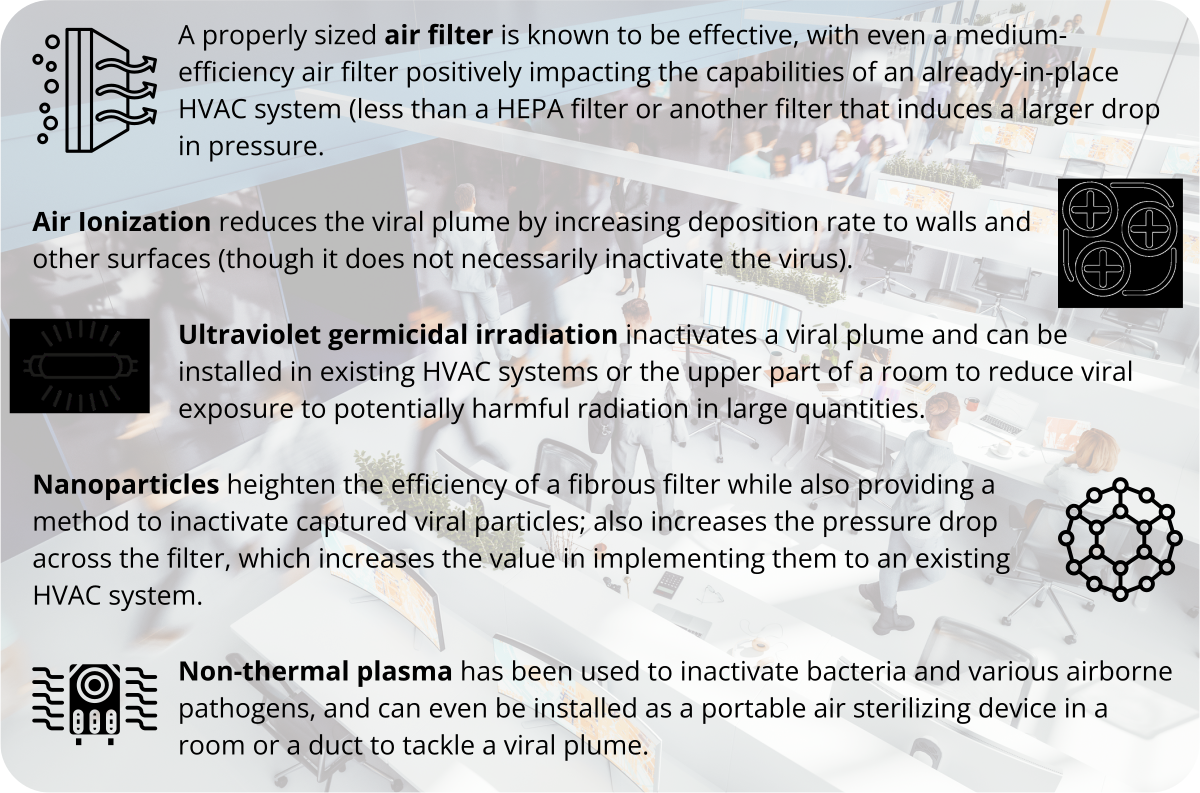 Investing in technologies that leverage dilution in the event of viral plumes has also proven to be quite effective, as proper dilution increases the exchange of stale indoor air with fresh outdoor air, which lowers the concentration of airborne particles and viruses; thus, cutting down on the risk of exposure to respiratory infections. Dilution also promotes improved indoor air quality, a major win-win.
 Thermal destratification & dilution
Among the various modern, complete indoor air circulation solutions today, one approach is a true standout: thermal destratification, which by leveraging dilution, is making a meaningful positive impact on the issue of viral plumes in today’s facilities.
Thermal destratification is designed to reduce vertical temperature layering, moving warmer ceiling air downward into occupied zones. In the event air circulation is lacking – an environment that perpetuates the existence of a viral plume – thermal destratification eliminates layers of stagnant air that are comprised of different temperatures. When a virus is transmitted and becomes airborne, such as through coughing, it becomes part of an existing viral plume or the onset of one, which over time builds up a dangerous level of concentration.
Luckily, technologies that tap into thermal destratification can break through the air layers to deplete the viral plume. What is more, air currents generated by traditional HVAC units only move the viral plume through a room, whereas thermal destratification disperses the viral plume.
Dilution is a major component of thermal destratification as it promotes the effective mixing of air within these layers, diluting the concentration of viral plumes to ensure that those within a space are not subjected to the potential exposure to viral infections.
No longer an uphill battle
That persistent cough that can be heard throughout a building no longer has to cause those within the facility to run and hide from the source. However, by exploring new HVAC air distribution methods, FMs will be on a path toward mitigation of viral plumes that can safeguard the health of others, not just in the winter months, but all year long.

Richard Halsall serves as the CEO of Exhale Fans. With an eye for technology and a desire to deliver the best in quality, comfort and satisfaction, Halsall has been instrumental in bringing Exhale Fans’ product from conception to fruition, driving the company to unprecedented levels of success, even in its infancy. In 2017, he fully immersed himself in the young company’s pivot into large-scale production. Prior to founding Exhale Fans, Halsall served in the U.S. Army as a Huey Cobra Pilot in Vietnam, as well as a pilot with a major U.S. airline, from which he retired in 2015.
Read more on Facility Operations and Risk Management or related topics Occupant Health , Occupant Safety and Operations and Maintenance Planning
Explore All FMJ Topics