
 Membership
 Network
 Regional Sites & Affiliates


 Events
 Participate
 Resources

 Training
 Credentials
 Government


 Content Channels
 Tools
Tools


 Business Overview




Overcoming the Fears
Implementing AI in facilities & workplace operations

Artificial intelligence (AI) is no longer a futuristic idea; it is rapidly reshaping how facilities and workplace teams operate. AI is changing the way facility managers plan, monitor and maintain their environments. Yet despite the growing availability of these tools, AI adoption in facilities and worker operations remains lagging. Many of the solutions that could streamline workflows or enhance visibility simply are not being leveraged, leaving the space falling behind even as technology accelerates.
Much of this hesitation stems from understandable concerns, including complex integrations, fear of job displacement and uncertainty about losing control over systems teams have mastered for years. But the future of this space goes far beyond maintenance. It is about creating better day-to-day experiences for employees and staff, improving job satisfaction, efficiency and overall productivity.
The reality behind the fear
When facility managers discuss AI, excitement is often tempered by hesitation, reflecting a significant awareness and readiness gap in the industry. While optimism exists, a survey of more than 400 facility management professionals revealed that 28 percent were unaware of AI's application in their field, and a mere 4 percent had received formal AI training. Additional research reinforces this: fewer than 20 percent felt proficient in using AI technologies. This collective skills gap and limited technical training present a major barrier to adoption, challenging the industry to embrace technological change without diminishing the crucial human expertise that defines the profession.
Facility leaders often hesitate to adopt AI because the technology feels complex, integrations with legacy systems seem uncertain, and the cost or ROI is not always clear. Leaders also fear choosing the wrong technology; nobody wants to risk their job on a bad decision. These concerns are valid, but they also present opportunities for improvement. Big wins often require big bets, and smart, intentional adoption is now essential for moving operations forward.
Job displacement is often the biggest concern, especially as tasks like scheduling or monitoring seem easy to automate, but most building-focused AI tools are meant to support, not replace, teams by taking over routine monitoring so staff can focus on higher-value work. Technical complexity also creates hesitation, as many managers worry about steep learning curves, costly implementations or over-relying on algorithms that may miss real-world context. Without strong oversight and quality data, AI can still produce inaccurate or biased outcomes.
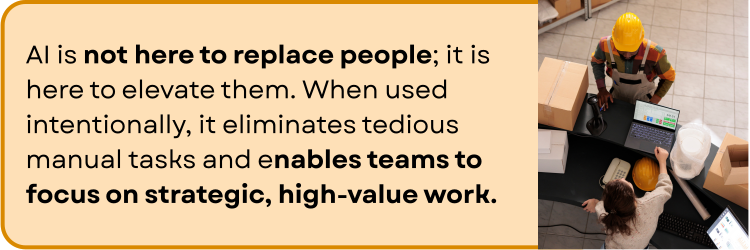
Overcoming hesitation starts with viewing AI as a partner rather than a threat.
Leading organizations now see AI not as a replacement for human expertise, but as a powerful tool that boosts efficiency, strengthens decision-making and removes repetitive tasks from already stretched facility teams.
Facility leaders tell the same story: their teams lack the time for preventive or long-term projects because they are constantly putting out fires, such as responding to repairs, urgent work orders and daily disruptions. One facilities team in higher education shared that they simply cannot pursue long-term efficiency initiatives because they are always dealing with immediate issues. This is where AI truly shines. It transforms FM from reactive firefighting into proactive, predictive and continuously optimized operations, giving teams the visibility, bandwidth and foresight they have never had before.
AI also improves workplace optimization by using occupancy data, sensors and environmental monitoring to reveal how spaces are truly used. This enables teams to adjust cleaning, lighting and energy usage in real time, often resulting in major gains in efficiency and significant reductions in energy consumption, all while improving comfort through smarter control of air quality, lighting and temperature.
While facility professionals bring judgment, context and strategy, AI brings precision and speed. Together, they create more responsive, resilient and sustainable environments. By focusing on clear benefits, lower costs, better performance and healthier workplaces, teams can view AI not as a disruptor but as a force multiplier that helps them work smarter and build the intelligent facilities of the future.
A practical path to adoption: Starting smart, not starting big
The good news? Organizations do not need a huge, expensive overhaul to integrate AI. Start small, measure everything and iterate. It is a steady climb, not a giant leap.
1. Pinpoint the pain points: Identify repetitive tasks
Before chasing the flashiest new tech, look inward. Identify the tasks that consume hours of the FM team's day but require almost no real human judgment. These are the low-complexity, high-time-sink activities: sorting and prioritizing work orders, manually adjusting lighting or HVAC schedules, checking asset locations one by one or rebuilding the same shipping labels over and over. But operational drag goes beyond facilities tasks alone; think about the constant back-and-forth for desk bookings, coordinating room setups or following up on vendor invoices that slipped through the cracks.
Individually, these tasks seem small. Together, they quietly drain bandwidth and morale. These are the best early targets. Automating these repetitive routines does not just save time; it gives staff immediate, noticeable relief and builds confidence in adopting new tools. When an organization removes the mundane, it elevates the work skilled people want and need to focus on.
2. Pilot small projects & prove the value
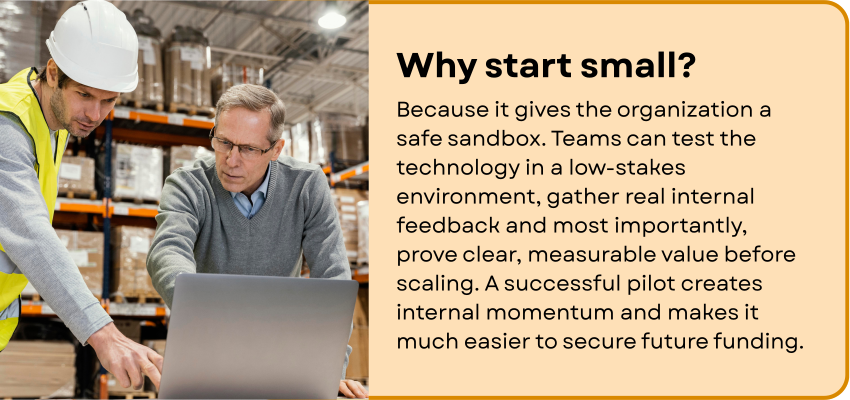
Do not jump straight into an enterprise-wide deployment. Instead, choose a single, contained area of operations for an AI pilot. This could be as simple as using AI to auto-generate shipping labels based on incoming requests or automating office logistics like assigning desks or coordinating room setups based on real-time booking patterns.
3. Build confidence
The biggest threat to adoption is the “black box” effect, wherein AI outputs appear mysterious, unchallengeable or simply wrong. If a team cannot understand the why, they will never trust the what.
To overcome this fear, organizations must prioritize transparency. Staff should not have to guess why the system made a decision. They need clear, simple explanations — things like, “This shipping label was generated with UPS Ground because it cuts costs by 20 percent and only adds two hours to delivery,” or, “We consolidated these internal deliveries because it saved over US$2,000 this month by shifting from UPS to FedEx.”
The same applies to office coordination: “Desk assignments were rebalanced because booking patterns showed a 40 percent cluster in the east wing, so we redistributed traffic to avoid bottlenecks,” or, “You’ve saved more than US$5,000 in the last three months by automatically applying discounted carrier rates.”
This type of clarity builds trust. Modern AI tools and office-logistics platforms can provide these explanations instantly, giving teams real insight, saving time and unlocking meaningful cost savings across the organization.
Human expertise must always retain the final say. Users should have the essential ability to override any AI-driven decision based on their invaluable, on-the-ground knowledge, especially when human context overrides an algorithm. When systems are designed to be fully auditable and easily explainable, the organization successfully tears down the black box and builds essential trust among the frontline users and stakeholders tasked with championing this technology every single day.
4. Invest strategically in training & upskilling
AI is powerful, but it is only effective when teams know how to use it. Meaningful training beyond basic system use should cover data interpretation, system management and ethical considerations. The goal is to turn staff into knowledgeable collaborators who can confidently apply AI insights. Teams that receive targeted training report significantly higher confidence and smoother adoption.
5. Collaborate across departments
AI depends on accurate, shared data, which means facility teams cannot work in isolation. Strong collaboration with IT, finance and operations ensures data flows smoothly and aligns with organizational goals. When all departments work together, AI becomes a strategic asset that boosts efficiency across the entire business, not just within facilities.
 Preparing for the future
As global pressure grows for sustainability, efficiency and resilience, the facilities sector will increasingly rely on AI to meet these demands. However, readiness is as much cultural as it is technical. Organizations that create environments of curiosity, continuous learning and openness to innovation will navigate this transformation more smoothly.
Emerging frameworks such as the ISO 41001 Facility Management Standard encourage data-driven approaches to facility performance. Integrating AI within these frameworks enhances the ability to monitor key metrics like energy intensity, indoor air quality and resource consumption with greater precision. AI can also strengthen office logistics by streamlining tasks such as shipping label creation, courier scheduling, delivery tracking, and mailroom coordination or parcel shipping overall. By improving both building performance and day-to-day logistical workflows, AI helps facilities operate more efficiently and respond more effectively to the demands of modern workplaces.
Looking ahead, AI will not simply optimize tasks; it will redefine how workplaces function, enabling buildings that learn, respond and evolve alongside the people who use them. The future of facility and workplace operations will belong to organizations that view AI not as a disruptive force, but as a strategic ally that empowers teams, amplifies human intelligence and transforms the built environment into a smarter, safer and more sustainable ecosystem.

Joshe Ordoñez is the founder and CEO of Airpals and a multidisciplinary strategist whose career spans fashion design, project production and technology-driven logistics, experiences that shape her unique perspective on facility management. She applies her design sensibility and operational expertise to strengthen the internal workflows that keep workplaces running smoothly. Ordoñez focuses on elevating the often invisible tasks behind facility operations, from interoffice logistics to day-to-day service coordination. Her work centers on transforming complex, behind-the-scenes processes into streamlined, user-friendly systems that support teams and enhance the overall workplace experience.
Read more on Facility Technology & Data Management , Quality and Facility Operations or related topics Training , Change Management and Facility Technology
Explore All FMJ TopicsRelated articles
-

Artificial Intelligence in FM
The stakeholder’s perspectiveBy Dr. Jake Smithwick & Dr. Kenneth Sullivan & Nneka Ubi05.01.2024 -

Don’t Drop the Ball
How a CMMS can make or break an FM organization’s successBy Michael Carmean09.17.2024 -

Beware of Growing Cyberthreats
Why it’s time for stronger facility cybersecurityBy Andrew Harris & Eric Headington10.30.2024