
 Membership
 Network
 Regional Sites & Affiliates


 Events
 Participate
 Resources

 Training
 Credentials
 Government


 Content Channels
 Tools
Tools


 Business Overview





Raising the Bar for Facility Performance
How chipmakers can modernize FM

The global semiconductor market has roughly doubled in size over the past decade as microchips have become increasingly critical to the world economy, enabling AI, electric vehicles, cloud computing and other technologies. However, semiconductor companies face major operational challenges in meeting this burgeoning demand. The demands of managing a massive semiconductor fabrication (“fab”) plant, transforming silicon wafers into integrated circuits 24/7, requires a sophisticated facility management strategy.
From an FM perspective, fab plants are a combination of a traditional manufacturing plant and a laboratory. As in other manufacturing sectors, every hour of fab plant downtime represents lost revenue. Like biopharmaceutical manufacturing, which often requires clean rooms and intense quality control, semiconductor production requires dust-free environments to protect product integrity. Every quality or compliance misstep carries the high cost of reputational damage.
Given the huge financial stakes of modern chipmaking, FM is critical for driving operational efficiency, maximizing throughput and controlling costs. Developing a leading-edge fab can exceed US$10 billion, a sum that includes not only the facility, but also the advanced production tools and utility equipment housed inside. Once a fab starts production, it must reliably deliver a high volume of microchips under precisely controlled conditions, incurring long-term operating costs including labor, maintenance, materials and utilities.
The importance of FM is only growing as chip technology evolves, giving rise to more extreme production demands. For semiconductor companies pushing the technology envelope, forward-thinking FM has become a competitive necessity.
 FM challenges at the leading edge of manufacturing
In this high-precision manufacturing environment, any disruption can cause significant losses. A brief power outage or fluctuation can ruin an entire batch of semiconductors worth millions. Failure of a single process tool can bring production to a halt and damage wafer output. Profitability relies on smooth and reliable operations, making it crucial to reduce the risk of equipment malfunctions and unplanned downtime.
Advancing chip technology increases these remarkable demands on facilities. As manufacturers push the boundaries of physics to fit ever-more transistors onto a single chip, they are adopting innovative tools that raise the requirements for fab infrastructure and operations.
An example is the use of extreme ultraviolet lithography (EUV), a cutting-edge manufacturing technique, to create miniscule integrated circuits — less than 20 nanometers in size — on a silicon wafer or other semiconductor substrate. EUV machines are massive and use significant energy to create a high-vacuum, dust-free environment, and require intensive, specialized maintenance to operate effectively and efficiently.
The drive toward more intricate chips heightens the need for ultra-clean manufacturing environments. Production spaces require stringent controls on airborne contaminants, temperature and humidity, enabled by sophisticated HVAC systems. Technicians must follow strict entry and exit protocols, and equipment must be carefully monitored and serviced.

The advantages of leading FM practices
Outdated FM practices that rely on fragmented systems and manual processes can create inefficiencies and jeopardize billion-dollar production lines. Resource constraints often force difficult decisions about investing in building systems versus production infrastructure. Without adequate data to determine the true cost of deferred facilities maintenance and equipment failures, many fab FM teams tend to follow a run-to-fail approach, rather than using preventive maintenance strategies to minimize downtime and extend equipment life.
Leading FM practices can play a pivotal role in navigating these daunting operational issues. An integrated, tech-driven approach to maintenance and engineering can ensure smooth and efficient operations, minimize energy use and keep critical HVAC, electrical and security systems running.
One of the ways that FM can enhance operations is by adopting next-generation predictive maintenance practices. In contrast with traditional calendar-based maintenance programs, predictive maintenance uses Internet of Things diagnostic tools to gather and analyze real-time data about equipment condition. Analytics and algorithms enable engineers to flag performance anomalies and resolve any issues before they can disrupt operations.
Thoughtful FM is also important when considering how to manage and upgrade aging facilities with reliability issues. Many semiconductor facilities were built decades ago and have accumulated significant deferred maintenance backlogs. One reason is that, in some instances, maintaining a critical asset requires undesirable downtime. A vital role for FM teams is to understand the condition and reliability of these aging assets and create a data-driven robust capital plan that will optimize efficiency and uptime.
 Zeroing in on efficiency
In addition to maintenance and capital planning, FM can support business goals by providing a more cost-efficient model for managing a facility. A rising topic of conversation in the semiconductor industry is how to integrate FM processes and technology both inside and outside the “yellow line” that demarcates the production area.
Laboratory spaces are typically managed by business-unit end-users, but a trained FM team can drive efficiencies through managing equipment, as well as ensuring that gowns, gases and other supplies are always on hand. In the biopharmaceutical and life sciences sector, companies are increasingly outsourcing facility functions on the other side of the yellow line, from equipment maintenance to environmental, health and safety. Many service providers are now able to shoulder these roles, enabling core staff to focus on production rather than on facility and equipment tasks.
Making the most of the real estate footprint
JLL’s 2025 Technology Spaces Report sheds light on another area of opportunity for semiconductor facilities teams: space utilization. To manage rising costs and free up capital for innovation spending, technology companies are placing more emphasis on portfolio optimization and trimming real estate costs. JLL’s research finds that 56 percent of clients reduced space in the last year to improve utilization. Meanwhile, tech companies are beginning to prioritize cost-effectiveness and real estate strategy in designing and planning lab spaces.
Notably, the report found that almost half, 47 percent, of tech companies that have laboratories do not track utilization of these spaces. In the semiconductor industry, lab spaces and the equipment they contain are typically managed by the business unit. However, cost concerns mean that manufacturers need to take a closer look at how these specialized spaces are being used.
Utilization tracking enables chipmakers to make smarter space-planning decisions. For example, if a business unit is asking for a new lab, utilization tracking will enable the FM team to identify unused lab space that might fit the requirements and avoid the need to invest millions of dollars to build a new facility. Lab space utilization presents a significant opportunity for cost efficiency.
Driving efficiencies for a semiconductor giant
Chipmaker FM teams also can reduce costs by using FM software to automate end-to-end workflows. Sophisticated FM platforms enhance productivity and limit the risk of costly human errors by automating operations and centralizing maintenance data. By providing a centralized view of asset performance and maintenance needs across an entire portfolio, FM software also enables data-driven, intelligent decision-making.
To understand how modern FM practices can deliver measurable benefits, consider the example of a Fortune 100 semiconductor maker that faced critical operational risks to its billion-dollar production lines due to outdated FM practices. Paper-based workflows and nonintegrated applications required technicians to manually log into multiple programs for basic tasks — creating inefficiencies across the company’s global operations.
A comprehensive digital FM strategy was developed for the company, with a cloud-based digital FM platform implemented that consolidated work order management, asset tracking and predictive analytics in a single interface. Other key features of the strategy included comprehensive training programs for technicians and the installation of more than 3,000 IoT sensors to enable real-time equipment performance monitoring.
The strategy delivered major cost savings and critical operational improvements — notably, dramatically faster response times for maintenance requests, data accuracy for asset management and less unplanned downtime. As a result, the chip giant achieved a five-fold return on investment in terms of digitally enabled cumulative net savings by the end of 2025.
Pointers for facilities leaders
Rethinking FM practices can drive crucial competitive advantages for semiconductor makers. The following are some key strategies for facilities leaders to consider:
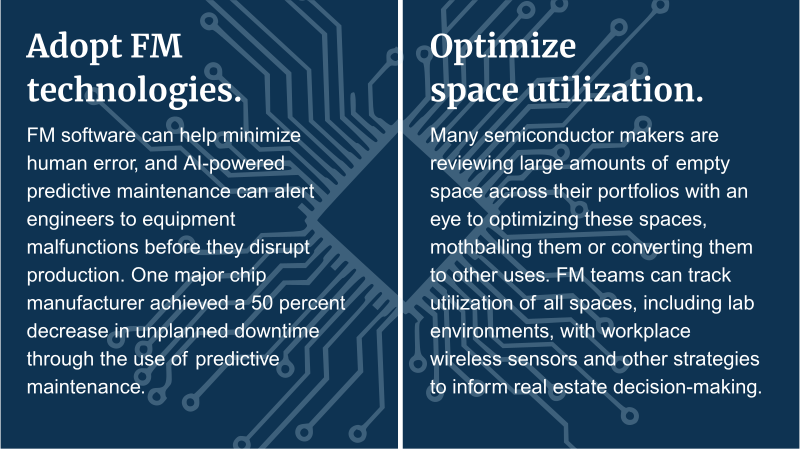
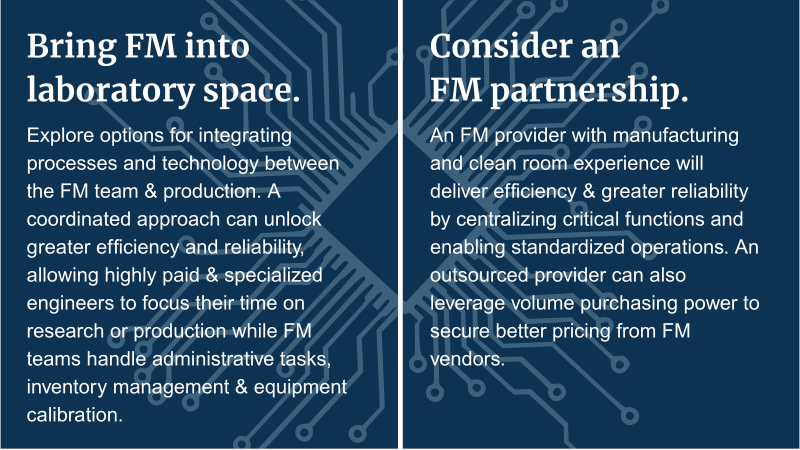
Chip boom raises the bar for facility performance
Semiconductor demand is surging with the global market projected to reach US$772 billion in 2025 (22 percent growth) and US$975 billion in 2026 (25 percent growth), driven primarily by AI's computational requirements. As manufacturing becomes more costly and complex, FM presents a key opportunity for semiconductor companies to improve operations and achieve cost savings through digital technology and modern practices.

John Leddy is a Managing Director in JLL's Technology Division, where he leads a team of commercial real estate professionals delivering integrated, cross-functional services that drive transformation for technology companies across advanced manufacturing, semiconductors, hardware and IT services. His team partners with technology organizations to navigate a rapidly evolving industry through portfolio optimization, sustainable operations and strategic scaling guidance. With 20 years of experience spanning real estate, technology and executive leadership, Leddy has developed deep expertise in understanding how changing regulations, macro trends and geopolitical issues affect global and scaling technology companies — and the critical role real estate plays in business success. His comprehensive understanding of these market dynamics enables him to deliver strategic guidance that addresses both immediate operational needs and long-term growth objectives.
References
Read more on Facility Technology & Data Management , Real Estate and Facility Operations or related topics Building Commissioning , Facility Technology , Operations and Site Management
Explore All FMJ TopicsRelated articles
-

Artificial Intelligence in FM
The stakeholder’s perspectiveBy Dr. Jake Smithwick & Dr. Kenneth Sullivan & Nneka Ubi05.01.2024 -

Don’t Drop the Ball
How a CMMS can make or break an FM organization’s successBy Michael Carmean09.17.2024 -

Beware of Growing Cyberthreats
Why it’s time for stronger facility cybersecurityBy Andrew Harris & Eric Headington10.30.2024