
 Membership
 Network
 Regional Sites & Affiliates


 Events
 Participate
 Resources

 Training
 Credentials
 Government


 Content Channels
 Tools
Tools


 Business Overview





Realistic Value
Energy optimization without a capital project

Energy optimization in facilities is often treated as a capital planning problem. If a building uses too much energy, the assumed answer is frequently a major equipment replacement, a controls retrofit or a multiyear project that must compete for executive approval. Those investments can be necessary, especially when equipment is at end of life or controls infrastructure is no longer serviceable. But they are not always the only place to start.
For many facility teams, the more immediate challenge is not a lack of interest in energy performance. It is the difficulty of acting without creating new operational risk. A facility manager may recognize that HVAC systems are running inefficiently, but still face practical constraints: limited capital budget, tenant comfort requirements, maintenance workload, incomplete documentation, cybersecurity review and the need to keep existing operations stable.
 What software-first HVAC optimization means
Software-first HVAC optimization can provide a lower-risk path in the right buildings. Instead of beginning with equipment replacement, the approach starts by using the controls infrastructure already in place. The existing building automation system (BAS) or building management system (BMS) remains the execution layer. Optimization software analyzes system behavior, recommends or applies bounded supervisory adjustments, and measures results against operational constraints. In practical terms, that may mean adjusting setpoints within approved ranges, improving start-stop timing, reducing simultaneous heating and cooling, or coordinating schedules more effectively across equipment that operators already manage.
Why this approach matters now
This approach matters now because facility teams are being asked to move faster than traditional capital cycles allow. Energy costs remain volatile, local performance standards are expanding, and many organizations are setting carbon or efficiency goals that eventually land on FM. At the same time, many buildings already have more usable data than they did a decade ago. Trend logs, meter data, occupancy schedules and BAS histories may not be perfect, but they often contain enough information to identify operational waste and test improvements. Software-first optimization is a way to turn that existing infrastructure into action before a large capital project is approved.
Benefits beyond energy savings
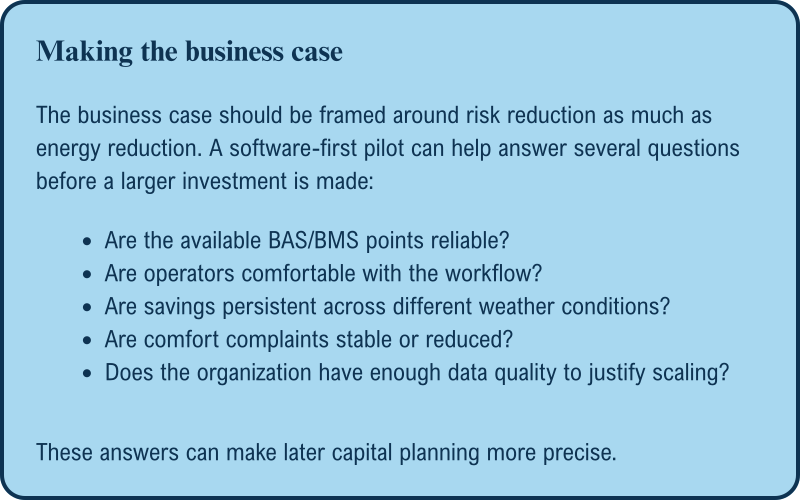
The benefits are not limited to energy savings. A smaller software-led pilot can reduce upfront costs, shorten the path to payback and limit disruption to occupants and operators. It can also create better information for future capital planning.
When a facility team can show measured savings, comfort impact, operator feedback and implementation effort from a limited pilot, the next investment conversation becomes more concrete.
The industry shift toward continuous optimization
Software-first optimization also fits a broader industry shift from periodic recommissioning to continuous optimization. Historically, many buildings improved performance through occasional audits, tune-ups or retrofit projects. Those efforts still have value, but building operations change every day. Schedules drift, overrides accumulate, tenants change, equipment ages and weather patterns vary. A one-time study can miss these changes or become outdated quickly. Continuous optimization gives FM teams a way to monitor performance, test adjustments and keep savings from disappearing after the initial project is complete.
Avoiding “software-wrapped” capital projects
FMs should still be cautious about the word “software.” Not every solution marketed as software-first actually reduces implementation risk. Some offerings primarily use dashboards, analytics or AI as a front end for a larger equipment sale or controls replacement. In those cases, the software may identify opportunities, but the path to action still depends on a major retrofit, new hardware package or long capital approval cycle. That may be appropriate when the building truly needs those upgrades, but it is different from software-first optimization.
A practical test is to ask what can be improved using the systems already in place. If the answer is always, “replace the controls,” “install a new platform” or “start with a major integration project,” then the software is functioning more as a sales wrapper than an operational tool. FMs should also ask how much control authority is required, whether the system can begin in advisory or limited-write mode, what operators can override, and how savings will be measured before broader deployment.
 Control authority & operator trust
The key distinction is control authority. A well-structured software-first program should not begin by taking unrestricted control of a facility. It should begin with a narrow operating scope, clear constraints and a way for operators to review or override changes. The goal is not to replace the FM team’s judgment, but to help the team find savings opportunities that are difficult to detect manually across large, dynamic systems. Operator trust is part of the technical design. If the FM team cannot see what changed, why it changed and how to reverse it, the optimization program will struggle regardless of how advanced the algorithm appears.
Starting with a pilot
A practical starting point is a pilot. The pilot should be small enough to manage, but large enough to produce measurable evidence. A single building, plant, air-handling unit group or defined operating zone may be appropriate depending on the facility type. The scope should be selected based on data availability, operational importance and the likelihood that savings can be measured without disrupting occupants. A good pilot should define the baseline period, the optimization period, comfort limits, success criteria and the review cadence before changes begin.
Guardrails before automation
Before any optimization begins, the facility team should define guardrails. Comfort limits, humidity requirements, ventilation constraints, equipment runtime limits, freeze protection, life safety boundaries and maintenance lockouts should be documented. If the optimization system can write to the BAS/BMS, those writes should be limited to agreed-upon points and ranges. Operators should understand which values may change, when changes may occur and how to disable optimization if conditions require it. A change log, regular review meeting and clear escalation path can make the workflow feel like an extension of operations rather than an external black box.
Measurement & verification
Measurement is equally important. A pilot should not rely on a simple before-and-after utility-bill comparison unless the facility and weather conditions make that method appropriate. Energy use is affected by occupancy, outdoor air temperature, production schedules, events, holidays and changes in operating hours. FM teams should establish a measurement and verification approach that is proportionate to the project. In some cases, interval meter data and weather normalization may be sufficient. In others, equipment-level trend data, BAS histories or regression-based baselines may be needed.
When software-first is not enough
Software-first optimization is not appropriate for every facility. Buildings with failing equipment, obsolete controls, poor sensor coverage, unmanaged overrides or unresolved maintenance issues may need foundational work first. Software cannot compensate for every mechanical or operational problem. In some cases, the best result of an optimization assessment is the discovery that repairs or recommissioning or controls cleanup should come before automation.
However, when the existing BAS/BMS is serviceable and enough trend data is available, software-first optimization can give facility teams a practical way to act sooner. It allows energy performance to be improved incrementally, with operator oversight and measurable results. It can also help identify where future capital investments will have the greatest impact.
Conclusion
For FMs, the value is not only lower energy use. The value is a path that fits the realities of facility operations: start with existing infrastructure, limit authority, protect comfort, measure outcomes and scale only after results are proven. In an environment where teams are expected to reduce energy, manage costs and avoid disruption, that lower-risk path can be the difference between an idea that waits for capital approval and an operational improvement that begins now.

Chuan He is the founder of ClimaMind, where he works on software-first HVAC optimization for commercial and industrial buildings. His work focuses on helping facility teams reduce energy use through existing building systems, measured pilots and practical controls workflows.
References
Top image via Getty Images.
Read more on Facility Technology & Data Management , Sustainability and Finance & Business or related topics Sustainable Facility , Operational and Capital Budgeting and Operational Technology
Explore All FMJ TopicsRelated articles
-

Artificial Intelligence in FM
The stakeholder’s perspectiveBy Dr. Jake Smithwick & Dr. Kenneth Sullivan & Nneka Ubi05.01.2024 -

Don’t Drop the Ball
How a CMMS can make or break an FM organization’s successBy Michael Carmean09.17.2024 -

Beware of Growing Cyberthreats
Why it’s time for stronger facility cybersecurityBy Andrew Harris & Eric Headington10.30.2024