 Membership
 Network
 Regional Sites & Affiliates


 Events
 Participate
 Resources

 Training
 Credentials
 Government


 Content Channels
 Tools
Tools


 Business Overview





Reliability-centered Thinking
A path to more resilient facilities

Facility managers are often evaluated by what occupants never notice.
When cooling systems maintain comfort, electrical systems provide uninterrupted power, water infrastructure operates reliably and life-safety systems remain ready for emergencies, FM teams quietly support organizational success. Yet when a critical asset fails, the consequences extend far beyond the maintenance department.
A failed chiller can disrupt employee productivity. A water supply interruption can halt operations. A malfunctioning fire protection system can expose an organization to significant safety and regulatory risks. In each case, what appears to be a technical failure quickly becomes a business problem.
As organizations rely more on complex building systems, downtime is no longer simply a maintenance concern. It affects business continuity, customer experience, safety performance and organizational resilience.
 Why time-based maintenance is no longer enough
For decades, preventive maintenance has been considered the preferred alternative to reactive maintenance. Scheduled inspections, routine replacements and periodic servicing have undoubtedly improved asset reliability across many industries.
However, reliability research has shown that age alone is not always the primary driver of failure.
A common example involves rolling-element bearings, one of the most widely used components in rotating equipment. Traditional maintenance programs often establish fixed replacement intervals based on operating hours or calendar schedules. The underlying assumption is that the probability of failure increases as the bearing ages.
The limitations of time-based maintenance can be illustrated through a study reported by John Wiley in “Ball and Roller Bearings: Theory, Design and Application.” Thirty identical 6309 bearings operating under the same conditions exhibited remarkably different service lives. Some bearings failed after approximately 50 million revolutions, while others continued operating beyond 300 million revolutions.
The results highlighted an important lesson: identical assets do not necessarily age in the same way. Maintenance decisions based solely on time may therefore result in unnecessary interventions, increased costs and missed opportunities to focus on actual failure mechanisms.
In practice, bearing failures are frequently associated with factors such as inadequate lubrication, contamination, improper installation, misalignment, excessive vibration or operating conditions rather than age itself.
Consider a centrifugal fire pump within a building's life-safety system. If bearing replacement is performed solely according to calendar intervals, the organization may invest resources in components that remain in good condition while overlooking degradation mechanisms that are affecting reliability.
 Reliability research conducted during the development of Reliability-centered Maintenance challenged one of the most common assumptions in maintenance management: the belief that equipment failures are primarily age-related. The landmark study performed by Nowlan and Heap for the aviation industry demonstrated that many failures occur randomly and are not necessarily associated with equipment age.
For FMs, this finding remains highly relevant because assets operating under seemingly similar conditions can exhibit very different reliability outcomes.
This understanding shifts the focus from “when should this component be replaced?” to “what failure mechanisms are affecting this asset and how can they be managed?” By concentrating on failure causes rather than asset age, organizations can improve reliability while reducing unnecessary maintenance activities.
Reliability as a business capability
Reliability is frequently understood as an engineering concept. Yet in FM, reliability is about enabling business outcomes.
Reliability is more than a maintenance metric; it is a business capability. Reliable facilities experience fewer disruptions, lower risk exposure and greater operational stability. The key question is no longer how to maintain equipment, but how to ensure critical systems continue supporting organizational objectives.
Reliability connects asset performance directly to productivity, safety, workplace experience, compliance and business continuity.
When reliability is viewed as a business capability, maintenance activities are no longer treated as isolated technical tasks. Instead, they become strategic actions that protect value, reduce uncertainty and improve organizational resilience.
“Reliability-Centered Maintenance 2” provides a structured framework for answering that question.
John Moubray's methodology is built around seven fundamental questions:
1. What are the functions and performance standards of the asset?
2. How can it fail?
3. What causes each failure?
4. What happens when failure occurs?
5. What are the consequences?
6. What can prevent or predict failure?
7. What should be done if no preventive task exists?
These questions encourage FMs to move beyond maintenance schedules and focus on operational risk and business consequences.
Although Moubray’s seven questions are often associated with maintenance engineering, their value extends well beyond the maintenance department. Together, they provide a structured decision-making framework that helps organizations understand how assets support business objectives and what risks emerge when those assets fail.
For FMs, this perspective is particularly important because facilities are no longer viewed solely as physical infrastructure. They are environments that enable productivity, employee well-being, customer experience, regulatory compliance and business continuity. Each reliability decision therefore has implications that extend beyond equipment performance.
By systematically evaluating functions, failure modes, consequences and mitigation strategies, FMs can allocate resources more effectively and ensure that maintenance investments generate measurable business value.
From FMEA to risk-based decisions
Understanding failure mechanisms is only the first step.
Failure modes and effects analysis (FMEA) provides a systematic method for evaluating how assets fail, why failures occur and what consequences result.
Combined with the P-F Curve, FMs gain visibility into the interval between potential failure and functional failure. During this interval, warning signs such as vibration increases, leaks, temperature changes, abnormal noise and pressure fluctuations can be detected before operational disruption occurs.
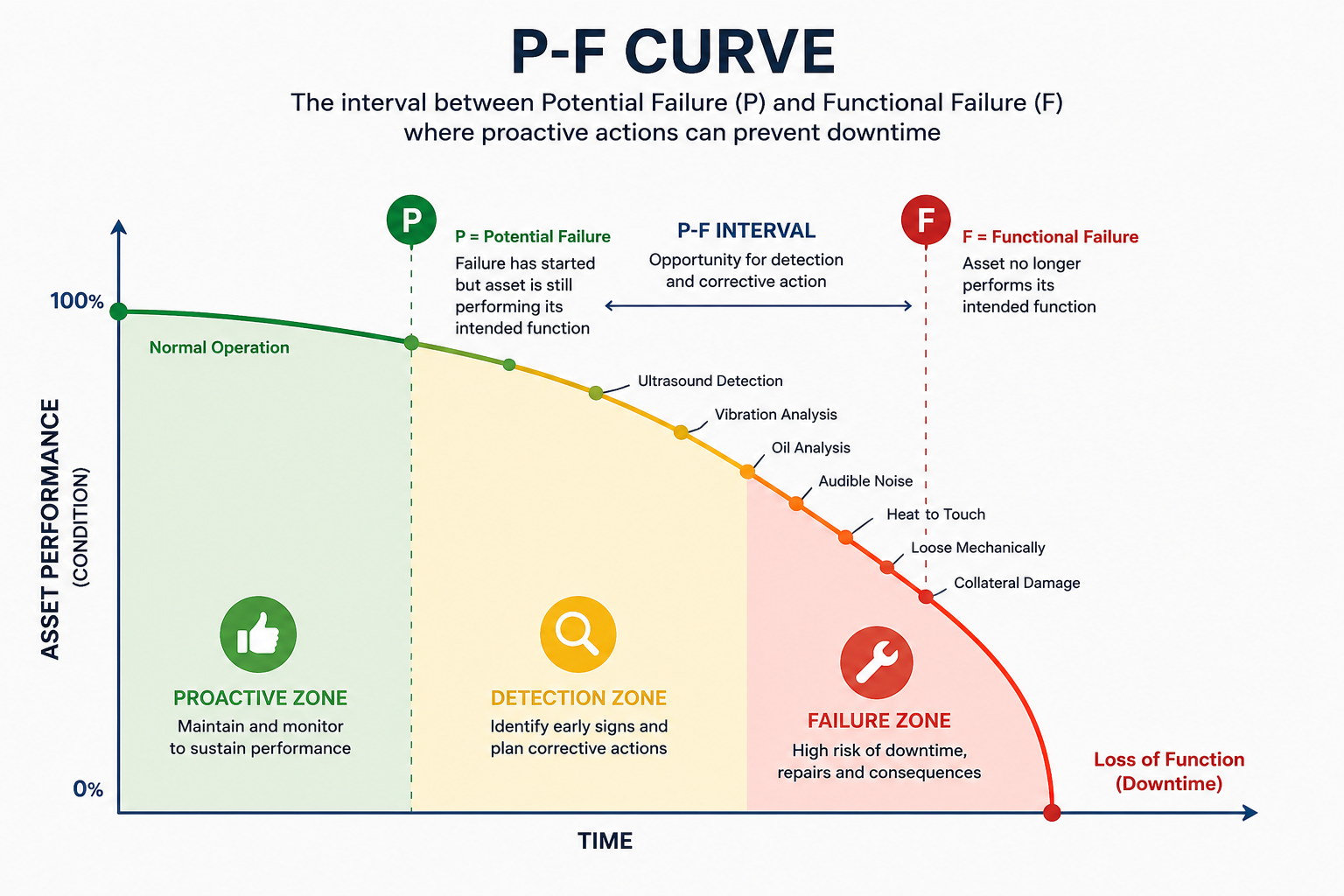 Figure 1. P-F Curve illustrating the progression from potential failure (P) to functional failure (F).
Source: Adapted from Teles, A. (2019). Generated and redesigned with AI support by the author.
Organizations can further strengthen decision-making through the RIME framework:
-
reactive
-
inspection-based
-
maintenance-based
-
engineering improvement
Together, RCM, FMEA, P-F analysis and RIME classification provide a structured pathway from maintenance activities to business risk management.
Reliability initiatives should be supported by measurable performance indicators. Metrics such as mean time between failures (MTBF), mean time to repair (MTTR) and availability provide FMs with objective evidence of whether maintenance strategies are producing meaningful operational improvements.
Traditional maintenance metrics often measure activity rather than effectiveness. Reliability-focused organizations prioritize outcomes such as reduced failures, improved availability and lower operational risk.
The application of Reliability-centered Maintenance principles typically leads to longer intervals between failures, reflected in improved MTBF values. At the same time, better planning, standardized procedures and improved troubleshooting capabilities contribute to lower MTTR values, reducing the operational impact of failures when they occur.
The combined effect is improved availability of critical systems. From an FM perspective, higher availability translates into greater operational stability, fewer service interruptions, reduced risk exposure and improved support for business continuity objectives.
These indicators also create a common language between facility teams and business leaders. Rather than discussing maintenance activities, facility managers can demonstrate how reliability initiatives contribute directly to productivity, risk reduction and organizational performance.
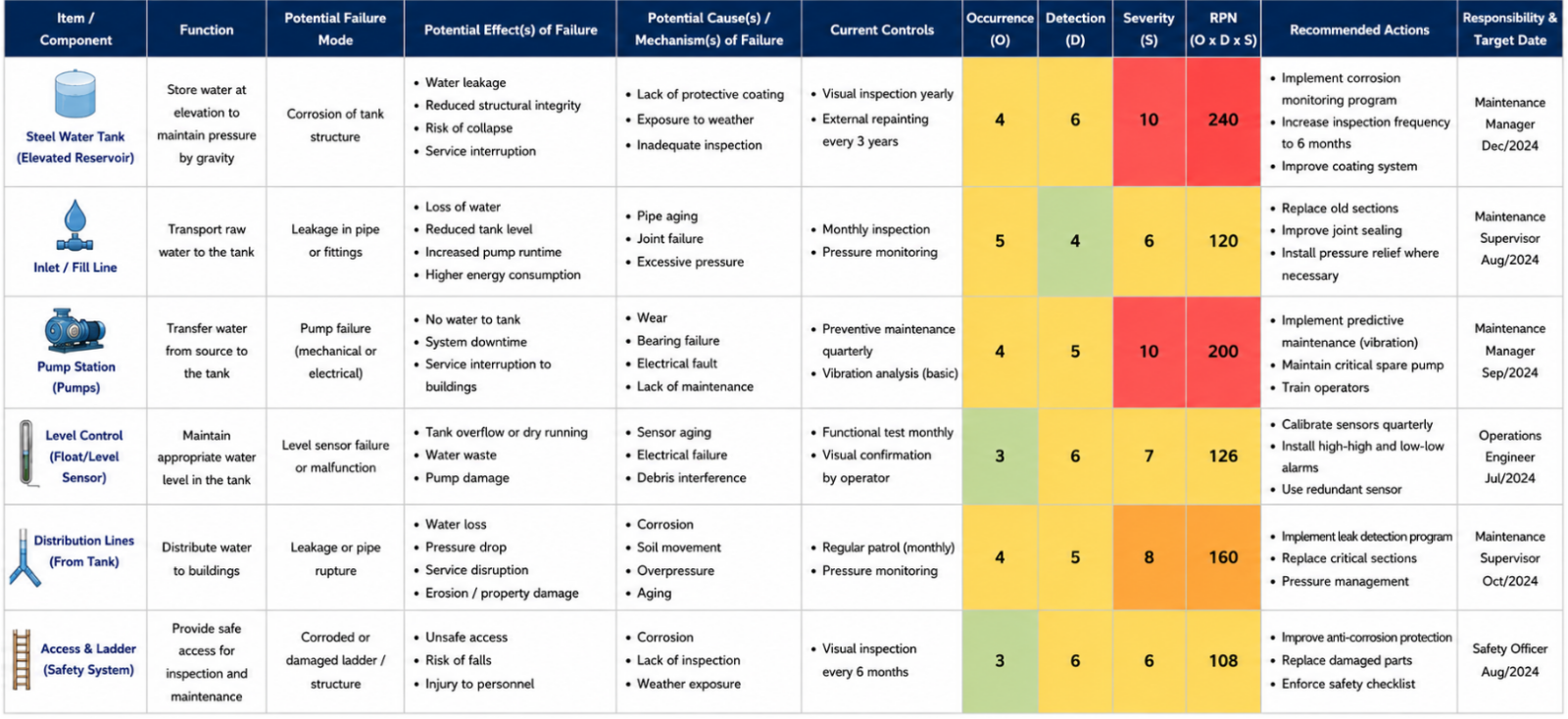
Case example: Critical water supply systemA practical example can be found in the assessment of a critical water supply system supporting operational continuity in an industrial environment. The system consisted of pumps, piping, valves, instrumentation and an elevated water reservoir responsible for maintaining water availability for operational activities. The assessment was initiated following recurring failures affecting the pumping system responsible for supplying water to the elevated reservoir. Although the immediate concern appeared to be a localized equipment issue, further investigation revealed broader opportunities to improve maintenance planning, asset visibility and reliability management practices. The project involved asset mapping, maintenance history review, criticality assessment and root-cause analysis using brainstorming sessions, Pareto analysis, Ishikawa diagrams and the Five Whys methodology. A FMEA was then performed to evaluate failure modes, causes, effects and risk priorities. The structured analysis provided greater visibility into the relationship between asset failures and operational consequences. Figure 2. FMEA applied to a critical water supply system (click on image to enlarge). The study demonstrated that reliability improvement was not achieved solely through equipment replacement. Greater benefits were generated through enhanced inspection routines, standardized maintenance procedures, improved failure reporting practices and more effective planning of preventive and predictive activities. The resulting maintenance strategy enabled activities to be prioritized according to operational criticality and business impact. While the assessment focused on water infrastructure, the same methodology can be applied to HVAC systems, electrical distribution networks, emergency power systems, vertical transportation equipment and life-safety assets commonly managed by facility professionals. |
Smart buildings & the future of reliability
The future of reliability will be increasingly data-driven.
Smart buildings and connected sensors provide real-time operational data that support earlier failure detection and more informed maintenance decisions. Technologies such as predictive analytics and digital twins are accelerating the transition toward condition-based maintenance.
The emergence of smart buildings is also transforming the role of FM. Traditionally, maintenance decisions relied heavily on inspections and historical records. Today, connected sensors provide continuous streams of operational data that allow organizations to identify abnormal conditions earlier and make more informed decisions.
This evolution does not eliminate the need for engineering judgment. Instead, it enhances the ability of FMs to prioritize resources, identify emerging risks and align maintenance investments with organizational objectives.
The organizations that succeed will not necessarily be those performing the most maintenance. They will be those making the best maintenance decisions.
Conclusion
For decades, maintenance performance was measured by how quickly teams responded to failure.
The next generation of FM will be measured by how effectively failures are prevented from affecting the business.
Reliability-centered thinking provides a framework for achieving this goal. By understanding asset functions, analyzing failure modes, prioritizing risk and leveraging data-driven insights, FMs can create facilities that are not only operationally efficient but also strategically resilient.
As organizations continue to face increasing operational complexity, FMs are uniquely positioned to bridge technical performance and business strategy. By adopting reliability-centered thinking, facilities can evolve from support functions into strategic enablers of resilience, adaptability and long-term organizational success.
The future of FM is not about repairing assets faster. It is about ensuring failures never become business problems.
Reliability is no longer a maintenance objective.
It is a business capability.

Rodrigo Silva is a facility management professional with experience leading facilities operations, infrastructure services and projects within complex business environments. He holds a degree in production engineering and an MBA in project management and agile methodologies. His areas of expertise include operational excellence, project management, workplace infrastructure, risk management and business continuity. Silva is a published author on reliability-centered maintenance and is passionate about helping organizations create safer, more resilient and adaptable workplaces. He combines technical rigor with a practical approach to delivering sustainable and business-focused solutions through people, processes, and the built environment, enabling facilities to contribute directly to organizational resilience and long-term business success.
References
Moubray, J. (1997). Reliability-Centered Maintenance (RCM II). Industrial Press.
Nowlan, F. S., & Heap, H. F. (1978). Reliability-Centered Maintenance. United States Department of Defense.
Smith, A. M., & Hinchcliffe, G. R. (2004). RCM: Gateway to World Class Maintenance. Elsevier.
Mobley, R. K. (2002). An Introduction to Predictive Maintenance. Butterworth-Heinemann.
Wiley, J. (1985). Ball and Roller Bearings: Theory, Design and Application. John Wiley & Sons.
Tsang, A. H. C. (2002). Strategic Dimensions of Maintenance Management. Journal of Quality in Maintenance Engineering.
Alsyouf, I. (2007). The Role of Maintenance in Improving Companies' Productivity and Profitability. International Journal of Production Economics.
ENGETELES. (2020). A Bíblia da Manutenção Centrada na Confiabilidade (RCM). Engeteles Academy.
Silva, R. F. (2024). Reliability-Centered Maintenance Applied to Building Maintenance Plans. In: Conhecimentos Contemporâneos Ligados às Ciências Sociais Aplicadas – Volume 3, Chapter 10.
Top image via Getty Images. Tables provided by the author.
Read more on Facility Operations or related topics Operations and Maintenance Planning , Operational and Capital Budgeting and Facility Resilience
Explore All FMJ Topics