
 Membership
 Network
 Regional Sites & Affiliates


 Events
 Participate
 Resources

 Training
 Credentials
 Government


 Content Channels
 Tools
Tools


 Business Overview





Replacing Chaos
What’s driving the next evolution of BAS

Walk into almost any commercial building and the same problem appears wearing different uniforms: every building automation system (BAS) speaks its own language, and some of them mumble.
Inconsistent naming, custom logic, mystery sequences, decades of “we’ve always done it this way,” and integrators who vanished the moment the warranty expired — the result is a system held together by tribal knowledge and crossed fingers.
That era is ending.
A new alignment is forming across the BAS world, centered on four pillars:
-
ASHRAE Guideline 36 — standardized control behavior
-
Project Haystack — standardized metadata
-
Brick Schema — standardized system relationships
-
Modern IP networking (BACnet/IP and T1L) — the bandwidth and transport layer required to support all of it
Consistency finally arrives
Guideline 36 delivers something the BAS industry has needed for years: a standardized, high-performance library of HVAC sequences.
No more one-off programming. No more deciphering cryptic logic that changes from building to building. No more performance roulette.
For facility management operations, G36 provides:
-
predictable behavior across a portfolio
-
repeatable, proven sequences
-
simplified troubleshooting
-
measurable energy gains without experimental coding
It gives a BAS what it has lacked for decades: clear, documented intent.
Project Haystack: Data that actually explains itself
If G36 standardizes behavior, Haystack standardizes meaning.
Haystack tagging answers the foundational BAS question: What exactly is this point?
A properly tagged system replaces confusing point lists with metadata that explains what each point represents, how it functions and where it belongs.
Haystack enables:
-
cleaner graphics
-
clearer trends and alarms
-
more accurate analytics
-
faster onboarding for new staff
-
reduced dependence on legacy programmers
It transforms data from something that must be deciphered into something that can be trusted.
Brick schema: The missing structural map
If Haystack labels the ingredients, Brick reveals the recipe.
Brick models:
-
equipment
-
systems
-
relationships
-
zones and spaces
-
upstream/downstream connections
It turns a BAS from a scattered collection of points into a structured, machine-readable representation of the entire building.
This matters because fault detection, optimization, digital twins and cross-building analytics only function correctly when the system understands how its components fit together. Brick supplies that missing context.
Modern networking: BACnet/IP and T1L bring the plumbing up to speed
Even the best sequences and metadata cannot overcome a slow transport layer. If the network crawls along at MSTP speeds, performance suffers everywhere else.
BACnet/IP — the modern backbone providing high throughput, low latency and IP-native communication.
T1L (Single-Pair Ethernet) — the retrofit enabler:
-
10 Mbps full duplex
-
1,000+ meter reach
-
runs over a single twisted pair
-
frequently reuses existing cabling
Together, BACnet/IP and T1L create the performance and bandwidth that G36, Haystack and Brick require.
The real power is in the combination
Each standard solves a specific portion of the chaos:
-
G36 → consistent sequences
-
Haystack → consistent metadata
-
Brick → consistent system structure
-
BACnet/IP + T1L → fast, modern, scalable transport
When aligned, the results are dramatic:
-
predictable building behavior
-
portable programming
-
clean analytics
-
simplified troubleshooting
-
unified user experience across a portfolio
-
readiness for digital twins and AI-driven operations
This alignment is the closest the industry has ever come to a true, scalable BAS operating model.
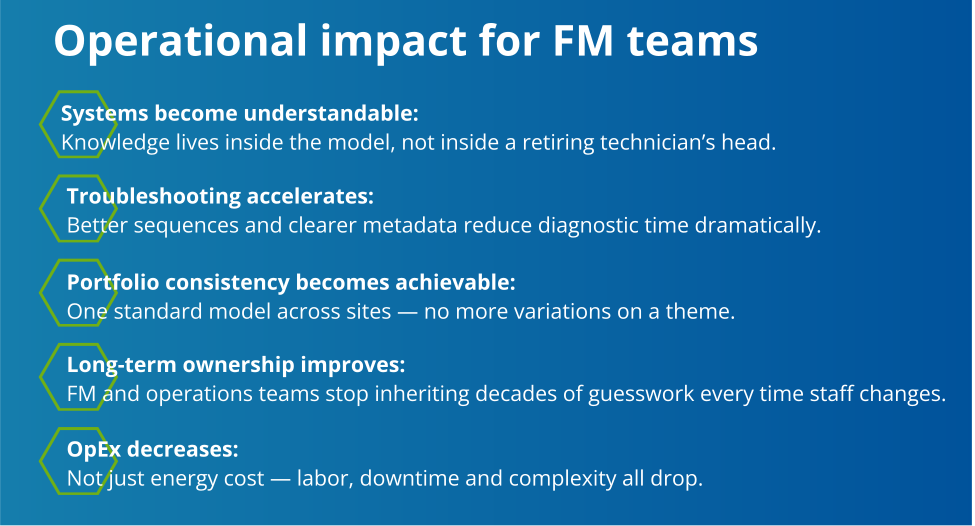
Momentum in the market
Early adopters are already seeing real-world benefits:
-
universities pairing Haystack + Brick for digital twins
-
health care systems standardizing G36 for consistent operation
-
multisite owners upgrading MSTP buildings to BACnet/IP
-
retrofits deploying T1L to modernize without demolition
This shift is not theoretical — it is already well underway.
Where this leads: Self-describing, self-optimizing buildings
Terms like “smart buildings,” “AI optimization” and “machine learning” get thrown around constantly; but none of them work without:
-
clean sequences
-
clean metadata
-
clean system models
-
fast IP networking
G36 + Haystack + Brick + BACnet/IP/T1L create the foundation that finally makes these outcomes realistic.
A direction for industry leadership
FM industry leadership does not require immediate system overhauls. It starts with expectations:
-
enforce G36 on new projects
-
require Haystack tagging
-
request Brick models where appropriate
-
mandate BACnet/IP-first designs
-
adopt T1L for retrofit IP migration
-
audit BAS metadata and naming consistency
-
hold vendors accountable for clarity and openness
The evolution of BAS will not be driven by any single technology, but by the alignment of many. For the first time, the FM industry has the standards, tools and network infrastructure required to deliver buildings that are understandable, interoperable and prepared for the future.
Clarity replaces chaos.
And FM teams finally gain the BAS performance the industry has been promised for decades.

Kevin Morris has more than 25 years of executive experience with a proven blend of business strategy, marketing insight and technical know-how. Throughout his career, he has built programs that consistently grow market share, strengthen profitability, and elevate the organizations he supports. Morris is an accomplished speaker and trainer with a sharp eye for identifying profitable market opportunities and the discipline to develop them. He designs and implements targeted marketing strategies, builds entrepreneurial team cultures, and creates clear, effective training templates for both technical staff and customer-facing roles. Morris has also developed industry-aligned contractor training programs that meet county, state and NATE standards, helping contractors stay compliant, confident and ahead of the curve.
Read more on Facility Operations , Quality and Facility Technology & Data Management or related topics Benchmarking , Analysis and Information Technology
Explore All FMJ Topics