 Membership
 Network
 Regional Sites & Affiliates


 Events
 Participate
 Resources

 Training
 Credentials
 Government


 Content Channels
 Tools
Tools


 Business Overview





Smarter Power, Cooler Infrastructure
Finding balance for data centers

From the consumer's perspective, the AI revolution has proceeded more or less seamlessly: the products work when they need them to work and improve with each passing month. But the companies operating these data centers are acutely aware of how tenuous progress has been from the very start. The AI revolution, along with exponential growth in cloud computing generally, has put tremendous strain on the system, with data center operators scrambling for new sources of power to sustain increased usage.
Given this premium on new power sources, it stands to reason that data center operators would want to maximize the value of the power that is already at their disposal. As things stand, given that cooling takes a major portion of a data center’s power budget, inefficient cooling methods are wasting massive amounts of power. In consequence, companies are spending much more money (and generating ever-larger carbon footprints) without any concomitant increase in capacity.
It makes sense, then, that the advantages of intelligent orchestration have been receiving more attention of late. This method, which intelligently manages energy flows and cooling resources across the entirety of a given facility, has demonstrated serious promise across a range of metrics that matter to data center owners, from power usage effectiveness (PUE) to operational expenses to sustainability.
Inefficiencies of traditional energy flow management
The system by which most data centers operate today is decidedly unintelligent — a faltering vestige of an outmoded data paradigm. Jobs here are processed in the order they arrive and distributed to servers without reference to real-time power and temperature conditions.
This approach ignores two facts at the heart of data center functionality.
 When the power needed to cool servers significantly exceeds the power needed to run them, businesses are liable to lose money, and that's not to mention other consequences like hardware failure.
Intelligent orchestration can account for these factors and act on them in real time. It predicts workload shifts and power requirements, and adjusts the mechanics of the system accordingly, adjusting cooling, optimizing fan speeds and transferring workloads to cooler areas. Incoming jobs are not merely flung onto the nearest available server; they are, instead, strategically packed into the most sensible locations, creating instant reductions in PUE and overall operational expenses.
 The need for intelligent orchestration
The advantages of this technology for so-called greenfields (i.e., new data centers) are self-evident. These new data centers are technically being constructed to meet the needs of AI workloads, but AI workloads are inherently unpredictable, defined by violent spikes that defy conventional planning methods. Intelligent orchestration, by accounting for real-time thermal conditions, can proactively anticipate these spikes and minimize strain on the overall system.
But the construction of these greenfields is itself a fraught proposition. For one, increased capacity is urgently needed now, but actually building these data centers takes an extraordinarily long time (upwards of seven years in some cases). Making matters even more difficult, increased politicization around AI and data center construction is making it more difficult for these projects to get off the ground, with red tape lengthening by the day. Factor in the massive cost of construction as well as ongoing construction worker shortages, and there is a perfect storm: data needs steeply escalating in the very teeth of a construction slowdown.
Under-acknowledged in discussions of this problem is the potential of existing data center infrastructure to handle escalating data needs. But intelligent orchestration, properly deployed, can enable them to do exactly that. Many of these data centers are operating at a fraction of their capacity. By merging cooling infrastructure, power delivery systems and workload management systems, intelligent orchestration can put that capacity to productive use. Retrofits of this nature, being both faster and cheaper than wholly new construction, present a highly viable solution to the problem of increased data needs.
Key components & functions of intelligent orchestration
 Given the technology's potential importance on this front, it is worth taking a closer look at how it works.
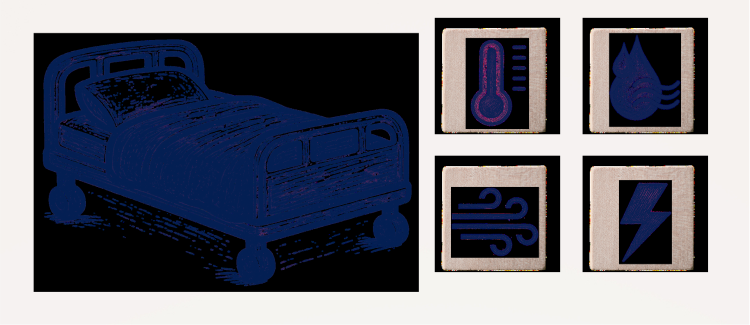
Sensors are key here. Picture a patient in a hospital bed hooked to a stand of equipment: the data center's vitals (temperature, humidity, airflow, power) are continuously monitored. Meanwhile, machine learning techniques model the potential power and temperature outcomes of allocating a task to a given server. Marshalling all this data, the system orchestrates each microcomponent of the data center's operations. The speed of fans, pumps and chillers is automatically adjusted in line with on-the-ground conditions, and relevant workloads are shifted to cooler or more power-efficient racks.
Fundamentally, this is a process that integrates and automates what was once separate departments, namely IT operations and facility management. The principle at play is that data center optimization is impossible if computing jobs are allocated without reference to real-time power and cooling conditions.
The perils of independent power generation
Despite the evident benefits of intelligent orchestration, some have sought alternate solutions. For instance, the deployment of independent, large-scale power generation solely for data centers. Many of the largest tech companies are pursuing this approach, hoping to bypass the complexities of grid connection and reduce the potential burden on surrounding communities.
But this logic is flawed. It is essentially impossible to wholly decouple from the grid: these systems are always interconnected. At minimum, these companies must still rely on the grid for backup support (and given current data increases, they will be making frequent recourse to these). If the goal is to reduce the strain on the overall energy infrastructure, this approach is likely unsuccessful.
Still, this point is largely academic considering the larger obstacle to any data center ever building an independent power supply, namely the sheer cost of such an undertaking, even for some of the richest companies on the planet. Even so, the numbers simply do not add up. In a sense, this is just a reformulation of the greenfields problem. In both cases, the hurdles, financial and regulatory, are immense.
The wisdom of retrofitting brownfields through intelligent orchestration is evident. The big tech companies do not need to spend time and money building alternate energy sources when, properly optimized, all the power they need is already at their disposal. Through intelligent orchestration there is a cost-effective and sustainable solution, protecting communities and businesses, while ensuring that data centers can keep up with ever-increasing demand for AI.
With the stakes this high and the existing resources this abundant, why risk starting from scratch?

Wannie Park is the founder and CEO of Pado. A seasoned entrepreneur with over 25 years of experience in energy, IoT and SaaS. Park has incubated and scaled companies in cleantech and sustainability, delivering three successful exits. Prior to founding Pado, Park was senior vice president of business and corporate development at Bidgely, a global AI-powered SaaS provider, CEO of Zen Ecosystems, a leading provider of energy management solutions to SMB and SVP of business and corporate development at Inspire Energy, a leading renewables and sustainability company.
References
Top image via Getty Images.
Read more on Facility Operations , Sustainability and Facility Technology & Data Management or related topics Energy , Data strategy and information management and Operations and Maintenance Planning
Explore All FMJ Topics