
 Membership
 Network
 Regional Sites & Affiliates


 Events
 Participate
 Resources

 Training
 Credentials
 Government


 Content Channels
 Tools
Tools


 Business Overview





Smart(er) Sustainability
Reducing carbon footprint & operational costs

Smart buildings are rapidly becoming one of facility management’s most effective tools for reducing both carbon footprint and operational costs in the built environment. With global climate goals tightening and cities expanding at record speed, the demand for efficient, intelligent infrastructure has never been greater.
Buildings are responsible for a significant share of global energy consumption and greenhouse gas emissions, often contributing 30-40 percent of national energy use largely through energy intensive systems such as heating, cooling, lighting, ventilation and plug loads. These systems are often oversized, poorly controlled or operating unnecessarily, leading to massive energy waste and increased carbon emissions.
As energy prices fluctuate and governments introduce stricter sustainability frameworks, organizations are turning toward digital transformation to sustainably transform their built assets. The emergence of advanced sensors, Internet of Things (IoT) devices, intelligent building management systems, AI and powerful analytics platforms has revolutionized how buildings function. Instead of operating on fixed schedules or manual controls, buildings continuously monitor environmental conditions, learn behavior patterns and self-adjust in real time to optimize performance. This shift from reactive to predictive and adaptive operations marks one of the most significant technological leaps in the workplace sector.
The impact of this transformation is no longer theoretical – it is proven and measurable. Recent studies and deployment results from 2023 to 2025 show that smart buildings consistently deliver substantial reductions in both energy consumption and carbon footprints. Many buildings equipped with AI-driven optimization tools achieve double-digit savings, often between 15-35 percent within the first year of implementation. Some high-performance cases, especially in commercial towers, universities and hospitals, report even higher reductions when combining smart controls with behavioral engagement programs and renewable-energy integration. These results highlight a critical reality: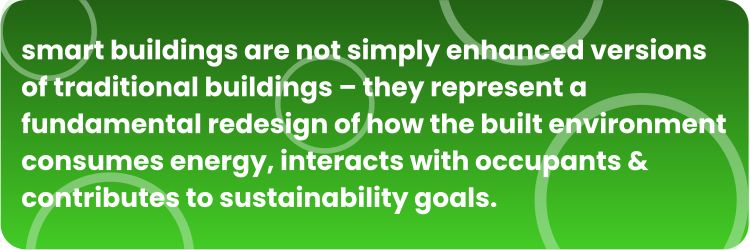
Another advantage of smart buildings is their ability to integrate with renewable energy systems and smart grids. As more governments endorse or mandate solar- and wind-powered electricity, organizations must adapt to fluctuating energy supply and dynamic pricing.
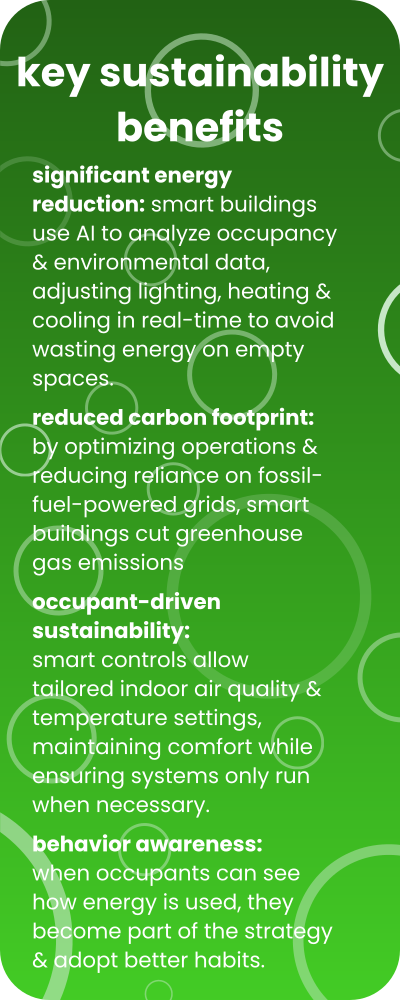
Smart buildings can shift loads from high-carbon or high-cost periods to times when renewable penetration is greater. If solar panels are installed, smart systems can coordinate HVAC pre-cooling or battery charging when solar output is highest. Over time, this reduces dependence on fossil-fuel-based electricity, cutting the building’s operational carbon footprint even if the grid is not fully decarbonized.
From an economic perspective, the operational cost reductions are compelling. When buildings reduce their electricity consumption by 10-35 percent through automation and advanced controls, utility bills drop dramatically. In regions with high peak demand charges, smart load management can reduce billing peaks, saving large commercial buildings thousands of dollars annually. Predictive and condition-based maintenance lowers labor and material costs by preventing breakdowns. Many organizations recover their investment in smart-building technologies within five years, depending on energy prices, climate conditions and building size. This short payback period is one reason smart-building retrofits are now considered one of the highest-ROI sustainability investments.
Universities, corporate campuses, hospitals, hotels and high-rise office spaces are leading adopters of smart-building solutions because they operate long hours and have complex HVAC and lighting needs. In these environments, energy savings compound quickly. For example, campus studies demonstrate that IoT-driven optimization can reduce total building energy use by up to one-third. AI-driven platforms used in hotels and commercial towers show consistent reductions in HVAC consumption without affecting guest comfort. Several large real estate portfolios have also adopted portfolio-level analytics: centralized platforms that track performance across hundreds of buildings to identify where the greatest savings can be achieved and to ensure that savings persist year after year.
Despite the promise, smart-building deployments face real challenges. Baseline conditions vary widely. Buildings that have never undergone optimization tend to achieve higher savings than newly retrofitted facilities. Measurement and verification are essential to distinguish real savings from estimated ones. Occupants may resist changes if comfort is compromised, therefore smart systems must maintain or enhance comfort standards.
Cybersecurity is another major consideration because connected systems can be vulnerable to attacks if not properly protected. Finally, integrating legacy equipment with modern IoT systems can be complicated and sometimes requires upgrading older components.
Still, the momentum is strong. International organizations such as the International Energy Agency (IEA) recognize digitalization of buildings as a key pathway to achieving energy-efficiency targets and reducing global CO2 emissions from the built environment. Governments are supporting more smart-building incentives, mandatory energy-reporting frameworks and green-financing mechanisms that reward efficient operations. Developers and FM companies are also adopting standardized analytics platforms to harmonize building data, streamline reporting and simplify measurement.
On a practical level, organizations looking to transform their workplaces into smart, low-carbon assets follow a structured approach. They begin with energy audits and baselining to understand where inefficiencies exist. They prioritize low-cost, high-ROI measures, such as occupancy-based controls and setpoint optimization, before implementing more complex AI-driven HVAC controls. Integration with solar panels, battery storage and demand-response programs follows as part of long-term planning.

Continuous commissioning, regularly tuning systems through analytics, ensures that savings persist over time. Finally, carbon-intensity tracking allows organizations to quantify how much CO2 they avoid each year from smarter operations.
The evidence is clear: smart workplaces can significantly reduce the built environment’s operational carbon footprint while delivering strong financial returns. They are not simply energy-efficient buildings. They are continuously learning systems that improve as they collect more data. This makes them ideal for long-term climate and cost-management strategies.
By reducing energy use through precision control, eliminating inefficiencies through analytics, integrating with renewables and enabling data-driven decision-making, smart buildings are reshaping FM. As AI models become more accurate and IoT devices become more affordable, the savings and carbon reductions will only grow. In a world where climate targets are tightening and operational budgets are under pressure, smart buildings represent one of FM’s most practical, scalable and impactful solutions available.

Aykean Forde CFM SFP, FMP, MBA, MA, is the facilities director of The International School Port of Spain in Trinidad & Tobago (grades Pre-K-12). Forde serves as a trustee of the IFMA Foundation, is an IFMA Qualified Instructor and a past member of the IFMA Global Board of Directors. An ambassador of FM, she passionately serves and collaborates with others to positively impact workplace experience while leading organizations towards making their vision a reality. She has also spoken at conferences in Trinidad and Tobago, the Bahamas and the U.S.

Izzat Ali Khan, SFP, FMP, is the general manager at EFSiM Facilities Services. A seasoned FM professional, he is passionate about creating a positive impact in business through sustainability. He focuses on integrating sustainability and innovation in businesses to build the FM industry and make the world a better place to live.
References
Top image via Getty Images.
Read more on Facility Technology & Data Management and Sustainability or related topics Sustainable Facility , Facility Technology and Carbon Footprint
Explore All FMJ TopicsRelated articles
-

Artificial Intelligence in FM
The stakeholder’s perspectiveBy Dr. Jake Smithwick & Dr. Kenneth Sullivan & Nneka Ubi05.01.2024 -

Don’t Drop the Ball
How a CMMS can make or break an FM organization’s successBy Michael Carmean09.17.2024 -

Beware of Growing Cyberthreats
Why it’s time for stronger facility cybersecurityBy Andrew Harris & Eric Headington10.30.2024