
 Membership
 Network
 Regional Sites & Affiliates


 Events
 Participate
 Resources

 Training
 Credentials
 Government


 Content Channels
 Tools
Tools


 Business Overview





Strategic Investment in a New Era of Office Fit-out Complexity
Finding balance in an evolving market

Geopolitical uncertainty and rising AI demand are driving up global office upgrade costs, as the office fit-out market navigates a complex and shifting landscape. The total cost of upgrading office space rose moderately in most markets in 2025 compared to prior years, as relative stabilization of material prices and easing inflation allowed construction costs to partially rebalance.
However, challenges remain, as uncertainty around global economies and energy supply grows, among other complexities. In tandem, technology requirements are becoming increasingly complicated, and the emergence of AI is set to raise the bar further for what offices need to deliver and what they cost to build. Within this complex era of rapid change, facility managers and corporate real estate leaders must be focused on adaptability and agility in both business planning and office fit-outs.
Informed by 68 cities and 40 countries globally to provide insights on trends and cost drivers, JLL’s latest Global Office Fit Out Costs Guide reveals how data-led, adaptable workplace investment can help organizations make more strategic decisions, balance costs with performance and stay resilient in a shifting market.
FMs and CRE leaders are key strategic partners in helping companies navigate the rapidly changing environment to design spaces that meet modern employee needs and ensure long-term competitive edge in the race for talent.
 This role has become more complex as the office is no longer simply a place to house desks: it is a business tool that must support collaboration, learning, client engagement and digital connectivity. Occupiers planning across a portfolio must determine how to allocate capital in a way that reflects local conditions, workplace objectives and long-term operational needs.
Pricing is influenced by a wider set of factors
Office fit-out costs have risen 2-6 percent across regions over the past year. While material prices largely stabilized in 2025, total fit-out costs were commonly impacted by the cost of labor, raw materials, and mechanical and electrical (M&E) works.
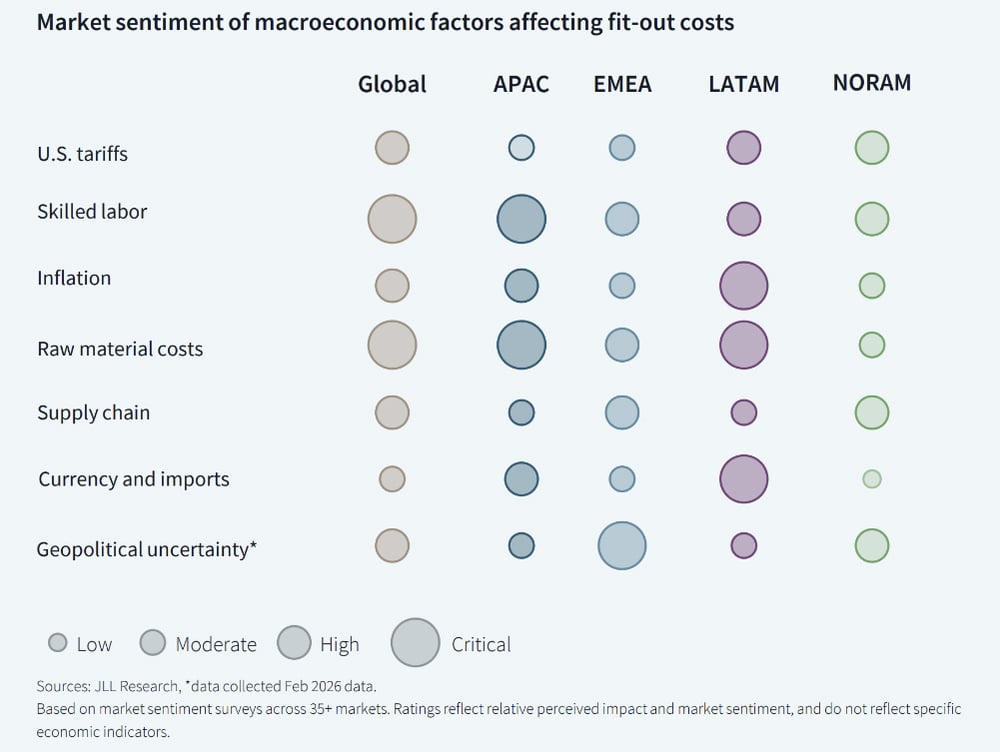 The 2026 market is even more complex. It is no longer being driven by a single cost pressure, rather, a confluence of persistent risks, from labor and energy to geopolitics. To navigate this new reality, workplace fit-outs are becoming a more important lever for balancing unpredictable costs, agility and the employee experience.
Delivering office fit-out projects on time and on budget has never been more complicated. Although economic conditions improved in 2025 and early 2026, the confluence of global macroeconomic pressures continues to impact local markets in a variety of ways, making it critical to understand how global forces translate to local context, buildability and viability.
Skilled labor shortages are notably impacting a large share, with over half (55 percent) of markets in several regions now defining structural challenges. M&E specialists, electricians and specialist fit-out trades are particularly impacted by these shortages, leading to higher costs and longer scheduling times.
 Technology requirements are becoming a more significant cost driver
Advanced technology offerings have quickly become standard, rather than a premium. Two-thirds of markets have reported a rising demand for more complex technology integration in fit-outs, as organizations seek AI-ready infrastructure, integrated building systems, and more sophisticated AV and IT capabilities. In parallel, costs to fit-out offices with these technology offerings are expected to continue to grow globally in the next 12 months, as rapid global AI investment increases demand for enhanced workspaces and technology becomes a baseline requirement, rather than a discretionary upgrade.
This shift has important implications for workplace strategy. Digital readiness is increasingly embedded from the beginning, as convergence across building systems means that all building technology, including lighting, security, AV, etc., often sit on a single network, raising underlying infrastructure costs before individual systems are specified.
Strategic planning & procurement are crucial to mitigate risk
Organizations are navigating challenging operating environments and are under pressure to improve employee performance, attract and retain talent, and maintain agility in both business planning and real estate strategy.
To meet employee needs and amenity expectations, occupiers must first determine how to fit out their office in the most cost-effective way. Therefore, businesses can no longer treat cost management as a static exercise: it must be integrated from project inception. Operational cost pressures have brought energy efficiency firmly into focus, with 73 percent of occupiers globally reporting cost reduction as their top organizational priority. Separately, 88 percent of global CRE leaders identify reducing operating costs through energy savings as a top C-suite priority for the next three years. There has been a clear shift toward viewing smart mechanical and electrical solutions as long-term operational investments rather than simple cost lines.
With cost-efficiency as a defined priority, the workplace model can serve as a blueprint for occupiers to achieve their fit-out ambitions. Before drawing conclusions about scope or specifications, organizations should define the office typology required, understand how many enclosed rooms, collaboration areas, quiet spaces and training areas are truly needed, and test whether the proposed workplace can support future growth or contraction. Without this discipline, office projects can easily drift into overspending or underinvestment.
 Office fit-out costs & needs vary by region
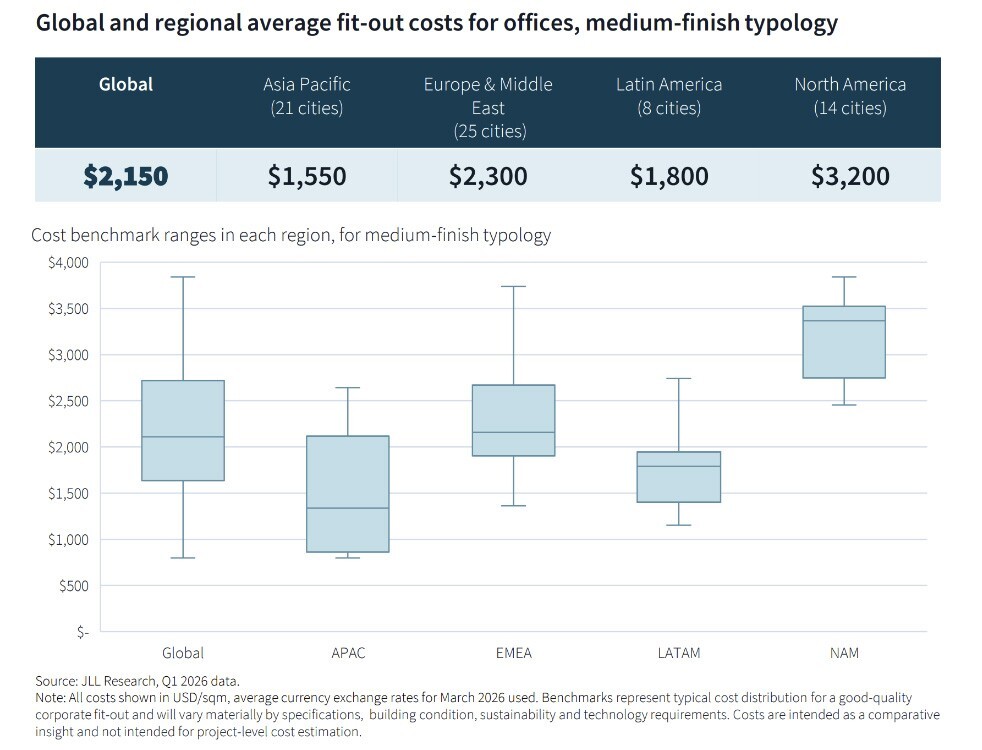
Globally, North America remains the most expensive market (US$3,200/sqm) with Asia Pacific (APAC) as the most cost-effective overall (US$1,550/sqm), despite premium hubs like Tokyo and Singapore. Sustainability demand is highest in Europe, the Middle East and Africa (EMEA), where ESG mandates make energy-efficient specifications and certified materials standard requirements. At the same time, APAC is seeing rising technology costs as semiconductor and chip shortages push up AV, security and smart building systems pricing.
The majority of the top 20 highest-cost cities remain in North America, alongside established global hubs in Europe and the Middle East, including Zurich, Dubai and Munich — markets where high construction costs and competitive conditions drive elevated pricing. In the U.S. and Canada specifically, fit-out costs are driven up by persistent geopolitical headwinds, which exist in parallel with rising demand for AI-ready workspaces. Global office leasing activity rose again in 2025, further stimulating fit-out demand and intensifying competition in major urban markets, with impact on total fit-out costs.
 Sustainability is a notable area where regional differences are widening. In parts of Europe, environmentally responsible materials and energy-efficient systems are part of baseline expectations. While sustainability-led upgrades may still be seen as a premium, they have also emerged as a strategic fit-out to reduce longer-term operating costs. These features include more efficient lighting, smarter controls and higher performing heating and cooling systems.
 Looking ahead
This year, geopolitical and economic uncertainty are influencing fit-out costs. The confluence of geopolitical instability, trade policy shifts and energy market volatility that defined 2025 and early 2026 is unlikely to resolve quickly, and occupiers should plan accordingly. In recent years, energy costs specifically have been a significant concern for corporate occupiers in terms of operational costs. Energy efficient fit-outs will likely increase as a key strategy to manage rising costs. In tandem, AI demand is growing with the rapidly developing technology and is at risk of cost increases. As this technology evolves to meet changing requirements, it is subject to energy price volatility and commodity cost increases.
As uncertainty and complexity shape operational needs, flexible office design allows for reduction in long-term cost exposure to strengthen investor return on investment. For many organizations, the most resilient fit-out strategy will be the one that accepts uncertainty as a planning assumption rather than a temporary disruption.
Client and project teams should carry contingency provisions and procurement strategies that account for continued uncertainty. In a market where cost and risk are volatile, the real advantage will belong to FM and CRE leaders who adapt their workplace strategy and invest with data-led intent.

Daniel Pomfrett, FRICS, has more than 28 years of experience in the built environment is managing director of JLL’s Cost Management and Project Controls team across the United States and Canada regions, providing leadership and strategic direction for the cost practice. Pomfrett is actively involved in projects, supporting the business across all project types including infrastructure, ground up, renovation and repurposing.
References
Top image via Getty Images.
Read more on Real Estate , Finance & Business and Facility Operations or related topics Real Estate Management , Space design and planning , Operational and Capital Budgeting and Operations and Maintenance Planning
Explore All FMJ TopicsRelated articles
-

Plugged In
Solving the data disconnect in real estate and FMBy Amanda Muzzarelli & James Waddell07.01.2024 -
Food for Thought
Installing pop-up food programsBy Stafford McKay09.18.2024 -

Guarding Against Graffiti
Protocols that help prevent & remove graffiti on college campus buildingsBy John Lesak & Sarah Brummett11.26.2024
