
 Membership
 Network
 Regional Sites & Affiliates


 Events
 Participate
 Resources

 Training
 Credentials
 Government


 Content Channels
 Tools
Tools


 Business Overview





Technology & Workplace Strategy
Supporting the employee experience

The pandemic has highlighted the success of a more general approach in which some may never fully return to the office. Many large firms such as Google, Salesforce, Facebook and HSBC have announced their adoption of a hybrid 3-2 plan (i.e., two/three days in the office, two/three days working from home), while Amazon recently announced their plan to return to an office-centric culture as its baseline.Gensler has also noted a new kind of FOMO (the fear of missing out) on useful updates, critical intel and key connections best shared in person. Facility managers are facing the challenge of a return-to-office plan that incorporates new safety measures, new occupancy/utilization models and investments in enabling technology solutions.
FM should work alongside IT and HR to find holistic solutions, present upgrades and new system requirements (as investment will no doubt be needed) in alignment with overall business goals and the continued pressures of digital transformation.
|
New challenges include density measurement, variable occupancy planning, reduced lift capacity, asynchronous work schedules, increased employee choice, flexible work hours and scheduling, especially across teams for the days a whole team or department wants to meet face to face in the office. |
As employees reoccupy the office space, changes and adjustments to the physical and virtual space will be a factor in demonstrating the organization’s post-COVID-19 intent and play a critical role in communicating a company’s vision, mission and values along with helping people work at their best.
The process should start with listening for concerns, documenting the challenges, suggesting a strategy that works with HR and IT, auditing the systems and solutions in place, identifying changes required to drive a transformation across culture, work practices and outcomes.
IFMA’s Information Technology Community (ITC) and Workplace Evolutionaries (WE) Community looked at how to develop a best-practice roadmap to help FMs plan for reoccupancy, coordinate and position changes, and steward investment toward the company’s overall goals.
|
The level of choice and empowerment at the individual or team level will require a level of flexibility and responsiveness in planning. Having equipped employees to be productive anywhere, according to the chosen strategy, the employee and team can exercise that choice each morning as they decide on the day ahead. Reservations, capacity and density may fluctuate significantly. |
Start with the customer journey
A customer journey map can illustrate not only the activities, but the touchpoints, emotions, pain points and possible solutions to understand the decision process and emotions of the employee as they contemplate the return to the office. Journey maps are a common tool to understand the customer experience and clearly show how HR policies, facilities and technology all impact the employee’s decision making. Once obstacles and challenges are identified, appropriate solutions can be investigated.
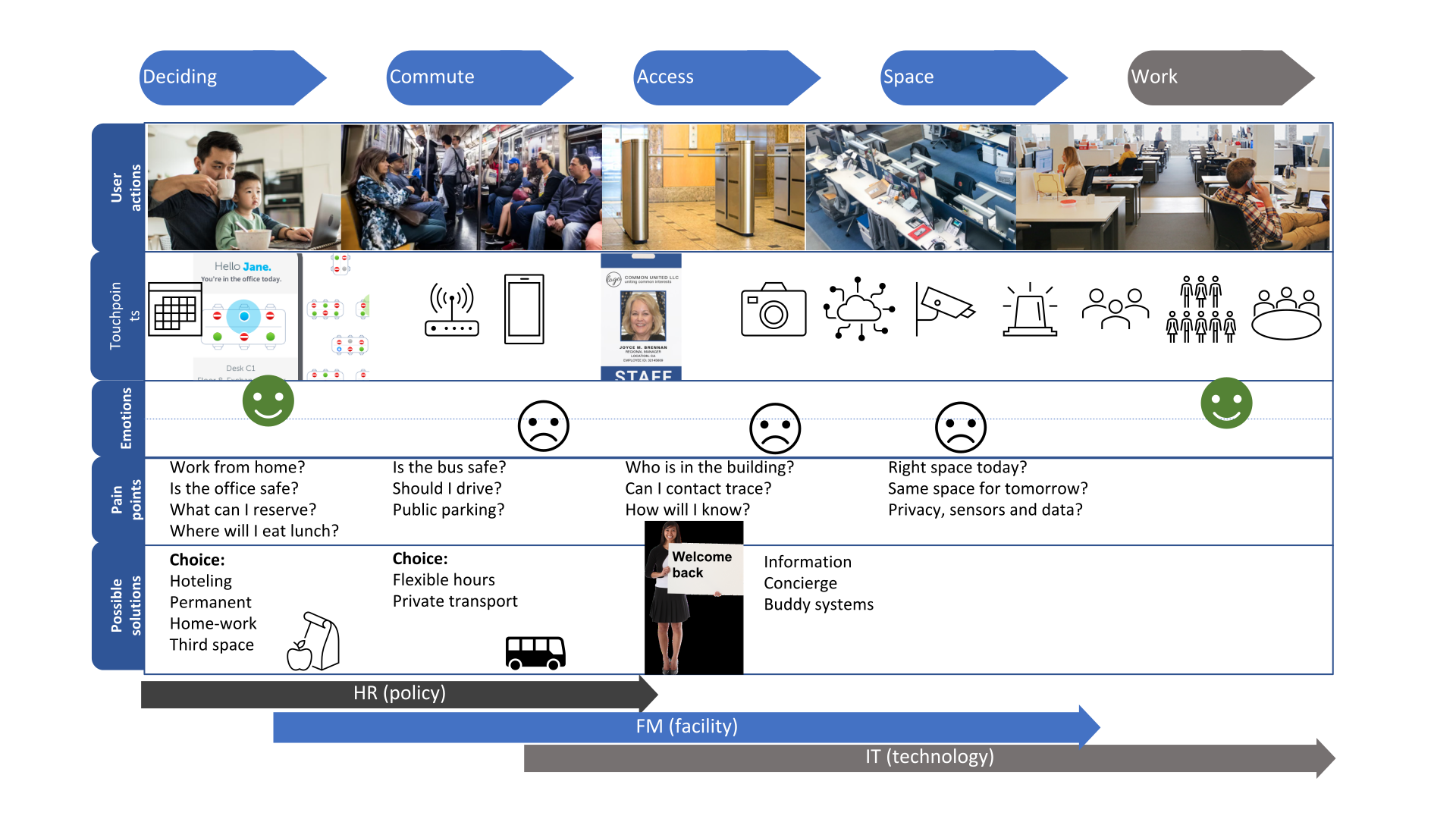
CASE STUDYPotential phased approaches can limit occupancy over the coming months; reservation systems will need to be flexible enough to respect overall occupancy percentages and other business rules. Hoteling is one strategy that allows individual workspaces to be reserved for specific dates and times so that the individual can check in to their reserved workspace when they arrive at the office. They have the assurance of knowing a safe space is waiting for them for a set period. Free address approaches in which individuals locate and use workspaces on a first-come, first-served basis may be less viable and much harder to manage under restricted occupancy percentages. A blended approach may work at the team level where space is reserved for the team, but the team members manage attendance and occupancy through local team communication tools. However, this may lack the rigor and record keeping required to comply with occupancy limits. |
Developing a technology roadmap
Developing a technology road map includes identifying and documenting a company’s short- and long-term needs and corresponding potential solutions. This considers the understanding that the technology landscape is getting more complicated every day for several reasons:
-
Tech consolidation – as companies merge, there is no clear picture of what products will be invested in or mothballed
-
Changing mindset - based on how facilities are seen post-pandemic – there will be a need to change existing systems to meet new needs and also potentially new technology to support short- to medium-term needs.
-
Proliferation of solutions – the tech market continues to grow exponentially. For example, reference unissu.com is tracking more than 9,000 solutions in PropTech
-
Growing Ecosystem – hardware/IoT based solutions (such as sensors), enablement technology and complimentary solutions (e.g., tenant experience) increase the complexity of planning a roadmap.
-
Tactical solutions - growth in tactical solutions to meet immediate needs (for example, desk booking and contact tracing). As tactical solutions grow to solve specific pain points (or requirements) there is a growing need to connect multiple solutions under an integrated reporting or BI solution to gain a single source of truth.
Built Environment Technology Alliance (BETA) has categorized relevant technology solutions (e.g., CMMS to visitor management solutions) and compiled a list of technology providers within each category on its website. In addition, recent ITC articles have highlighted new apps and return-to-work content. While many new solutions are available, a quick audit may pay dividends in leveraging existing technology during the evaluation phase.
An initial step in developing a technology roadmap is the evaluation phase, which should include:
-
Maturity assessment - How well do current systems meet your business needs today?
-
Opportunity analysis - Can current systems meet anticipated future strategic objectives? Where are the technology deltas in current and future needs?
-
Gap analysis - Can the gaps be filled by augmenting the current solutions (e.g., integration of existing solutions and data through APIs).
-
Pain points - What needs to be addressed to mitigate current pain points with systems in place?
-
Costs and rentability of technology and its longevity/duration of use.
-
Vision – What needs are likely within three to five years?
Corporations do not yet have all the data points needed to determine respective future needs in facilities occupancy management. This year could be characterized by a lot of experimentation around the workplace, and probably more visibility to FM services than ever before. Encouraging people back into the office will require them to feel safe – air quality and cleaning routines are just two things that can likely allay employees’ concerns.
A focus on measurement and data sharing will ensure the workplace is optimized according to needs and that the levels of employee experience are maintained and improved. This is supported by HR policy around key data confidentiality and communication strategy for sharing success.
The suggested approach continues with mapping the solution categories to the customer journey map and selecting those systems that can address identified pain points. Typical capabilities to improve that rely on underlying technologies such as:
Engagement:
-
-
Wellness, comfort (STS, AI, sensors)
-
Choice, flexibility (self-service, concierge, sensors, beacons, Cameras)
-
Access, shared space (scheduling, reservation, badge systems)
-
Alerts (communication)
-
Productivity effectiveness:
-
-
Collaboration, knowledge sharing (connectivity, web + cloud based tools, monitors)
-
User availability, focus status (sensors, status indicator/lights)
-
Focus, quiet (white sound)
-
Wayfinding (digital signage, sensors)
-
Change and learning
-
Use/access
-
-
Utilization and occupancy (presence, sensors, beacons, cameras)
-
Smart buildings
-
-
Building systems (workplace analytics, asset and work order management, AI, cameras)
-
But what else is still needed? Some concerns are already observed and are driving new capability requirements:
-
Self-health declarations, vaccination status, contact tracing, safety and occupancy passports. As with airline travel, some form of digital health passport may soon be associated with building entry.
-
Alert systems for office information, closure or evacuation.
-
Measure and analytics – privacy and concerns over system-collected data on employee performance and activity at work (using AI or sensors). Employees feel like they are being tracked or followed, especially from their employer, so levels of transparency and opt-in required.
-
Equitable presence for those not returning to work or not able to attend an in-person meeting – culture of inclusion required.
-
Further integration with existing systems; for example, HR. Try to avoid the rush to point to solutions that increase technical debt (i.e., implied cost of additional rework caused by choosing an easy, limited solution now instead of using a better approach that would take longer to implement) and will need to be retired through integration with APIs. Are there situations of double, triple entry? Consider the employee experience of these additional point solutions.
-
Increased levels of automation - look for opportunities for optimization and automation.
Working toward business outcomes
Having identified the challenges and possible technology solutions, a business case will likely be required for investment in new apps or solutions and associated change management. But how can FM present the required investment as part of a roadmap to business transformation? There is an important opportunity to leverage these changes to support new business models and ways of working and not just the return to work.
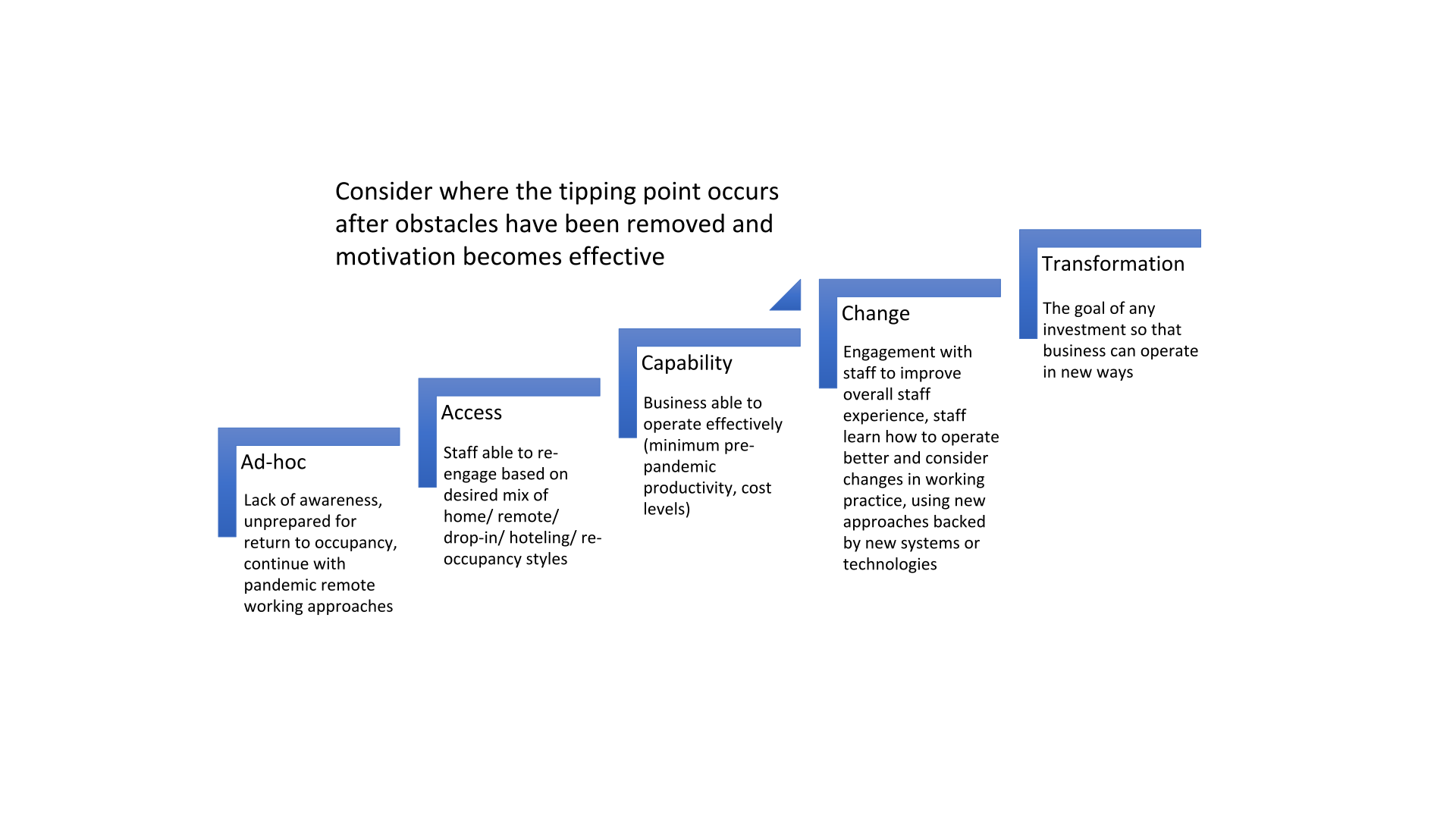
Numerous stages to reach the transformation goals and map proposed apps or solutions to those goals include:
Ad hoc: Lack of awareness, unprepared for return to occupancy, continue with pre-pandemic or temporary remote-working approaches.
-
Consider apps that address the uncertainty and fear of coming back to the office.
-
Access: Staff able to reengage or confirm desired mix of home/remote/drop-in/hoteling/reoccupancy styles; so far, the 3-2 plan seems popular with staff and managers alike
-
Consider app integration taking advantage of APIs to HR and building systems.
-
Take advantage of sensor and data collection to tell the success story (with numbers) to build stronger relationships.
-
Building on the success of the return to occupancy, demonstrate change capability highlighting the importance of the physical space.
Capability: The business can operate effectively again equaling or exceeding pre-pandemic productivity and cost levels.
Learning/Change: Engagement with staff to improve overall staff experience, staff learn how to operate better and consider changes in working practice, using new approaches backed by new systems or technologies.
People Change: Obstacle removal and motivation
FM should consider adopting a human-centered approach to change management and understand the mindset shifts that staff will undergo. To reach a tipping point one will need to address both obstacle removal and motivation:
 An audit of systems and capabilities can be used to ensure most obstacles (if not all) are addressed:
-
Is it safe to return – layout and distancing
-
Will colleagues be vaccinated – badges and tracing
-
Easy to book the right space
-
Ideation and relationship building from face-to-face collaboration and team working
As well as motivating factors:
-
Easy to book the right space
-
Ideation and relationship building from face-to-face collaboration and team working
Most people have heard of Maslow's Needs Hierarchy, which, as applied to workplace motivation, sought to explain individual employee motivation as a pyramid of needs. But there is more.. Frederick Herzberg's motivation theory and Alderfer’s ERG (existence, relatedness, growth) are adaptations of Maslow. Herzberg classified hygiene factors (supervision, interpersonal relations, poor workplace environment, as well as salary, benefits and rewards), which all de-motivate when not present “as well as motivation factors (achievement, advancement, recognition, responsibility),” which will work when present.
The tipping point occurs with a shift from hygiene (fear) to motivation (desire) when staff can see (again the importance of the physical space) that the hygiene factors have been addressed. Only then are staff open to motivating factors on a topic (a return to occupancy), which can drive the intrinsic value and satisfaction gained.
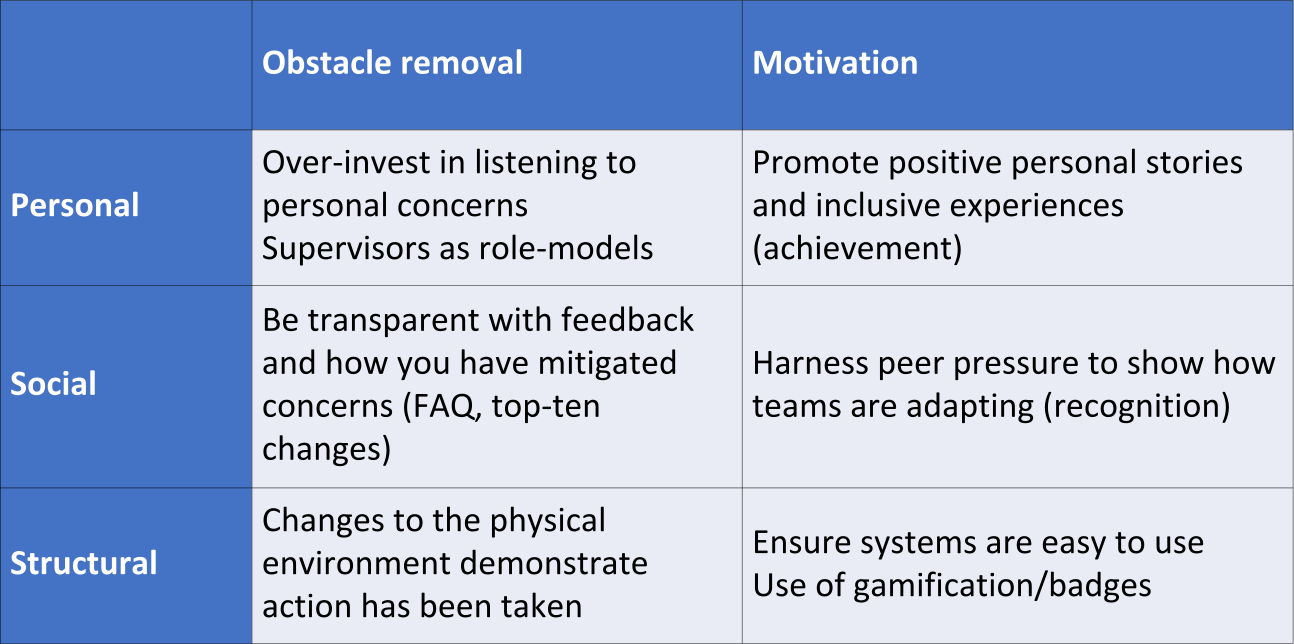
While many change frameworks include a step for motivation this vital smarts influence model covers all the bases. It is a holistic people-centric approach (with individual, social and systematic elements) that can be used to document both obstacle removal and motivation. FMs can use this to check off how they have addressed the obstacles, as no amount of motivation will succeed if they are not addressed in parallel.

Simon Davis is senior vice president of workplace technology at Impec Group, which encompasses agnostic technology consulting, provision of CAD and test fitting services and a technology accelerator to identify PropTech startups and help them grow quickly. As a recognized thought leader in real estate technology, he has almost 20 years of related experience and serves as event chair and strategic advisor to IFMA’s IT community and is part of the Workplace Evolutionaries (WE) Phoenix hub.

Martin Ruppe is a facility management consultant and workplace strategist with over 20 years of experience in digital transformation projects for leading financial institutions like Erste Group and UniCredit. As an active IFMA thought leader, he drives innovation in FM through global communities and thought leadership.
David Slight focuses on how to accelerate people-centric change across workplace, technical and business capabilities in large organizations. He works closely on client engagements with large organizations to ensure they realize value from change. Slight articulates the strategy and the execution of change, drawing on wide experience of business architecture, transformation, change management, business and IT alignment, governance processes, adoption and the early realization of benefit and value outcomes to the business.
References
-
Wakabayashi, Daisuke. “Google Delays Return to Office and Eyes 'Flexible Work Week'.” The New York Times, The New York Times, 14 Dec. 2020.
-
Kelly, Jack. “Salesforce Says '9-To-5 Workday Is Dead' And Employees Will Only Come Into The Office One To Three Days A Week.” Forbes, Forbes Magazine, 10 Feb. 2021, forbes.com/sites/jackkelly/2021/02/10/salesforce-says-9-to-5-workday-is-dead-and-employees-will-only-come-into-the-office-one-to-three-days-a-week
-
Westfall, Chris. “Facebook CEO Zuckerberg Offers Provocative New Viewpoint On The Future Of Work.” Forbes, Forbes Magazine, 8 Feb. 2021, forbes.com/sites/chriswestfall/2021/02/06/facebook-ceo-zuckerberg-offers-provocative-new-viewpoint-on-the-future-of-work/?sh=1e8f84274c6f
-
Flinders, Karl. “Tech-Enabled Hybrid Working Enables HSBC to Cut 40% of Its Global Office Space.” ComputerWeekly.com, ComputerWeekly.com, 25 Feb. 2021, computerweekly.com/news/252496927/Tech-enabled-hybrid-working-enables-HSBC-to-cut-40-of-its-global-office-space
-
“Amazon Plans Return to ‘Office-Centric Culture’ by Fall.” CBS News, CBS Interactive, 1 Apr. 2021, cbsnews.com/news/amazon-return-to-office-covid-19-pandemic/.
-
April 02, 2021 | By Andy Cohen This article was originally published on LinkedIn. “How FOMO Is Driving People Back to the Office: Dialogue Blog: Research & Insight.” Gensler, 2 Apr. 2021, gensler.com/blog/how-fomo-is-driving-people-back-to-the-office?
-
“Time Is the New Value.” October 16, 2017 BCS, bcs.org/content-hub/time-is-the-new-value/.
Read more on Facility Technology & Data Management , Workplace and Occupancy & Human Factors or related topics Facility Technology , Occupant Services , Occupant Health and Workplace Utilization
Explore All FMJ TopicsRelated articles
-

Artificial Intelligence in FM
The stakeholder’s perspectiveBy Dr. Jake Smithwick & Dr. Kenneth Sullivan & Nneka Ubi05.01.2024 -

Don’t Drop the Ball
How a CMMS can make or break an FM organization’s successBy Michael Carmean09.17.2024 -

Beware of Growing Cyberthreats
Why it’s time for stronger facility cybersecurityBy Andrew Harris & Eric Headington10.30.2024
