 Membership
 Network
 Regional Sites & Affiliates


 Events
 Participate
 Resources

 Training
 Credentials
 Government


 Content Channels
 Tools
Tools


 Business Overview





The BaseLINE Program
Validating the as-built design for occupant safety

A new project at the last leg of construction brings excitement to the end users. As project managers, contractors and designers have worked tirelessly to develop a new or renovated space, it is important to have another set of eyes review the space before it is turned over for occupancy. A short survey of industrial hygiene and safety indicators is an excellent method to determine if there are potential occupational or safety hazards in the early months of operation.
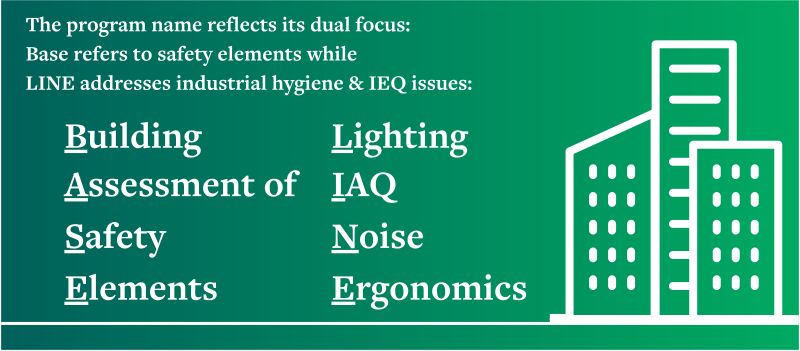
The BaseLINE program is the National Institutes of Health (NIH) approach for addressing hazardous conditions or building system deficiencies before occupancy. It is a systematic assessment to evaluate overall occupancy readiness between construction completion and occupancy. The survey combines elements of traditional building commissioning with comprehensive safety and industrial hygiene assessments to establish operational baselines before occupying a newly constructed or renovated space. The program name reflects its dual focus: “Base” refers to safety elements while “LINE” addresses industrial hygiene and indoor environmental quality (IEQ) issues:
 In the absence of a comprehensive safety assessment, engineers may participate in the design review of new construction and renovation projects, focusing on eliminating hazards through design or the installation of engineering controls. After occupancy, workplaces typically undergo an annual safety survey to identify hazards, with additional workplace safety and ergonomic issues addressed as they arise. But design drawings do not always match as-built conditions. Consequently, occupants may be exposed to hazards in a newly constructed or renovated space until the annual safety survey is completed.
The BaseLINE program addresses this gap by collecting baseline data on indoor environmental quality and safety conditions before personnel occupancy. This proactive approach allows for the evaluation and verification of safety systems, engineering controls and design features immediately after construction. By assessing building conditions prior to occupancy, organizations can commence facility operations with safety systems functioning at optimal performance.
The assessment is typically performed by industrial hygienists and safety professionals in coordination with facility managers, engineers and project personnel. The survey evaluates IEQ, ventilation performance, safety systems, ergonomic conditions and overall occupancy readiness.
The commissioning and occupancy of a new or renovated building represent critical opportunities to integrate necessary health and safety protections into both the physical and operational processes. Adopting such a systematic approach to building assessment, the BaseLINE program provides a structured framework for identifying and correcting industrial hygiene and safety deficiencies before occupying new or renovated building spaces. By integrating predictive industrial hygiene principles with commissioning and safety verification activities, BaseLINE supports safer occupancy, improved operational readiness and long-term facility performance.
To illustrate the value of the BaseLINE program, laboratories provide an ideal model environment because they incorporate many of the systems and safety features common to modern buildings, including ventilation, lighting, emergency eyewash stations and other engineered safety controls.
Laboratories are often designed to support cutting-edge research, accommodate advanced technologies, and expand institutional capabilities. However, the introduction of new equipment, materials and workflows also can bring uncertainty regarding potential occupational hazards. Unlike established laboratories, new facilities lack historical exposure data to chemical hazards, injury incident trends and operational baselines. This absence of empirical information increases the importance of predictive industrial hygiene and safety during the design, commissioning and early occupancy phases.
The American Industrial Hygiene Association (AIHA) defines industrial hygiene as the discipline dedicated to anticipating, recognizing, evaluating and controlling workplace conditions that may cause worker injury or illness. When applied during laboratory design and commissioning, industrial hygiene serves as a predictive framework capable of identifying hazards before occupancy and integrating effective controls into the laboratory’s physical and procedural infrastructure. Safety engineering follows a similar philosophy by emphasizing hazard elimination and risk reduction through design and system performance verification.
The role of industrial hygiene & safety engineering in lab environments
Laboratories present a unique combination of chemical, biological, physical and ergonomic hazards. These environments often involve:
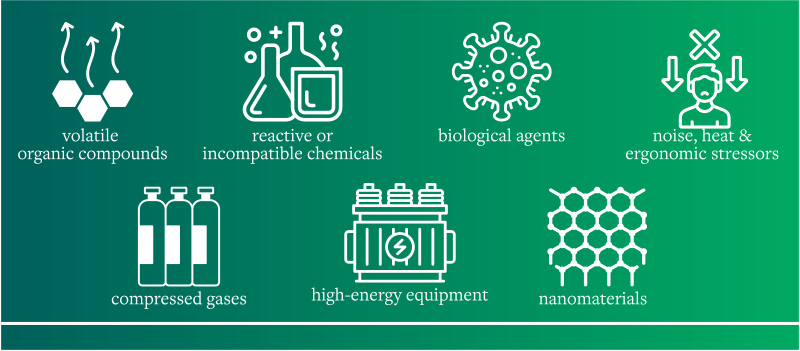 Industrial hygienists and safety engineers play a central role in helping to control these hazards through engineering systems, administrative policies and personal protective equipment (PPE). In new laboratories, the emphasis shifts toward anticipation, the first step in the industrial hygiene (IH) process.
Predictive value defined
Predictive value in IH and safety engineering refers to the ability to anticipate potential exposures, operational deficiencies and workplace hazards before laboratory activities begin. This predictive approach relies on hazard identification, exposure modeling to chemical hazards, risk assessment frameworks, engineering design review, benchmarking against established occupational safety standards, and professional judgment to evaluate how a laboratory is expected to function under anticipated operating conditions.
Because new laboratories lack historical exposure data, incident trends and operational experience, predictive assessment techniques play an important role during design and commissioning. These methods help identify hazards before they manifest, guide engineering control decisions, inform laboratory layout and workflow design, and support compliance with regulatory and consensus standards. Early identification of potential deficiencies can also reduce long-term operational costs by minimizing retrofits and operational disruptions while supporting the development of a strong safety culture from the beginning of occupancy.
Integrating safety & IH into the design phase
The design phase offers the greatest opportunity to enhance laboratory safety by eliminating hazards from the built environment. Decisions made during this stage affect the space’s ventilation design, equipment placement and chemical storage infrastructure. These considerations have long‑term implications for minimizing risk to occupants by controlling hazardous exposures.
Activities during design include:
-
reviewing architectural and mechanical drawings
-
evaluating ventilation systems (general and local exhaust)
-
assessing fume hood placement and quantity
-
identifying areas requiring specialized containment
-
ensuring adequate segregation of incompatible materials
-
anticipating noise, heat and ergonomic stressors
Indoor air quality characterization
Another important component of the BaseLINE assessment process involves characterizing IEQ and anticipated airborne exposures before laboratory operations begin. During the planning and commissioning phases, exposure modeling tools may be incorporated into the BaseLINE assessment process to estimate airborne concentrations of chemicals or particulates prior to active laboratory operations. These models consider:
-
emission rates
-
room dimensions
-
ventilation rates
-
task duration
-
worker proximity
This outcome of exposure monitoring helps support decisions about:
-
chemical fume hood placement
-
local exhaust ventilation needs
-
general ventilation rates
-
PPE requirements
Regulatory & consensus standards supporting safety engineering & IH
Predictive IH and safety aligns with numerous regulatory and consensus standards, including: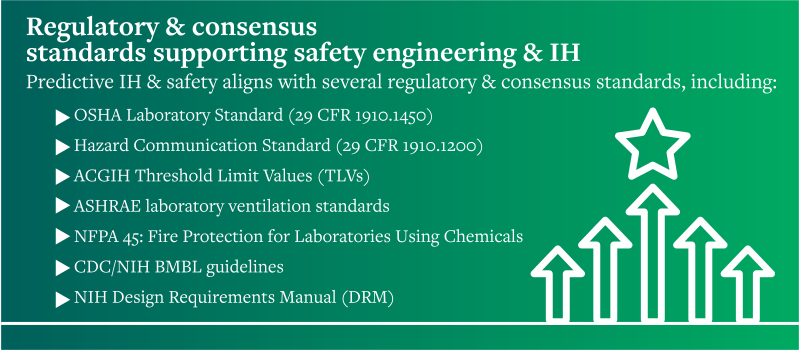
These standards define occupational exposure limits to chemicals, design requirements, and reference best practices that inform predictive assessments. Design and engineering decisions informed by these standards directly affect potential exposure to workplace hazards, operational efficiencies, emergency response capabilities and the long-term operational safety of the laboratory environment. In addition to chemical and biological hazards, BaseLINE assessments also consider physical and ergonomic conditions that may affect worker health, comfort and operational performance.
Physical & ergonomic hazard prediction
New laboratories may introduce physical and ergonomic stressors that can affect worker health, comfort and operational performance. Because these conditions are often influenced by equipment selection, workspace layout and anticipated work practices, they should be evaluated during the pre-occupancy assessment process. Common concerns include high-noise equipment, heat-generating instruments, repetitive motion tasks and awkward working postures that may contribute to fatigue or musculoskeletal strain over time.
Ventilation assessment tools
Ventilation performance is a major aspect of the BaseLINE process because it directly influences the concentration of contaminants in the room air. Assessment tools may include airflow modeling, temperature and humidity measurements, and chemical fume hood performance predictions to evaluate whether ventilation systems can support anticipated laboratory activities. These predictive tools help determine whether ventilation systems have capacity to meet the demands of the planned research environment.
While predictive modeling and design review provide important insights, system performance must also be verified under actual operating conditions before personnel occupy the laboratory.
Commissioning & verification tools
Commissioning and verification activities confirm that engineering systems perform as intended and meet established design criteria. By comparing actual system performance with design expectations, these activities provide assurance that engineering controls will effectively support safe laboratory operations upon occupancy. Common verification methods include:
-
ventilation testing
-
hood face velocity measurements
-
pressure differential verification
Challenges & limitations of IH & safety engineering
Like other disciplines of science, the reliability of the assessment is limited by the precision of the data collected. Measurement errors associated with IH measurements include:
-
uncertainty in input data
-
variability in worker behavior
-
understanding complex laboratory processes
-
limitations of exposure models due to input variables
-
changes in research scope over time where new hazards are introduced into the laboratory
For this reason, predictive IH and safety assessments should be supplemented with ongoing monitoring, periodic reassessment and operational feedback after occupancy to ensure that controls remain effective as laboratory activities evolve.
Engage IH & safety engineers early
Corrective actions identified during pre-occupancy assessments can be implemented before personnel occupy the space, reducing long-term operational risk, minimizing disruption to research activities and avoiding costly retrofits. For this reason, it is important for FMs to engage IH and safety professionals during conceptual design phase of the project, not after construction.
Findings from initial BaseLINE studies
For the studies using the BaseLINE survey technique, issues of concern have been identified and resolved before occupancy. Remediation of these deficiencies improved operational readiness and reduced the likelihood of early occupant exposures to hazardous agents. Additionally, the findings have contributed to acceptable IEQ, which may not have an immediate health effect on the occupants but is known to affect productivity.
An example of findings discovered through the BaseLINE assessment include:
Industrial hygiene:
-
Ambient air temperature exceeding comfort guidelines
-
Lighting levels not meeting the recommended illumination levels
Safety elements
-
Flammable cabinet wall mounted above eye level
-
Laboratory pressurization not negative to the corridor
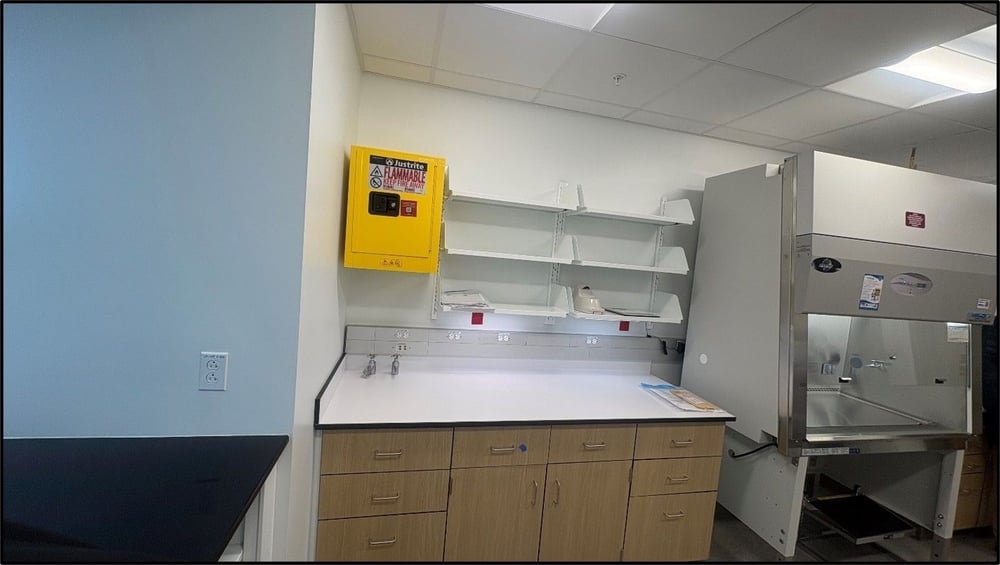 Figure 1: Lab features assessed during a BaseLINE survey of a new cell culture room included the position of the wall mounted flammable cabinet, shelving, a biological safety cabinet, the casework and countertop.
Conclusion
Industrial hygiene and safety engineering are essential to ensuring that new laboratories are compliant with safety regulations and operationally efficient before occupied by the end users.
 As laboratory environments become increasingly complex, predictive IH and safety engineering will remain a cornerstone of effective occupational health and safety management.

Roy Deitchman is a senior industrial hygienist working for CSS, Inc. at the National Institutes of Health (NIH). He has an S.M. degree in environmental health from the Harvard Chan School of Public Health and a J.D. degree from New York Law School. He previously served as the Vice President – Environmental Health and Safety at Amtrak.

Yassin Drammeh is a former biocontainment safety engineer who focused on keeping laboratory and adjacent administrative areas HVAC systems safe for occupancy. Through a mechanical engineering background and respective safety experience, she measured and verified air pressurization to keep contaminants within the primary and secondary barriers. Additionally, Drammeh worked to ensure new constructions and renovations included proper engineering controls to effectively isolate users from potential hazards.

Capt. Derek Newcomer is a commissioned officer in the United States Public Health Service detailed to the National Institutes of Health (NIH), where he serves as Deputy Director of the Division of Safety, Office of Research Services. The Division acts as the agency’s principal advocate and advisor for worker safety, providing technical expertise and guidance across a broad range of occupational safety and health issues, including support for water intrusion and related environmental hazard response projects.

Scott Robbins, is the vice president of Safety & Health for CSS-Inc. supporting the National Institutes of Health Division of Safety. He supports facilities by evaluating indoor air quality, engineering controls and conducting chemical exposure and physical hazard assessments. Robbins holds a master's of Science in Public Health in Industrial Hygiene and is a Certified Industrial hygienist, Certified Safety Professional and Project Management Professional.
References
-
AIHA. (2015). A Strategy for Assessing and Managing Occupational Exposures (4th ed.). American Industrial Hygiene Association.
-
ASHRAE. (2019). Laboratory Ventilation Standard 110. American Society of Heating, Refrigerating and Air‑Conditioning Engineers.
-
CDC & NIH. (2020). Biosafety in Microbiological and Biomedical Laboratories (6th ed.).
-
NFPA. (2019). NFPA 45: Standard on Fire Protection for Laboratories Using Chemicals. National Fire Protection Association.
-
NIOSH. (2009). Qualitative Risk Characterization and Management.
-
NIOSH. (2015). Hierarchy of Controls.
-
NIOSH. (2016). Occupational Exposure Modeling Tools.
-
OSHA. (2012). Job Hazard Analysis (OSHA 3071).
-
OSHA. (29 CFR 1910.1200). Hazard Communication Standard.
-
OSHA. (29 CFR 1910.1450). Occupational Exposure to Hazardous Chemicals in Laboratories.
The authors thank Diego Osorio Sanchez and Nicolo Gilozzi of the NIH Division of Safety for their support of the NIH BaseLINE Project.
Read more on Facility Operations and Risk Management or related topics Occupant Health and Operations and Maintenance Planning
Explore All FMJ Topics