
 Membership
 Network
 Regional Sites & Affiliates


 Events
 Participate
 Resources

 Training
 Credentials
 Government


 Content Channels
 Tools
Tools


 Business Overview





The Cascade
How top-down AI rollouts are failing FM teams

Like every other industry over the last five years, facility management has not been spared the barrage of new AI tools and functionalities promising to move everyone toward a better working life. Predictive maintenance, intricate computerized maintenance management system (CMMS) integrations, building analytics layered on top of building automation system (BAS) data: heavens were promised. With costs now a meaningful line item in technology budgets, many technology leaders in the FM space are assessing whether AI has lived up to its hype against productivity and other organizational goals.
Unlike previous software waves, AI has proven it is here to stay.
 Many directors and leaders deployed tools, set mandates and developed AI-use policies to drive adoption, sometimes without tying any of it to specific business outcomes. AI capability in FM tools is not new, but the arrival of large language models (LLMs) and conversational interfaces ushered in something categorically different: more sophisticated building analytics, more capable fault detection and work order automation that can reason across data rather than just flag thresholds.
FM sits on some of the most granular operational data in any organization, from maintenance histories to space utilization records. It has been a persistent failure to connect that data to how work actually gets done, and that failure is exactly what top-down AI rollouts repeat. A research report from the IFMA IT Community and Autodesk found that operations bear 68 percent of the costs of poor data interoperability.
 Top-down rollout models that ignore how work actually happens are among the most common culprits. The failures that follow tend to build on each other.
3 mistakes that cascade into each other
In FM work, the day is defined by interruptions: alarms, comfort complaints, safety tasks, vendor coordination and the steady drumbeat of work orders. Any new tool must earn a role inside that continuous yet disjointed cadence. When it does not, three mistakes tend to follow each other in sequence.
1. The fear frame
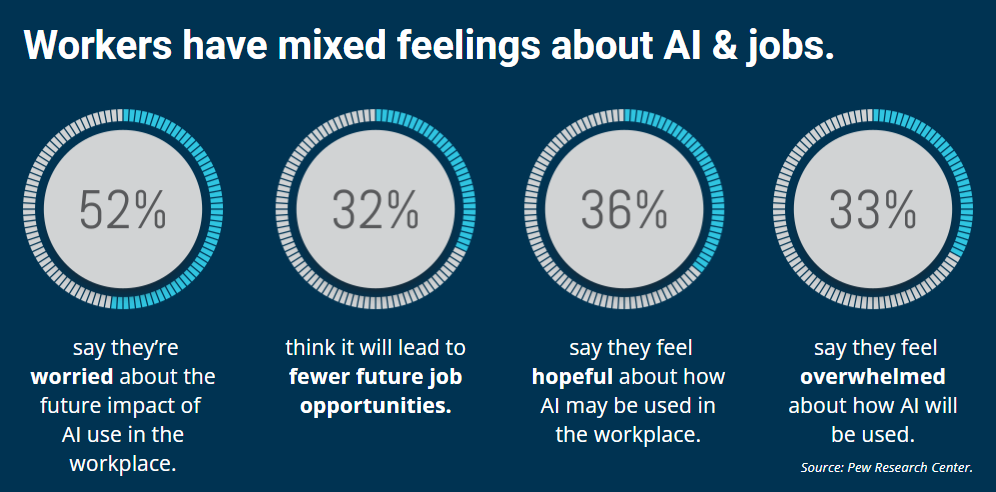
AI is typically introduced using efficiency language that leadership perceives as value neutral. FM teams often hear something else, specifically a headcount conversation. Pew Research Center found that 52 percent of workers surveyed are worried about the future impact of AI in the workplace, a concern reflected in workforce surveys across multiple countries. A Reuters/Ipsos poll found 71 percent concerned that AI will put too many people out of work permanently. In FM, that anxiety has a particular texture. A technician who suspects a new system is measuring their productivity is not going to volunteer that the data it is pulling is incomplete, that the alarm thresholds are wrong or that the workflow it is automating does not match how the job actually gets done. In FM specifically, that fear suppresses the exact behaviors a successful rollout needs most: reporting edge cases flagging bad data, and asking basic questions early. Researcher Amy Edmondson’s work on psychological safety links the belief that a team is safe for interpersonal risk-taking directly to the learning behaviors that drive performance improvement. When technicians believe a rollout is primarily about oversight, the safest move is to keep real decision-making off-system, and the organization loses the feedback loop it needs to improve the tool.
 2. The last mile problem
The goals that drive AI rollouts are usually legitimate: cost reduction, faster response times, better asset utilization. Leaders bear accountability for those outcomes, and setting goals is appropriate for their role. The breakdown tends to happen in translation. By the time a boardroom objective becomes a training module and a policy mandate, the connection to what changes for a technician on a Tuesday morning has often been lost. Training tends to focus on features, showing people how to navigate a platform rather than how it helps close out a work order faster. That gap is exactly where workarounds emerge. Research on enterprise system workarounds describes them as goal-driven adaptations, meaning ways to bypass obstacles that prevent people from achieving outcomes they see as essential.
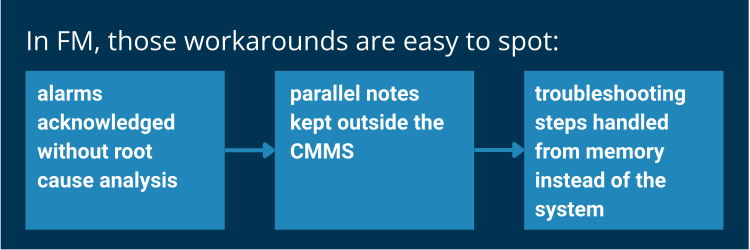
BAS/BMS programs generate a flood of threshold alarms; NYSERDA has noted that the volume can overwhelm staff, leading some to acknowledge or deactivate alarms without troubleshooting root cause. If an AI layer simply adds more alerts, technicians will comply with whatever is audited and use their own judgment everywhere else.
3. No safe space to explore
Organizations expect technicians to build fluency with new AI tools in production, under performance pressure, with no protected time to practice. Microsoft’s Work Trend Index research found that regular experimentation is the strongest predictor of advanced, high-frequency AI use. Remove the chance to experiment safely, and the most reliable pathway to fluency disappears with it.
What FM teams are already doing
Top-down rollouts tend to miss a quieter reality: many FM professionals are already building personal AI habits outside official systems. Microsoft and LinkedIn data shows that 78 percent of AI users bring their own tools to work, which means these tools are not provided or sanctioned by their organization. Gartner’s 2025 research adds the governance concern, projecting a growing risk of security and compliance incidents tied to what it calls shadow AI.
Informal AI uses clusters around friction. Pew found that common uses include research, editing and drafting, which in FM operations, mapping cleanly to summarize shift logs and drafting closeout notes, turning a messy equipment history into a readable narrative, or finding the right procedure buried in a long operations and maintenance (O&M) manual. The IFMA IT Community and Autodesk research report found many operators spending between one to three hours per day searching for the right information. When organizations ignore the informal AI use that is already happening, they miss the best roadmap available, which is what the team is already trying to fix.
 A workflow-first alternative
A workflow-first adoption model starts where most experienced FM leaders already know to start: with the work itself, not a representation of it. The alternative to top-down deployment is to map real workflows with the technicians and operators who execute them, identify friction and then a narrow AI deployment to remove specific pain points so that adoption becomes a pull, not a push.
FM already has a useful template for this in life cycle data handover. The IFMA IT Community and Autodesk report contrasts good handover, where facility operators help determine data requirements and continuously verify data, against bad handover, wherein limited involvement produces limited trust and poor operational readiness. The same principle applies to AI: if the people doing the work do not help define what “good” looks like, they will not trust the outputs enough to act on them. Workflow-first adoption runs as a short, repeatable cycle: map the work as-is, identify friction, pilot a narrowly scoped AI assist that removes it, then iterate based on technician feedback.
Predictive maintenance illustrates the point. Adoption becomes natural only when alerts connect to real constraints including planned downtime, parts availability and the crew’s calendar, not just a dashboard graph that nobody asked for. Building analytics and fault detection and diagnostics (FDD) offer a second example. NYSERDA emphasizes that helping operators diagnose root cause quickly is where FDD genuinely improves on simple BAS/BMS alarming. A workflow-first pilot starts by reducing noise, standardizing the handoff into the CMMS, and giving technicians a next checks checklist that matches how troubleshooting actually happens on the floor.
The case for a sandbox
For organizations with the resources to invest, a dedicated AI sandbox is one of the highest-value steps available. Building one properly requires real commitments: infrastructure, time to stand it up, and ongoing coaching and peer sharing. Those costs must be weighed against the alternative of scaling a failed rollout across a portfolio. Research on AI experimentation sandboxes from the California Management Review argues that AI does not fail because the technology is not ready, but because enterprise structures are not. A sandbox is one way to build that structure deliberately.
Where resources allow, a sandbox should be designed like a controlled commissioning environment, ringfenced from production systems, tied to real operational tasks and used as the governed answer to shadow AI. The result gives technicians a place to explore value without exporting sensitive data to consumer tools. RAND’s analysis of AI project failures points to the root causes a sandbox is built to catch: misunderstanding the problem to be solved, optimizing the wrong metrics and deploying solutions that do not fit actual workflows. Catching those mismatches before they scale is where the investment pays back.
 Putting it into practice
-
Document a workflow library before deploying any new tool. Work with technicians and operators to capture how work actually gets done, including the informal coordination that never makes it into a process map. This becomes the foundation every AI pilot should be measured against.
-
Understand how the team is already using AI, including outside work. Before setting policy, learn what people are already doing with tools they found on their own. The gap between sanctioned systems and actual behavior is where the real adoption roadmap lives.
-
Identify high-friction periodic tasks as the first deployment targets. Use the workflow library to surface activities that are time-consuming, repetitive and rules based. Shift log summarization, closeout documentation and procedure lookup are common starting points that deliver visible value quickly.
-
Find the power users and build a sharing mechanism around them. Every team has someone who has figured something out. Identify those people early, run structured experiments with them and create a lightweight method to share what works across functions before it stays siloed.
-
Build user personas and keep revisiting them. Different roles experience AI friction differently. A persona for the technician on the floor, the supervisor triaging work orders and the director pulling reports will surface different needs and different barriers. Revisit them as both the tools and the team evolve.
 Closing the gap
Closing the gap between boardroom intent and floor-level reality is a design problem: how tools, data, training and governance are structured around the work rather than around the organizational chart.
McKinsey’s 2025 AI in the Workplace report found that while nearly all companies are investing in AI, only 1 percent describe themselves as mature, and the firm argues the biggest barrier is not employees but leaders who are not steering fast enough. In FM, that steering looks less like a bigger mandate and more like three deliberate choices: a fear-aware message when introducing the tools, workflow-first design that starts with real friction, and a sandbox where teams can learn without penalty.
The most successful AI transformations will be the ones that give their facilities workforce the most agency in figuring out how those tools actually fit into the work. The organizations that succeed will not be the ones that deploy more AI. They will be the ones that deploy it closer to the work.

Marcus Elendu is a technical program manager and analytics practitioner specializing in enterprise workplace systems and Integrated Facilities Management technology. He has spent his career at the intersection of facilities operations and data, leading the implementation and management of analytics platforms, automation initiatives and workplace technology stacks for global IFM teams.
References
Top image via Getty Images.
Read more on Facility Technology & Data Management or related topics Facility Technology and Data strategy and information management
Explore All FMJ TopicsRelated articles
-

Artificial Intelligence in FM
The stakeholder’s perspectiveBy Dr. Jake Smithwick & Dr. Kenneth Sullivan & Nneka Ubi05.01.2024 -

Don’t Drop the Ball
How a CMMS can make or break an FM organization’s successBy Michael Carmean09.17.2024 -

Beware of Growing Cyberthreats
Why it’s time for stronger facility cybersecurityBy Andrew Harris & Eric Headington10.30.2024
