
 Membership
 Network
 Regional Sites & Affiliates


 Events
 Participate
 Resources

 Training
 Credentials
 Government


 Content Channels
 Tools
Tools


 Business Overview




The CMMS Dilemma
Turning a software purchase into a sustainable FM platform

A computerized maintenance management system (CMMS) promises a more organized approach to facility operations. Work orders can be assigned and tracked, preventive maintenance can be scheduled, equipment histories can be retained, and performance information can support operational and capital planning.
The reality is more complicated.
A CMMS may be purchased with considerable optimism, introduced through demonstrations and training and populated with at least part of the facility’s equipment inventory. Work orders begin moving through the system, technicians receive assignments electronically, and management gains access to new reports and dashboards.
Then employees leave, equipment is replaced, operating priorities change and new technicians join the department. Asset records become outdated, preventive maintenance procedures no longer match field conditions, and work orders are closed with limited information. Spreadsheets, notebooks and email begin reappearing as parallel maintenance systems.
The CMMS may still be operational, but it is no longer the reliable source of facility information it was intended to become.
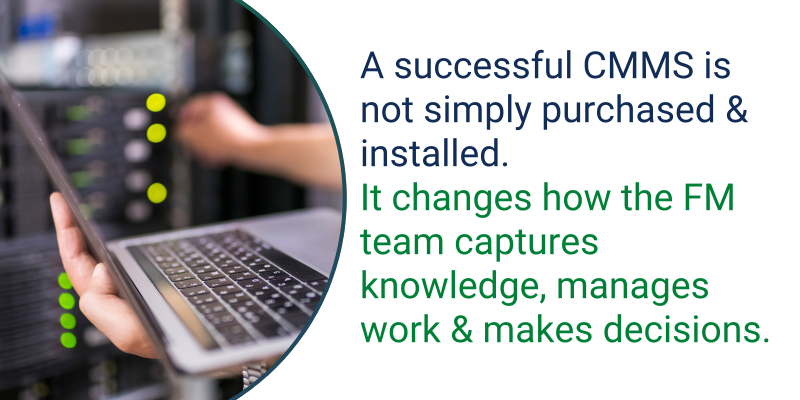
The dilemma is not whether CMMS technology has value. It does. The greater challenge is creating the departmental structure, staff participation and continuing oversight required to sustain that value.
Select for the facility, not the demonstration
A polished software demonstration can make almost any system appear intuitive. The sample equipment records are complete, the work orders follow a predictable path, and performance reports appear almost instantly.
Actual facilities are rarely that orderly.
The appropriate system depends on the organization’s operating environment, workforce and level of risk.
-
A hospital or laboratory may require detailed inspection records, calibration histories, compliance documentation and tightly controlled maintenance procedures.
-
A hotel may place greater emphasis on guest requests, room-level tracking, mobile communication and response time.
-
Manufacturing facilities may require production equipment integration, spare-parts management and reliability analysis.
-
Commercial property portfolios may focus on tenant service, vendor management and reporting across multiple locations.
 Staff size and capability are equally important. A highly configurable enterprise platform may be appropriate for a large, multisite engineering organization with dedicated administrative support. The same platform may overwhelm a smaller facility team that needs straightforward work-order management and preventive maintenance scheduling.
Selection should begin with clearly defined operational requirements, including facility and asset counts, user roles, regulatory obligations, mobile access, contractor participation, reporting needs, integration requirements and available administrative support.
Requirements should be divided between essential functions and desirable features. Additional capability frequently adds cost, complexity and training requirements.
A function that appears impressive during a demonstration offers little value when the FM team lacks the need, information or resources to use it.
The technician’s experience should receive as much attention as the management dashboard. Technicians may need to receive assignments, locate assets, review previous repairs, record labor and materials, attach photographs and close work orders while standing in a mechanical room. If those tasks require excessive navigation or duplicate data entry, adoption will suffer.
Mobile access should therefore be evaluated during selection, not after purchase. Tablets and smartphones can connect technicians directly to equipment records through barcodes or quick-response codes. The interface should be tested under realistic field conditions, including spaces where connectivity may be limited.
IT must be part of the partnership
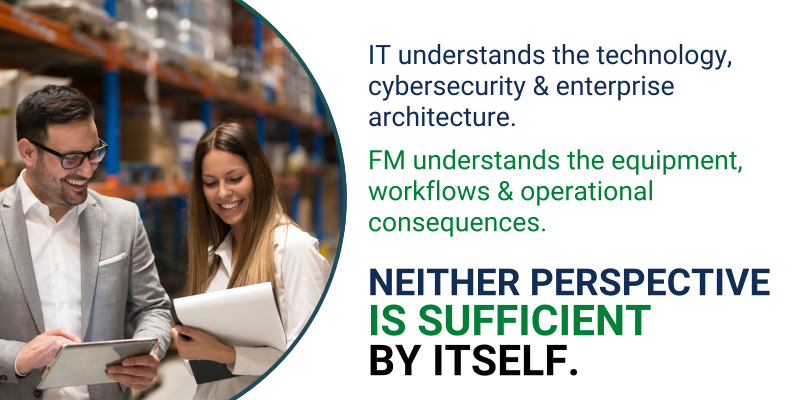
CMMS selection is often led by the FM department, but it should not be completed by that team alone.
Many contemporary platforms are delivered through software as a service (SaaS), in which the application is hosted by the provider and accessed through the internet. Even when the software does not reside on the organization’s internal servers, it may connect with company networks, mobile devices, employee directories, purchasing platforms, financial systems, building automation systems and other operational technology.
The IT department should therefore become an early partner in the selection and implementation process. IT participation may be required to evaluate network compatibility, user authentication, cybersecurity, cloud hosting, data storage, backups, software updates, integrations and data ownership.
Access by consultants, contractors, software providers and other outside parties should also be addressed before implementation. Permissions should be limited to the information required for the assignment, and responsibility for approving, monitoring and removing access should be clear.
 Implementation begins before data collection
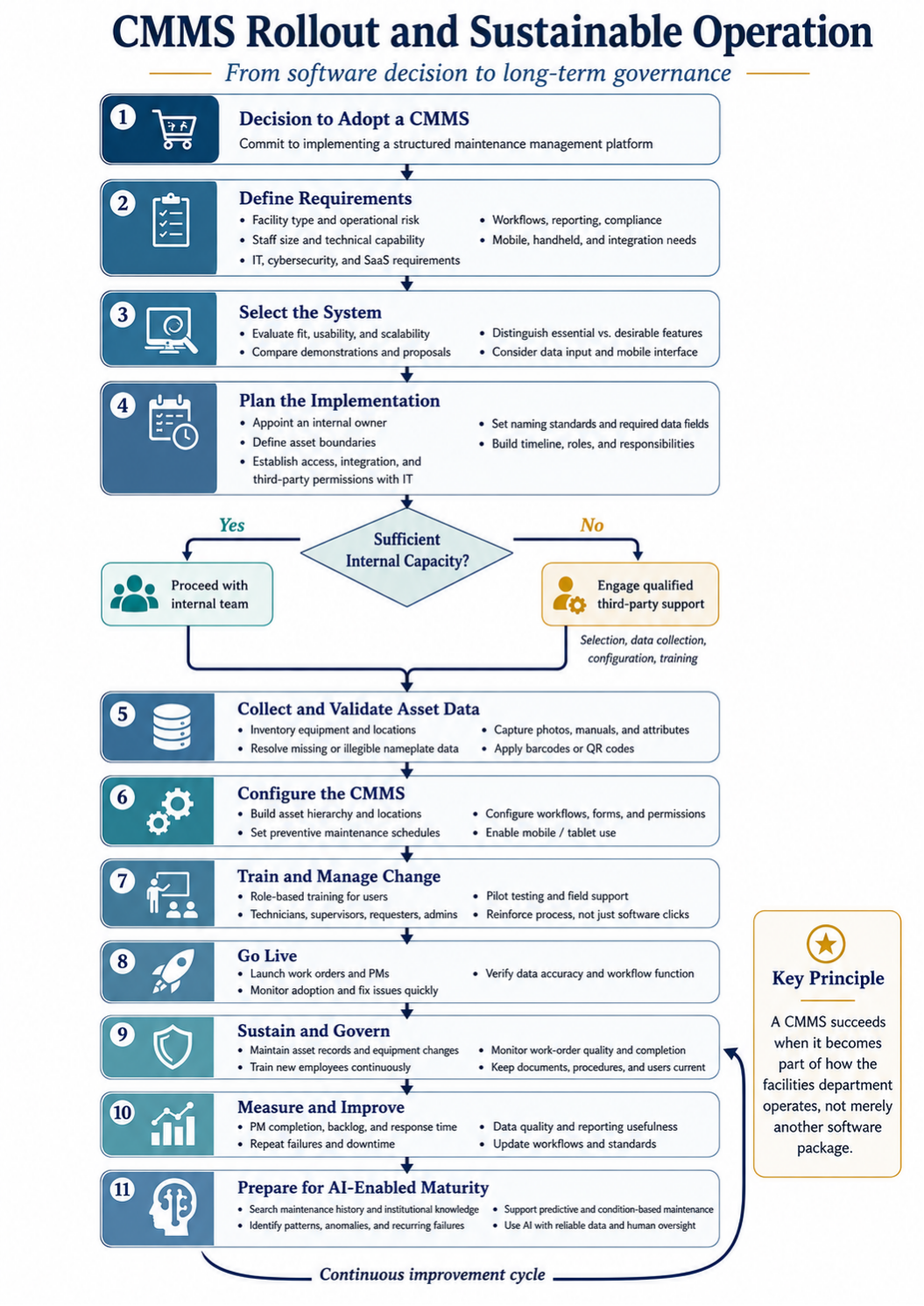
Implementation is sometimes treated as the period between signing the software agreement and activating the application. In practice, it begins when the organization defines how the FM department will operate within the system.
Several decisions must be made before large quantities of information are entered. The organization must determine how requests will enter the system, who will prioritize them, how work will be assigned, what technicians must record, when a work order is complete, and who may add, modify or retire equipment records.
The organization must also establish its asset hierarchy, naming standards, location structure and minimum data requirements.
One of the most consequential decisions is determining where the asset inventory begins and ends. A facility may contain thousands of physical components, but not every component requires an individual record.
Major mechanical, electrical, plumbing and life-safety equipment will generally be included. The organization must then decide whether to track doors, plumbing fixtures, kitchen equipment, architectural components, furniture, specialty equipment and other assets.
The decision should be based on maintenance responsibility, operational risk, inspection requirements and the usefulness of retaining a separate history. Attempting to catalogue every object may produce a database too large to maintain. Drawing the boundary too narrowly may prevent the CMMS from supporting preventive maintenance, compliance and capital planning.
Data collection is a technical undertaking
Asset collection is frequently one of the most time-consuming parts of implementation.
Useful records may include equipment type, location, manufacturer, model, serial number, capacity, electrical characteristics, installation date, warranty status, maintenance responsibility, condition and preventive maintenance requirements. Photographs, manuals and drawings may also be associated with the asset.
Existing information is rarely located in one place. It may be distributed among spreadsheets, drawings, equipment manuals, purchase records, maintenance logs and the knowledge of experienced employees.
Field conditions create additional complications. Nameplates may be painted over, corroded, illegible or missing. Original or as-built drawings may no longer reflect actual installations. Equipment may have been modified, relocated or replaced without corresponding documentation.
Standards must be established for incomplete information. An estimated installation date should be identified as an estimate. Equipment without a visible serial number may require an internally assigned identification number. Unknown information should not be replaced by unsupported assumptions merely to complete a field.
Barcodes and quick-response codes can connect physical equipment to the electronic record. Labels should be durable, consistently positioned and appropriate for the environment. Scanning should provide access to useful information, including maintenance history, procedures, manuals and open work orders.
When third-party support makes sense
Facility engineers and technicians may be the people most qualified to identify equipment, but they are also responsible for keeping the facility operating. Removing them from preventive maintenance, corrective work and emergency response for an extended inventory can create more operational problems.
Large campuses, complex facilities and multibuilding portfolios may not have the internal capacity to complete selection and implementation within a reasonable period. A prolonged process can also create inconsistencies as personnel and priorities change.
Qualified third-party support may assist with development, procurement documents, platform evaluation, asset hierarchies, field data collection, data validation, workflow configuration, training and post-implementation reviews.
Asset collection should not be treated solely as clerical data entry. Personnel collecting information from mechanical and electrical systems should understand the equipment, how it relates to the facility, and whether it warrants a separate maintainable asset record.
External support should supplement internal knowledge rather than replace it. FM personnel must remain involved in defining requirements, resolving technical questions and validating the system. The engagement should also provide for an orderly transfer of knowledge so the organization can manage the CMMS after implementation support ends.
Training means changing the work process
Software training explains which buttons to select. Operational training explains how the department will manage maintenance.
Users must understand how requests are submitted, how priorities are established, what information belongs in a work order, how emergency repairs are recorded and how equipment changes are reported. Training should also explain why the information matters.
The requirements vary by role.
-
Technicians need realistic field exercises involving actual assets and work orders.
-
Supervisors need to understand scheduling, backlog management, work quality and reporting.
-
Administrators require deeper knowledge of asset records, user permissions, preventive maintenance schedules and system configuration.
-
Senior leaders need reports that connect maintenance activity with risk, staffing, budgeting and capital planning.
A single classroom session is not sufficient. Initial instruction should be followed by field support, refresher training and reinforcement by supervisors. New employees require structured onboarding, particularly as experienced personnel leave and institutional knowledge is lost.
The system needs a permanent owner
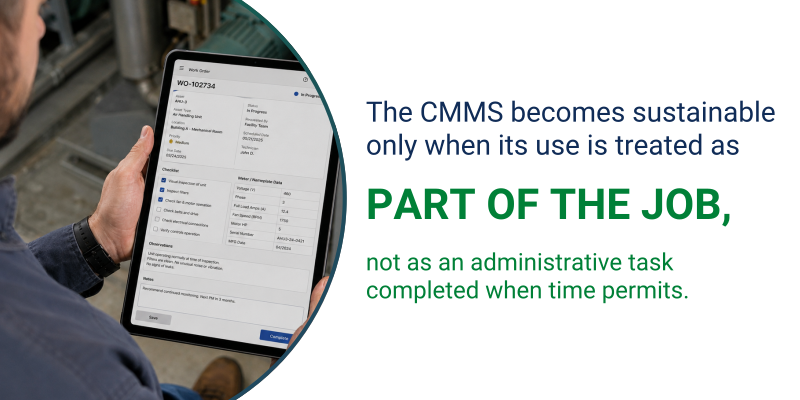
A CMMS requires a designated owner after implementation.
The title may be CMMS administrator, maintenance planner, facilities coordinator, supervisor or facilities analyst. The title matters less than the authority, time and accountability assigned to the responsibility.
Ongoing duties include adding new equipment, archiving retired assets, maintaining naming standards, reviewing work-order completeness, updating preventive maintenance procedures, managing users with IT, training employees, maintaining records, reviewing software updates and conducting periodic database audits.
Without this oversight, the database gradually separates from the physical facility. Reports become less credible, preventive maintenance schedules become unreliable, and users begin maintaining information outside the system.
Management also influences sustainability. When facility leaders rely on CMMS information for staffing, budgeting and capital decisions, employees have a reason to keep the system accurate. When management ignores the information, disciplined use becomes more difficult to enforce.
Preparing the CMMS for AI
AI is expanding the capabilities associated with maintenance management. Potential applications include analyzing equipment-condition data, identifying patterns that may precede failure, classifying maintenance requests, retrieving repair histories and highlighting inconsistencies in asset records.
AI may also help preserve institutional knowledge. A technician or supervisor could search years of maintenance records using ordinary language, locate previous repairs, identify recurring failures or retrieve procedures associated with a particular asset. This becomes increasingly useful as experienced employees retire and new personnel join the organization.
Predictive maintenance is another developing application. Sensor information involving vibration, temperature, pressure, energy use or operating hours may be analyzed to identify emerging equipment problems. Maintenance can then be planned according to asset condition rather than relying exclusively on calendar-based intervals.
Analysis based on incomplete equipment histories, inconsistent failure codes or poor work-order closeouts may produce results that appear authoritative but are operationally incorrect. AI cannot know that a pump, chiller or electrical panel was replaced unless the change was documented or communicated through a connected system.
AI capabilities should therefore be considered during CMMS selection, even when immediate use is not planned. Questions should address data access, integration, human review, cybersecurity, vendor claims and ownership of the information used by AI tools.
A qualified third party may assist with evaluating these capabilities, separating practical functionality from marketing language and helping the organization establish an appropriate pilot and governance structure. The purpose should be to support facility judgment, not replace it.
From purchase to sustainable operation
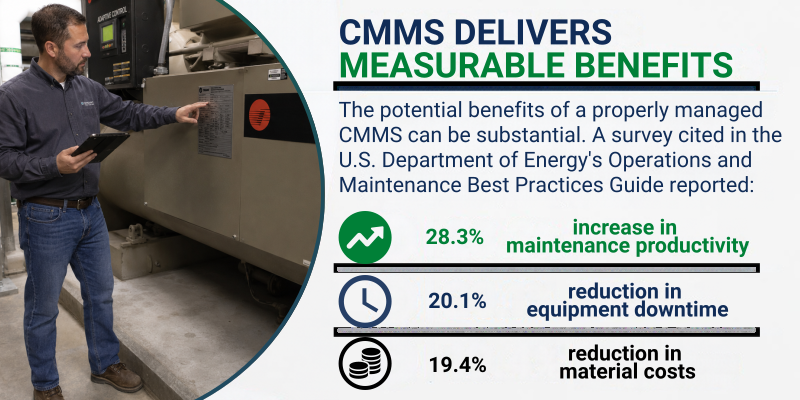 The potential benefits of a properly managed CMMS can be substantial. A survey cited in the U.S. Department of Energy’s Operations and Maintenance Best Practices Guide reported an average 28.3 percent increase in maintenance productivity, a 20.1 percent reduction in equipment downtime, and a 19.4 percent reduction in material costs following CMMS implementation.
The underlying survey is dated and should not be treated as a current universal benchmark. It nevertheless illustrates the scale of improvement that structured work management and reliable maintenance information can support.
A CMMS is not a one-time information technology project. It is an operating platform for the facilities department.
Selection determines whether the system fits the organization. IT partnership determines whether it can operate securely within the broader technology environment.
Implementation determines whether the database and workflows reflect actual facility conditions. Training determines whether the workforce adopts the process. Long-term ownership determines whether the information remains useful as personnel, equipment and buildings change.
AI may extend the system’s capabilities, but it cannot correct years of poor information or inconsistent use.
A CMMS succeeds when it becomes part of the way the facilities department operates, not merely another software package the organization owns.

John J. Lembo, CFM, LEED AP, is managing principal of The Navitas Group, an owner-side facilities and energy management consultancy that helps organizations make informed decisions regarding infrastructure, capital planning, operations, sustainability, compliance and technology. Over a career spanning nearly four decades, he has held senior leadership roles in facilities, engineering, construction, energy, and asset management across hospitality, health care, senior living, commercial real estate and other complex built environments. He is also the author of So You Want to Be a Consultant: Hard Truths, Real Tools and the no-BS Road to Consulting Success, which draws upon his experience as an executive, advisor, and consultant. Lembo serves as vice president of Professional Development for IFMA Greater New York and contributes to the advancement of the FM profession through writing, speaking, mentoring and industry education.
References
Top image via Getty Images. Article images via the author & Getty Images.
Read more on Facility Technology & Data Management , Communication and Facility Operations or related topics Information Technology , Facility Technology , Communication Management , Team Management and Operational and Capital Budgeting
Explore All FMJ TopicsRelated articles
-

Artificial Intelligence in FM
The stakeholder’s perspectiveBy Dr. Jake Smithwick & Dr. Kenneth Sullivan & Nneka Ubi05.01.2024 -

Don’t Drop the Ball
How a CMMS can make or break an FM organization’s successBy Michael Carmean09.17.2024 -

Beware of Growing Cyberthreats
Why it’s time for stronger facility cybersecurityBy Andrew Harris & Eric Headington10.30.2024