
 Membership
 Network
 Regional Sites & Affiliates


 Events
 Participate
 Resources

 Training
 Credentials
 Government


 Content Channels
 Tools
Tools


 Business Overview





The Human-AI Partnership
Why FM’s future is about augmentation, not automation

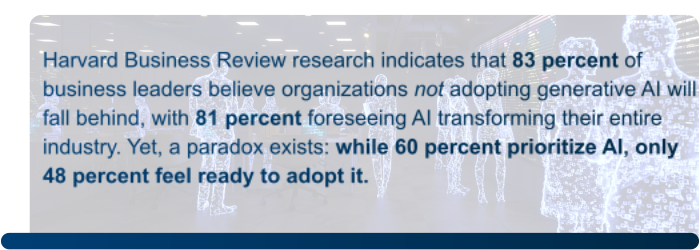 This readiness gap stems from a fundamental misunderstanding of AI's role in FM. The pertinent question is not whether AI will replace facility professionals, but how it will amplify their expertise and strategic impact globally. Modern AI tools are already enabling standards-based assessments, revolutionizing asset data capture and providing actionable insights through advanced thermal image analysis, all while ensuring human judgment remains central.
Beyond the hype: AI's true contribution to FM
Successful AI implementations in facility management prioritize eliminating administrative burdens, freeing professionals to apply their expertise strategically.
Consider traditional facility condition assessments. A seasoned FM might spend 2-3 hours documenting conditions in a moderately sized space, followed by 4-6 hours transforming notes into a structured report. This is valuable expertise consumed by data entry, not critical thinking.
AI-powered assessment tools fundamentally shift this dynamic. Professionals can capture comprehensive visual data in minutes, then focus on uniquely human strengths: interpreting findings, making strategic decisions and fostering stakeholder relationships. These solutions are not futuristic concepts; they are actively deployed today, delivering tangible benefits.
The augmentation advantage: Synergizing human & AI capabilities
Effective AI implementations establish a clear division of labor, maximizing both technological efficiency and human insight:
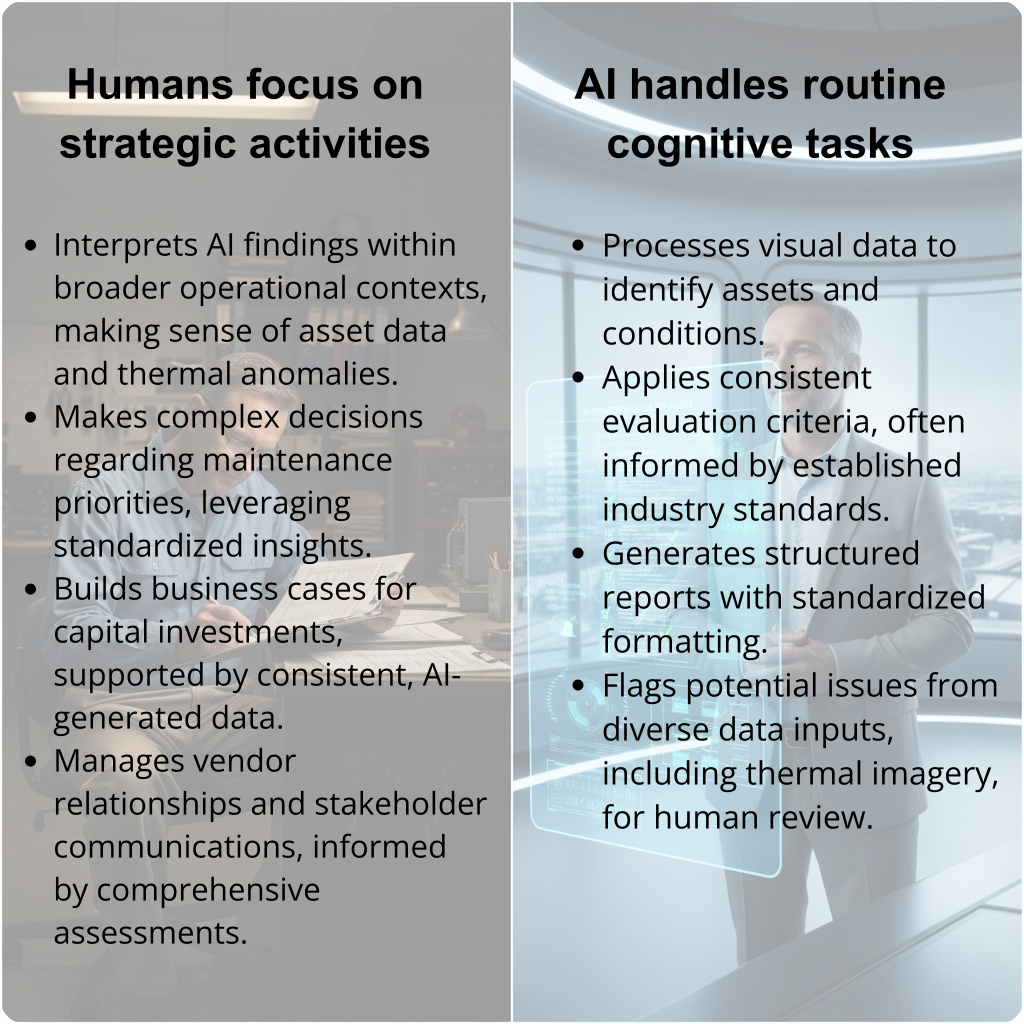
The power of AI in augmenting administrative tasks is widely observed. For instance, a facility professional recently utilized an AI chatbot tool to create a seven-page slide deck detailing automated external defibrillator (AED) inspection requirements and relevant laws. This task, typically requiring 4-6 hours of manual research and compilation, was completed in just 15 minutes, allowing the professional to dedicate more time to critical oversight and strategic planning rather than routine document creation.
Practical augmentation applications: Current solutions in FM
AI augmentation is evident in specific applications transforming FM workflows:
-
A standards-based approach to assessments: AI platforms empower facility managers to implement and enforce consistent assessment standards across their portfolios. AI can be trained to recognize and categorize conditions according to established industry guidelines (e.g., APPA condition ratings). This standardization reduces subjective variability between inspectors, ensuring data is consistently collected and analyzed. This adherence to a standards approach is crucial for maintaining data integrity and comparability across diverse assets and regions, providing a reliable foundation for benchmarking and strategic planning.
-
Enhanced asset data capture: Manual asset inventory and data logging are notoriously time-consuming and error-prone. AI significantly streamlines this. Through advanced computer vision, AI rapidly identifies and categorizes assets from images or video captured by various devices, from smartphones to drones. It automatically extracts key data points, such as asset type, location and serial numbers, integrating them into a centralized system. This accelerates initial data collection and ensures a more accurate, comprehensive asset register, vital for life cycle management and maintenance planning.
-
Actionable thermal image analysis: Thermal imaging is an indispensable tool for proactive maintenance, revealing hidden issues like electrical hotspots, moisture intrusion and insulation deficiencies. Manually analyzing extensive thermal images can be laborious. AI-driven thermal image analysis automates the detection and flagging of anomalies within these images. AI quickly processes large volumes of thermal data, identifies deviations from normal operating temperatures and pinpoints potential failures before escalation. This augmentation allows facility professionals to prioritize inspections and maintenance tasks more effectively, facilitating a shift from reactive repairs to predictive, standards-compliant interventions.
Real-world impact: Transforming assessment efficiency
Early adopters across diverse facility types are experiencing dramatic efficiency gains driven by these AI applications. Organizations implementing AI-powered inspection tools report significant reductions in time spent on routine assessments, with some facilities completing comprehensive evaluations in minutes rather than hours.
Recent case studies demonstrate these improvements:
-
Educational facilities have reduced inspection times from more than 60 minutes to 30 minutes for 1,300 square foot spaces, thanks to faster data capture and report generation.
-
Religious facilities completed comprehensive asset capture of 75,000 square feet in four hours versus traditional three-day processes, attributed to AI's ability to rapidly identify and log assets.
The real value extends beyond speed to consistency and reliability. AI applies identical evaluation criteria every time, eliminating variability between different inspectors or assessment periods. This generates more reliable data for portfolio-wide comparisons and trend analysis — critical for organizations managing facilities across multiple regions.
The strategic shift: From data entry to decision-making
When AI manages documentation and initial data analysis, facility professionals can redirect their energy toward activities leveraging uniquely human skills:
-
Enhanced strategic planning: With consistent, comprehensive data available rapidly, facility managers can dedicate more time to analyzing trends and developing long-term strategies, supported by a standards-based approach to data.
-
Improved stakeholder engagement: Free from paperwork, professionals can focus on building relationships with executives, tenants and vendors — activities directly impacting organizational success.
-
Proactive problem solving: AI flags potential issues early (e.g., from thermal analysis or asset condition reports), but humans determine the appropriate response based on operational priorities, budget constraints and organizational goals.
-
Innovation & optimization: With routine tasks handled by AI, bandwidth becomes available for creative problem-solving and process improvement initiatives, further leveraging asset data to optimize performance.
Managing the transition: Best practices from global implementations
As the Harvard Business Review research indicates, establishing clear organizational guiding principles is a necessary first step to navigate the risks of gen AI. Successful global implementations share common characteristics:
-
Start with clear guidelines: Establish protocols for AI use, data handling and quality control before organization-wide rollout. This is vital for multinational organizations managing diverse regulatory environments and local standards.
-
Emphasize human oversight: While AI processes data rapidly, human verification remains critical. Successful organizations ensure humans verify or quantify control AI outputs, maintaining accountability and accuracy, especially for critical asset data and thermal anomaly interpretations.
-
Focus on change management: Major technology shifts require substantial change management investment. Training and communication help teams understand how AI enhances, rather than threatens, their roles — a message resonating across cultures.
-
Build feedback loops: AI systems improve through iteration. Mechanisms for user feedback and refining AI performance ensure continuous improvement and cultural adaptation, making AI more effective in applying standards and interpreting diverse data sets.
The competitive imperative
Organizations viewing AI as a replacement fundamentally misunderstand its strategic value. Competitive advantage emerges from combining AI's processing power with human expertise and judgment.
Consider two FM approaches: teams manually documenting conditions versus teams using AI for routine tasks, asset data capture, thermal image analysis and standards application, while focusing human effort on strategic analysis and stakeholder management. The latter consistently delivers greater organizational value and resilience.
The window for thoughtful adaptation is narrowing. With only 16 percent of organizations having established full-scale AI use cases, significant opportunity for strategic implementation remains — but not indefinitely.
Looking forward: The human-centric AI future
FM’s future involves orchestrating human and AI capabilities effectively. AI excels at pattern recognition, data processing and consistent application of criteria in areas like asset data capture, thermal analysis and standards adherence. Humans excel at contextual interpretation, relationship building and strategic thinking.
Successful FM organizations will recognize AI as a powerful tool for amplifying human capabilities. They will use AI to eliminate administrative burden while investing in uniquely human skills that drive organizational success.
The transformation timeline varies, but the direction is globally consistent. FM professionals embracing AI as a strategic partner will gain more time, better data and greater impact.
Implementation framework for success
Organizations ready to implement AI augmentation can follow this structured approach:
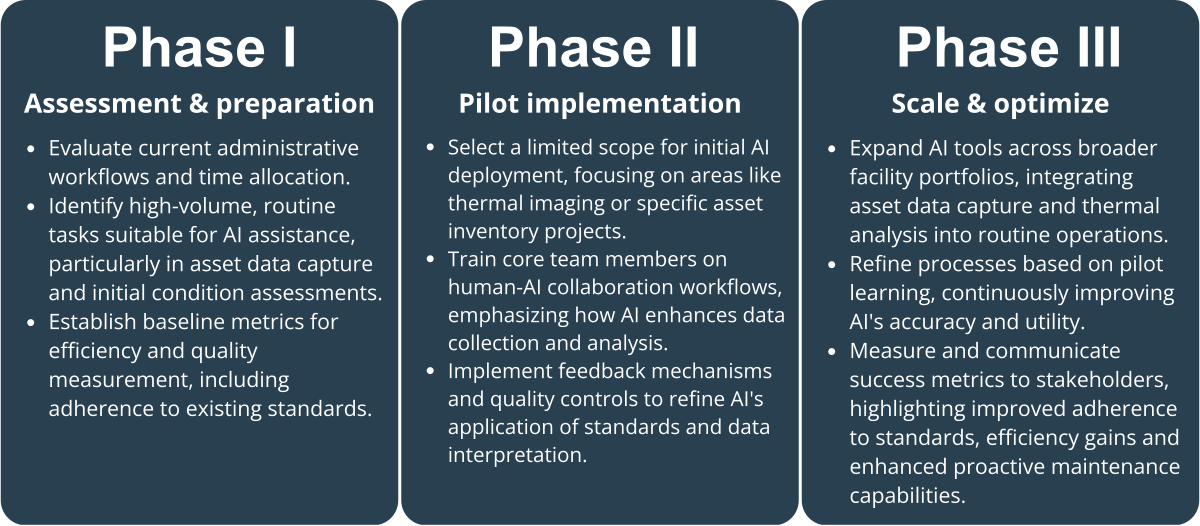
The FM industry stands at an inflection point. Organizations embracing AI as an augmentation tool, leveraging its power for standards-based assessments, efficient asset data capture and intelligent thermal image analysis, will secure a sustained competitive advantage. Those that delay risk falling behind competitors who utilize these powerful capabilities to enhance human expertise.

References
Read more on Facility Technology & Data Management , Leadership & Strategy and Emerging Topics or related topics Facility Technology and Strategic Planning
Explore All FMJ TopicsRelated articles
-

Artificial Intelligence in FM
The stakeholder’s perspectiveBy Dr. Jake Smithwick & Dr. Kenneth Sullivan & Nneka Ubi05.01.2024 -

Don’t Drop the Ball
How a CMMS can make or break an FM organization’s successBy Michael Carmean09.17.2024 -

Beware of Growing Cyberthreats
Why it’s time for stronger facility cybersecurityBy Andrew Harris & Eric Headington10.30.2024