
 Membership
 Network
 Regional Sites & Affiliates


 Events
 Participate
 Resources

 Training
 Credentials
 Government


 Content Channels
 Tools
Tools


 Business Overview





The Inherited Surface
Assessing & maintaining exterior hard surfaces without a laboratory
Facility management teams rarely choose the exterior hard surfaces they are responsible for. Paving, terraces, steps and plaza surfaces are usually inherited — specified by someone else, installed under a contract that closed years earlier, and handed over with drawings that describe a layout but not a material. The team then owns that surface for decades is judged on how it looks and how safe it is and is asked to justify its costs at every budget round.
Assessment is possible without laboratory testing. Most of what determines how an exterior stone surface is behaving can be established by a competent observer walking it, provided the observer knows which patterns distinguish a material problem from an installation problem, and which distinguish either from ordinary wear.
Establishing what the material actually is
The first difficulty is that the original documentation, where it survives, often names a product rather than a rock. Commercial naming conventions across the industry permit broad trade categories, and a material sold under a familiar name may belong entirely to a different geological family. The physical behavior of a surface follows the rock it is made from, not the name on the invoice.
Several characteristics can be established on site. Carbonate stones such as limestone and marble react visibly to a drop of dilute acid, while silicate stones such as granite, basalt and quartzite do not. Bedding planes visible on a cut edge indicate a sedimentary origin and a direction of weakness. Shell or fossil structure, visible cavities or a fine uniform crystalline texture each narrow the possibilities considerably.
Where the identification carries consequence — matching replacement material, resolving a dispute or committing to a large-scale renewal — a petrographic examination by a qualified laboratory can identify the rock and materials. Most national standards bodies publish guidance for that examination, and the relevant one is whichever applies in the jurisdiction where the building sits. The principle is constant; the standard number is not.
Reading the surface: 3 patterns, 3 different problems
Deterioration on exterior stone falls into three broad patterns. Their differences matter because the remedies have almost nothing in common, and two of the three are not caused by the stone at all.
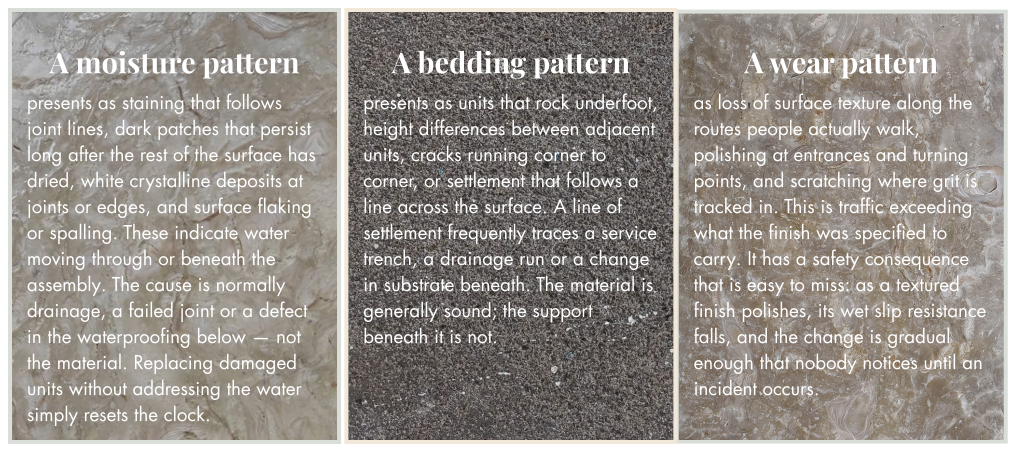
A surface showing all three patterns in different areas is common and is not a sign of a failed material. It is a sign that different parts of the same surface are exposed to different things.
The same stone behaves differently in different positions
One material can occupy three quite different conditions on a single site, and each imposes a distinct maintenance regime.
At grade, a paving unit is supported continuously by the base beneath it and borrows thermal mass from the ground. Temperature swings are moderated, drainage occurs through joints and base together, and loads are distributed across the full underside.
On an elevated deck, terrace or balcony, the same unit may be supported only at its corners on pedestals. A load applied at the center places the underside in tension rather than compression, and stone is considerably weaker in tension. The assembly is also ventilated beneath, so it has no ground thermal mass, cools faster and cycles more often. In climates with a freeze-thaw cycle, this is the harshest position on the site. In hot, dry climates, it is the position that reaches the highest surface temperature.
Around water — pool surrounds, fountains, water features and entrance thresholds — the surface undergoes constant wetting and drying, is exposed to treatment chemicals or de-icing salts depending on climate and carries the highest slip risk on the site because it is walked on wet by design.
The practical consequence is that a maintenance schedule written for one position may be actively wrong in another. A sealer suited to a sheltered interior threshold can trap moisture in an exposed deck. A cleaning regimen appropriate at grade may be too aggressive for a surface already losing texture through wear.
Which conditions can be maintained & which signal replacement
The distinction that matters at budget time is between deterioration that can be arrested and deterioration that indicates the surface is approaching the end of its service life.
Conditions that are generally maintainable include surface soiling and biological growth; open, washed-out or failed joints; localized loss of drainage falls; isolated damaged units where matching material remains available; and loss of surface finish that can be retextured without significant loss of thickness.
Conditions that indicate an approaching replacement include widespread spalling or delamination, which shows water has penetrated the body of the material rather than sitting on it; measurable loss of thickness across a trafficked area, which reduces load capacity as well as appearance; systemic bedding failure across a large area rather than in isolated positions; and structural cracking that recurs after repair, which normally indicates continuing movement below.
One factor decides more replacement arguments than any technical measurement: whether matching material can still be obtained. Natural stone varies between extraction areas and between periods of extraction. A quarry face worked 10 years ago does not necessarily yield the same color range today, and some sources close entirely. A surface that could have been repaired in sections for a decade may reach a point where partial repair guarantees a visible mismatch, and at that point the decision changes from technical to aesthetic.
Establishing material availability early gives an FM team a defensible reason to plan a phased renewal rather than defend an increasingly patched surface.
A repeatable condition survey
A consistent, annual walk-round survey produces something a single inspection cannot: a trend. Trends support budget cases in a way that photographs of current damage do not.
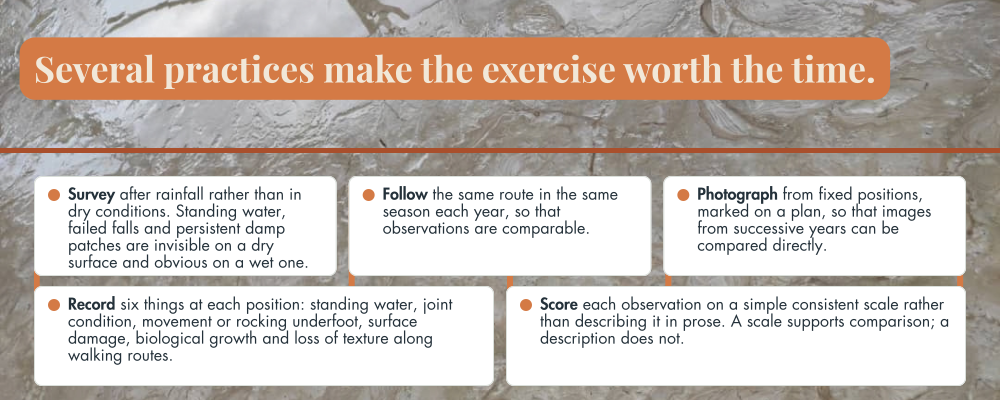
The survey does not require specialist equipment. It requires consistency and a record that future staff can continue.
Making the case at budget time
An evidence-based position is stronger than an appearance-based one, and considerably harder to defer. Three elements support it.
Trend data from consecutive surveys, showing whether a condition is stable or accelerating.
A clear statement of which of the three deterioration patterns is present, because a moisture problem requires a drainage budget rather than a stone budget, and presenting it correctly avoids spending money on the wrong remedy.
Where any documentation from the original installation survives, is the test data supplied with the material — absorption, strength and slip resistance figures recorded at the time establish what the surface was capable of when new and how far it has moved from that. Exterior stone surfaces routinely outlast the contracts that installed them, the people who specified them and the records that described them. The teams that manage them well are not the ones with the most technical knowledge of geology. They are the ones who look at the surface systematically, distinguish what the material is doing from what the installation is doing, and keep a record consistent enough that the next budget conversation starts from evidence.

Kareem Klisharo is founder and chief executive of Citadel Stone, a wholesale supplier of natural stone paving. He selects material at partner quarries and advises contractors, distributors and specifiers on stone selection, testing and specification. He writes on stone durability and specification for the building and public works trade press, with work published in Stone World, Stone Update Magazine and IIBEC Interface. Klisharo works from the supply side of the industry rather than as a quarrier or fabricator, which shapes his interest in the gap between what a specification asks for and what a supplier can actually certify.
References
Top image via Getty Images. Stone surface images provided by Citadel Stone.
Read more on Facility Operations and Risk Management or related topics Operations and Maintenance Planning and Risk Management
Explore All FMJ Topics