Membership
 Network
 Regional Sites & Affiliates


 Events
 Participate
 Resources

 Training
 Credentials
 Government


 Content Channels
 Tools
Tools


 Business Overview





The Missing Layer
Building system-level continuity across mechanical & energy assets

Every mature asset class has a persistent identity layer underneath it. Securities are assigned Committee on Uniform Securities Identification Procedures (CUSIP) numbers. Vehicles carry vehicle identification numbers (VINs). Medical providers use National Provider Identifiers (NPIs). These identifiers allow capital markets, insurers and regulators to reference the same asset consistently over time, regardless of ownership or system changes.
Mechanical and energy systems inside commercial and institutional buildings do not have an equivalent layer. A boiler’s service history is often tied to the platform used to track it rather than to the equipment itself. As buildings change ownership, contractors rotate and software platforms are replaced, system-level records fragment.
This fragmentation introduces practical challenges for facility management teams, asset owners and financial stakeholders. It affects how systems are tracked, how capital planning is approached and how risk is evaluated across portfolios. As asset management practices evolve globally, including frameworks such as ISO 55000, there is increasing attention on maintaining continuity in infrastructure records.
Why system-level continuity matters
Facility management teams are responsible for maintaining operational performance across complex systems over long-term horizons. Mechanical and energy systems often remain in place for 15 to 30 years, spanning multiple ownership cycles, service providers and internal teams.
When continuity is lost, the impact is not always immediate. Systems continue to operate, work orders are completed and maintenance schedules are followed. The consequences tend to surface later when decisions require a longer view.
Examples include:
-
capital planning based on incomplete system histories
-
replacement decisions driven by age assumptions rather than condition
-
difficulty validating service quality across contractors
-
limited visibility into recurring issues or performance trends
These challenges are not typically caused by a lack of data. In many cases, the data exists but is distributed across different systems and stakeholders, making it difficult to interpret at the system level over time.
The scale of what is being tracked continues to expand. The International Energy Agency reports that buildings account for approximately 30 percent of global final energy consumption and 26 percent of energy-related emissions, with global floor area projected to grow roughly 15 percent by 2030. Commercial heating, ventilation and air conditioning (HVAC) systems typically operate for 15 to 20 years, and the North America HVAC services market in 2024 was led by the repair and replacement segment, which accounted for 46.2 percent of total market share, reflecting the size of the aging installed base. As more equipment enters service across longer asset bases, the consequences of fragmented records become more visible across operations, finance and risk functions.
Where continuity breaks down
System-level continuity often degrades at transition points.
One of the most common examples is a change in ownership. When a building is sold, records may be transferred, but they are not always structured in a way that preserves system-level relationships. Key details can be lost or reinterpreted.
Contractor transitions present a similar challenge. Service providers often maintain their own records, which may not fully transfer when contracts change. Over time, this leads to fragmented histories where different portions of a system’s life cycle are held by different parties.
Software changes also contribute to fragmentation. When a computerized maintenance management system (CMMS) or enterprise asset management (EAM) platform is replaced, data migration typically focuses on active records rather than full historical continuity. Even when historical data is transferred, it may lose context or structure.
Across these transitions, the underlying issue is consistent: records are tied to the entities managing them rather than to the systems themselves. This makes it difficult to observe how systems relate to one another across time within a portfolio.
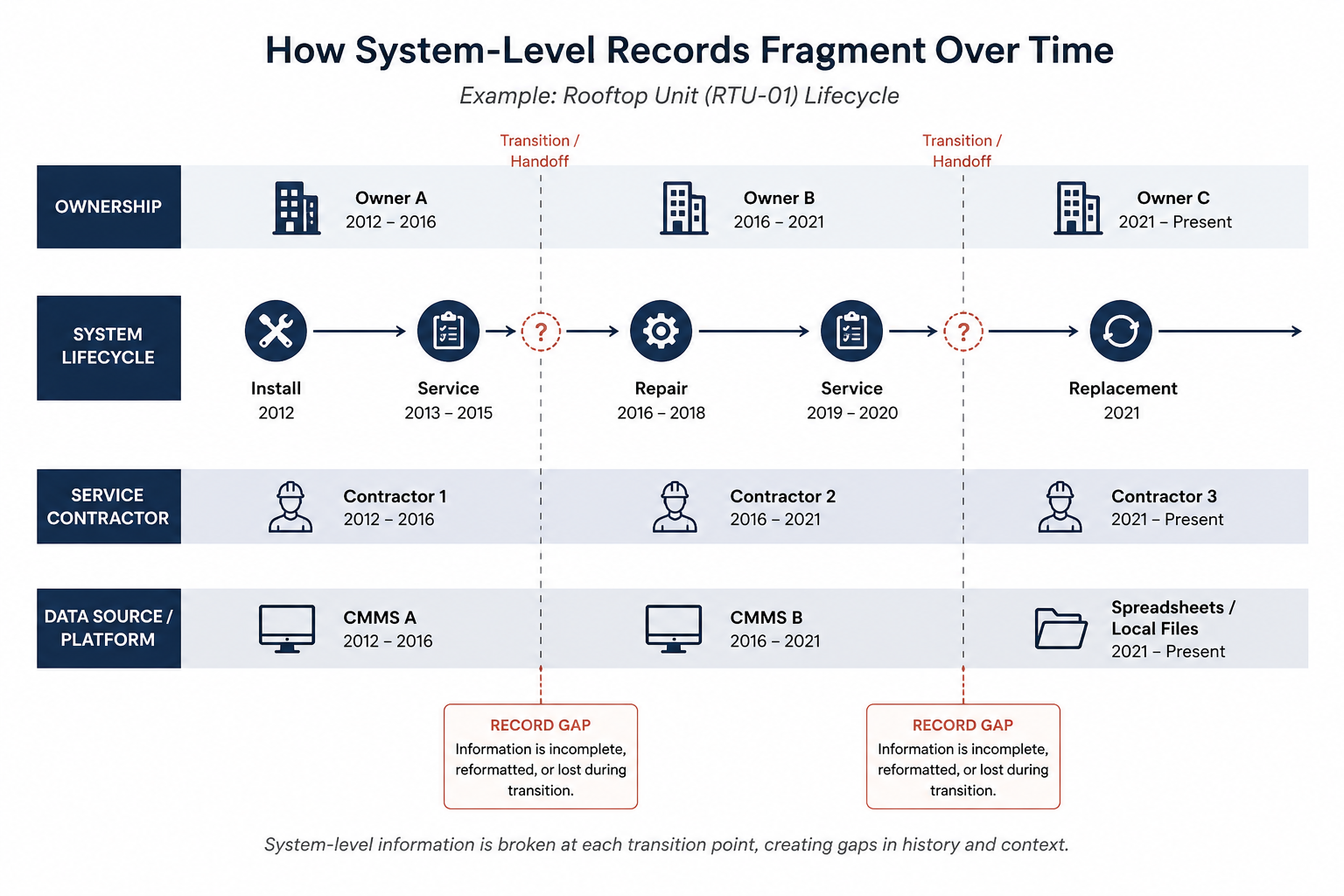 Figure 1. Example of how system-level records fragment across ownership, contractor and platform transitions.
Image provided by the author.
The impact on capital planning & risk
The absence of system-level continuity becomes particularly visible in capital planning.
Without a consistent record of installation, service activity and performance, FM teams often rely on generalized assumptions about system life expectancy. While industry benchmarks are useful, they cannot fully account for variations in usage, maintenance quality and environmental conditions.
This can result in:
-
overly conservative replacement strategies
-
unexpected clustering of system failures
-
difficulty prioritizing capital allocation across assets
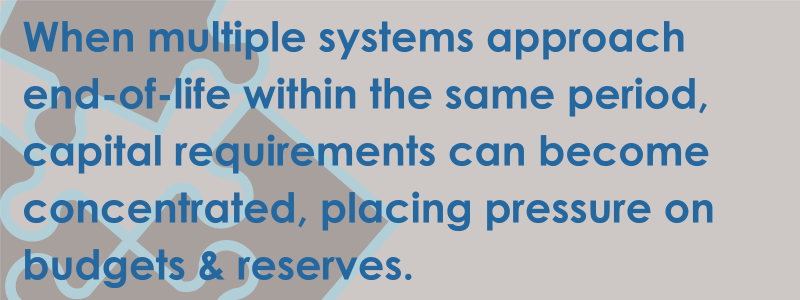
From a financial perspective, the issue is not only the total cost of replacement but also the timing.
Industry data points to how widespread these documentation gaps remain. A national survey of plant maintenance managers, published by Reliable Plant, found that 94.7 percent of respondents believe they are not using their computerized maintenance management system to its full capability. The Global HVAC market itself is on a long growth trajectory, projected to expand from approximately US$525 billion in 2025 to more than US$1.2 trillion by 2035, according to Global Market Insights, with replacement and retrofit work consistently outpacing new construction in mature markets. As the volume of equipment under management grows, the practical cost of incomplete system-level records can compound across portfolios.
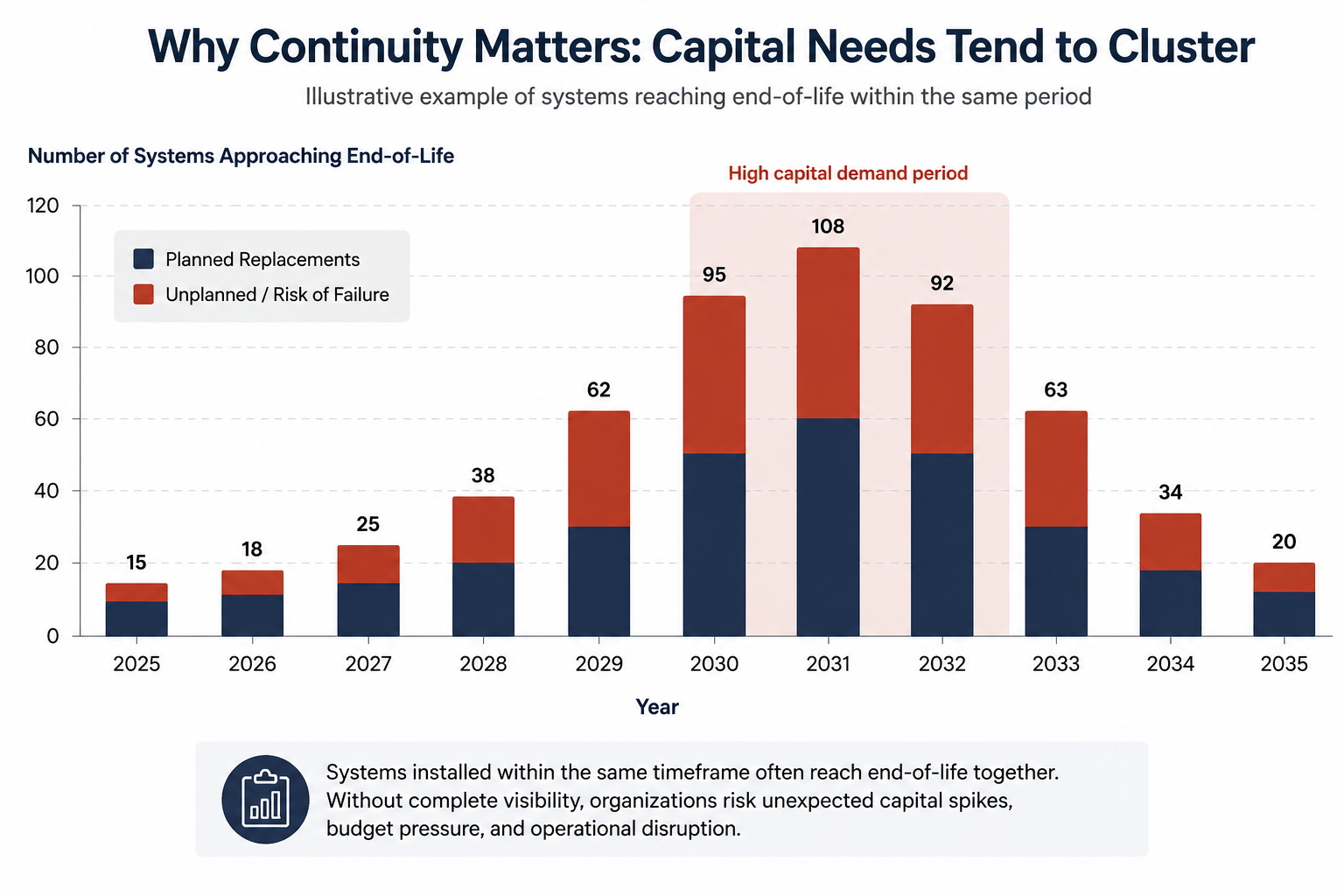 Illustrative example of systems approaching end-of-life within the same timeframe, creating concentrated capital demand. Image provided by the author.
For insurers and lenders, limited system-level visibility can affect underwriting assumptions. For asset owners, it can reduce confidence in long-term planning.
1. Establish consistent system identification
Each mechanical and energy system should have a clearly defined and consistent identifier within the portfolio. This identifier should remain stable over time and not change based on ownership, contractor or software platform.
Consistency in naming and classification allows systems to be tracked more effectively across different contexts.
2. Capture installation & replacement data at the source
Installation and replacement events represent key points in a system’s life cycle. Capturing accurate information at the time of these events is critical.
This includes:
-
-
installation date
-
equipment type and specifications
-
location within the building
-
contractor information
-
Ensuring this data is recorded consistently reduces the need for reconstruction later.
3. Maintain continuity across contractor workflows
Service providers play a central role in maintaining system records. Aligning documentation practices across contractors can help reduce fragmentation.
This may include:
-
-
standardized reporting formats
-
consistent terminology
-
requirements for recording key service data
-
The goal is not to replace contractor systems but to ensure that essential information can be understood across different providers.
4. Structure records beyond individual platforms
While CMMS and EAM platforms are essential tools, it is important to consider how system-level records persist beyond any single system.
This involves:
-
-
maintaining exportable, structured data
-
ensuring historical context is preserved during system transitions
-
periodically reviewing how records are stored and accessed
-
A system-level perspective helps reduce dependence on any one platform for long-term continuity.
5. Periodically review system-level data
Regular reviews of system-level records can help identify gaps, inconsistencies or missing information.
This may involve:
-
-
cross-checking installation dates
-
validating service histories
-
identifying systems with incomplete records
-
Over time, these reviews improve data quality and support more informed decision-making.
A global perspective on asset continuity
The importance of system-level continuity is increasingly reflected in global asset management practices.
Standards such as ISO 55000 emphasize life cycle thinking and the need for consistent, reliable information across asset portfolios. While these frameworks do not prescribe specific data structures, they highlight the role of information in supporting long-term asset performance.
In regions with mature infrastructure markets, there is growing alignment between FM, finance and risk management functions. This alignment places greater emphasis on data consistency and traceability.
Emerging markets, where infrastructure development is ongoing, may have an opportunity to incorporate stronger continuity practices earlier in the life cycle. In these contexts, establishing structured records at the time of installation can help avoid fragmentation later.
Moving toward continuity
System-level continuity does not require a single solution or immediate transformation. It can be developed progressively through changes in how information is captured, structured and maintained.
The shift begins with recognizing that mechanical and energy systems are long-lived assets that extend beyond any single ownership period or operational framework. Maintaining a consistent reference for these systems over time supports better decision-making across operations, capital planning and risk management.
As expectations around infrastructure performance evolve, the ability to maintain continuity at the system level is likely to become increasingly relevant to FM professionals.

Brad Pettes works at the intersection of mechanical systems and portfolio capital. His experience spans installation, service and asset life cycle environments. He focuses on system-level data continuity and its role in long-term facility management and capital planning.
References
Top image via Getty Images.
Read more on Facility Operations , Facility Technology & Data Management and Finance & Business or related topics Operational Technology , Facility Technology and Financial Analysis
Explore All FMJ Topics