 Membership
 Network
 Regional Sites & Affiliates


 Events
 Participate
 Resources

 Training
 Credentials
 Government


 Content Channels
 Tools
Tools


 Business Overview





The New Cool for Infrastructure
Why new hyperscale data centers are designed for liquid cooling

A physical and operational bottleneck for the scalability of modern data centers is the complexity in thermal management and HVAC systems. The difficulty stems from a fundamental mismatch between traditional cooling infrastructure and the growing thermal demands of modern workloads.
Each data center houses thousands of heat-emitting components — servers, storage units, networking switches and power distribution equipment — all of which continuously produce thermal loads that must be removed quickly and efficiently.
If this heat is not properly managed, equipment can experience thermal throttling, malfunction or shut down entirely. The criticality of cooling systems as a bottleneck is shaped by four interconnected factors:
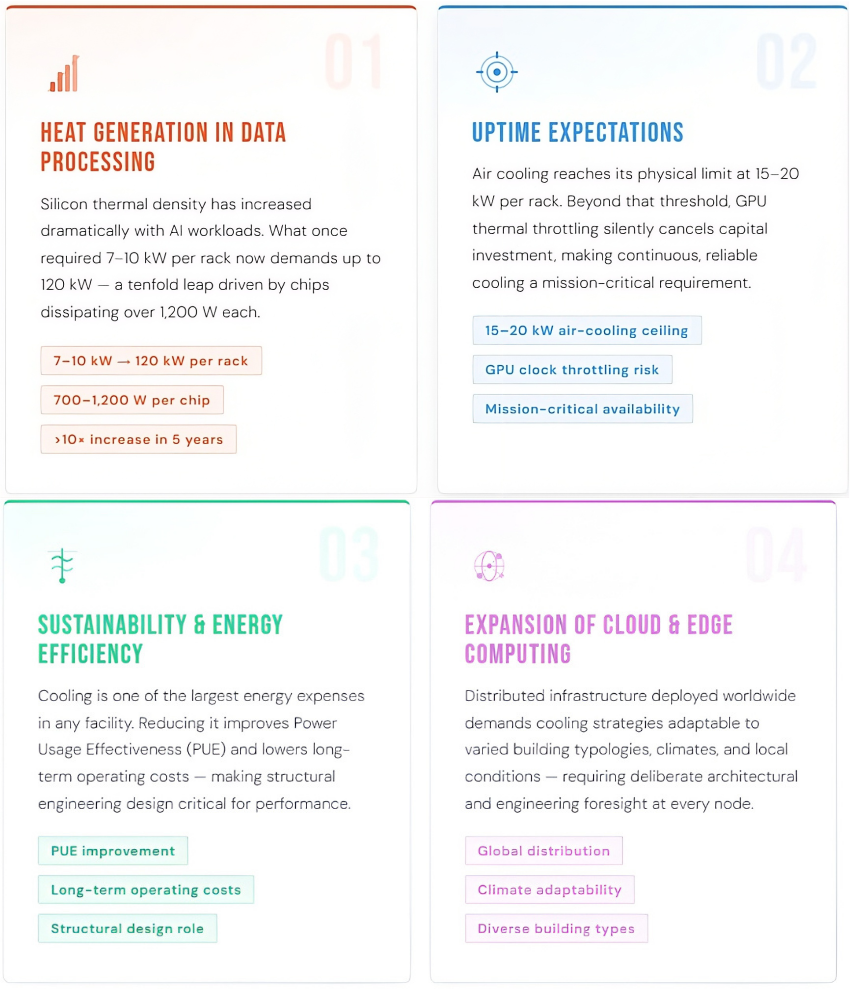 Figure 1. Cooling system complex factors for data centers.
-
Scale of heat generation: early data centers were designed to dissipate heat from racks drawing between 7 and 10 kW, but modern processors now dissipate between 700 W and 1,200 W of heat per chip. At the infrastructure level, fully integrated systems can demand up to 120 kW of cooling capacity, generating immense and sustained thermal loads.
-
Uptime expectation: if cooling falls behind, GPUs automatically throttle their clock speeds to prevent hardware damage.
-
Sustainability & energy efficiency: cooling accounts for a substantial portion of a facility's total energy consumption, and reducing this demand directly improves the facility's power usage effectiveness (PUE) while lowering long-term operating costs.
-
Expansion of cloud & edge computing: as organizations deploy distributed digital infrastructure worldwide, cooling strategies must be highly adaptable to a wide range of building typologies and climatic conditions.
Advanced cooling techniques: Liquid cooling
As rack power densities push past traditional limits, relying solely on air-based cooling is not physically or economically viable. The volume of air required becomes excessive, and airflow management becomes more complex. Therefore, data center FM is making a necessary transition toward liquid cooling as an advanced, high-efficiency thermal management.
Engineered fluids and treated water carry heat far more effectively than air, by orders of magnitude. That property allows a facility system to capture and move heat without the oversized air-handling equipment driving the spatial bottleneck. Two methods are in active deployment.
Direct-to-chip cooling runs coolant through cold plates mounted on the hottest components, pulling heat straight from the source.
Immersion cooling submerges entire servers in a dielectric fluid, so every component sheds heat directly to the liquid.
Cooling accounts for roughly 40 percent of a data center’s total energy consumption. Air-cooled installations typically achieve a power usage effectiveness (PUE) between 1.4 and 1.6. Liquid-cooled facilities consistently come in below 1.2, with documented improvements of up to 45 percent after the transition — equivalent to US$3-7 million in annual energy savings per 10 MW of capacity. Liquid also eliminates the wide aisles and oversized ductwork that air requires, freeing floor area for revenue-generating racks rather than cooling infrastructure.
 Figure 2. Cooling systems comparison of practical density, typical PUE and position.
For facilities with mixed workload profiles, a hybrid approach lets teams match the cooling method to the load rather than committing the entire hall to one architecture. Liquid handles the dense AI clusters; air handles the lower-density zones. This is not a compromise that dilutes the benefits — it is a practical way to adopt liquid where it earns its keep and extend it as densities climb, without requiring the entire facility to operate at the edge of current supply-chain readiness. Free cooling and economizers, where climate and water access allow, reduce mechanical chiller runtime and lower PUE further, independent of whether the primary system is air or liquid. Also, to mitigate the heavy reliance on complex mechanical cooling, facilities located in favorable climates can implement ambient economization.
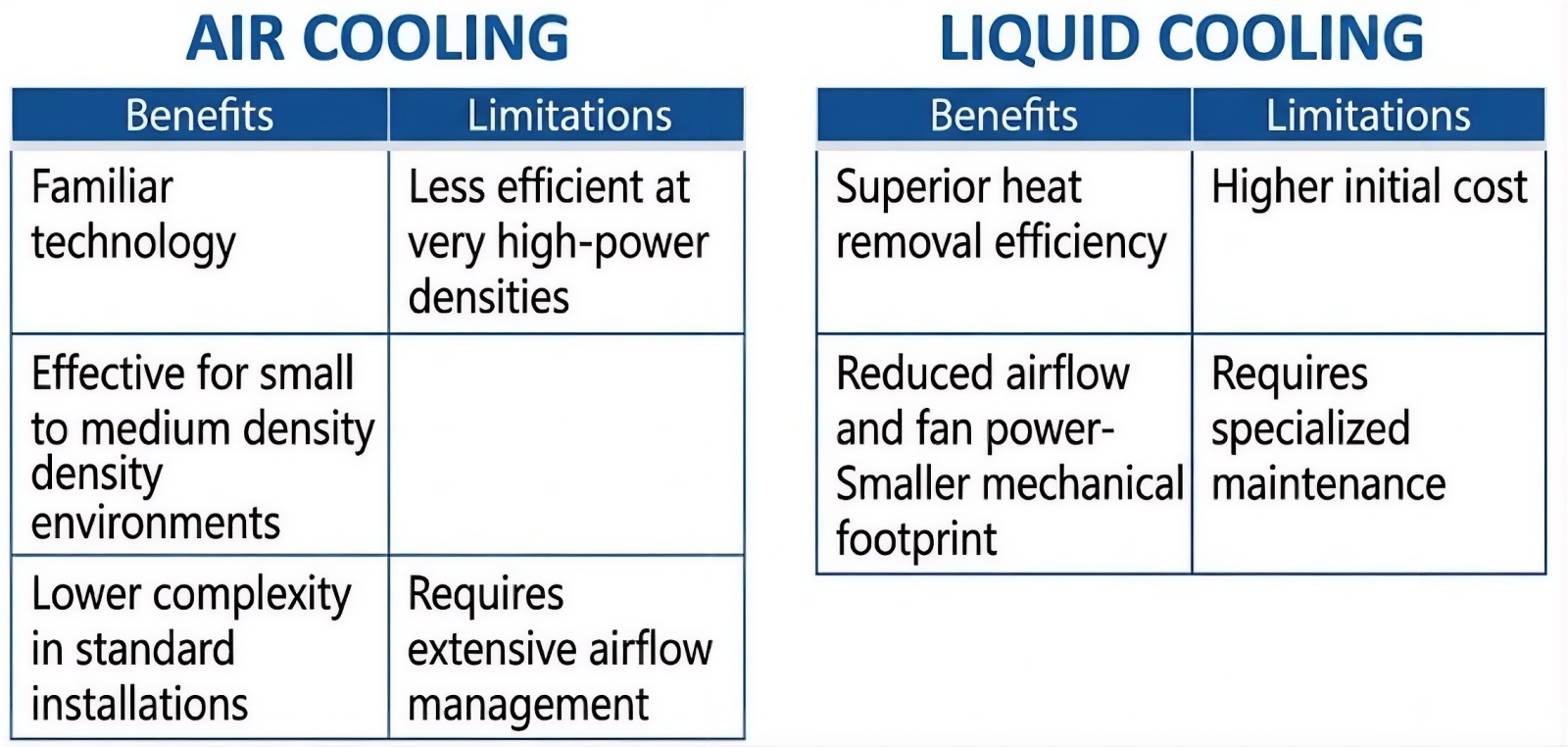 Figure 3. Air cooling vs. liquid cooling benefits and limitations.
The cooling method shapes the mechanical layout & spatial planning
In an air-cooled facility, the internal architecture is dictated by one goal: keeping air moving. Rack placement, aisle containment, overhead cable trays and raised ceiling plenums are all arranged around the airflow path. When that path is compromised, the consequences are immediate. A densely packed cable tray can act as an air dam, blocking the flow and creating localized hotspots: pockets of trapped heat that force the mechanical systems to work harder and waste energy doing it. The building, in effect, is a machine for circulating air, and the computing is fitted around it. Liquid changes the relationship. There is a common assumption that liquid systems are more complex and therefore consume more space. The opposite is true at the facility level. A liquid mechanical room holds more specialized equipment and demands a more careful layout, but it eliminates the wide aisles, bulky raised floors and oversized ducts that air cooling requires. Air is a poor conductor of heat, so cooling a dense rack with it means reserving large volumes of the data hall for empty airflow paths. Liquid trades that dead space for high-performance infrastructure, which is why the overall footprint shrinks even as the mechanical room grows.
Less mechanical bulk means more computing per building
Removing the large air-handling plant frees floor area, and overhead space can be translated to revenue-generating racks instead of ductwork. The same building envelope holds significantly more compute. For an operator weighing the cost of a site against the capacity it can deliver, the density gain changes the economics of the whole facility, not only the cooling line item.
It also affects water. Cooling is the dominant driver of a data center’s water consumption, and the more efficient thermal transfer of a well-designed liquid system can ease the draw on local water resources that increasingly shapes where facilities are allowed to be built.
Designing for liquid now avoids a disruptive retrofit later
The case for acting at design time rather than later rests on how the two paths actually unfold. A facility built for air and later converted to liquid must be partly emptied, with cooling distribution, piping and electrical capacity reworked around equipment that is already running and already under contract to tenants. That work happens in a live building, on someone else’s uptime, and it competes for the same scarce mechanical labor that every other project is chasing.
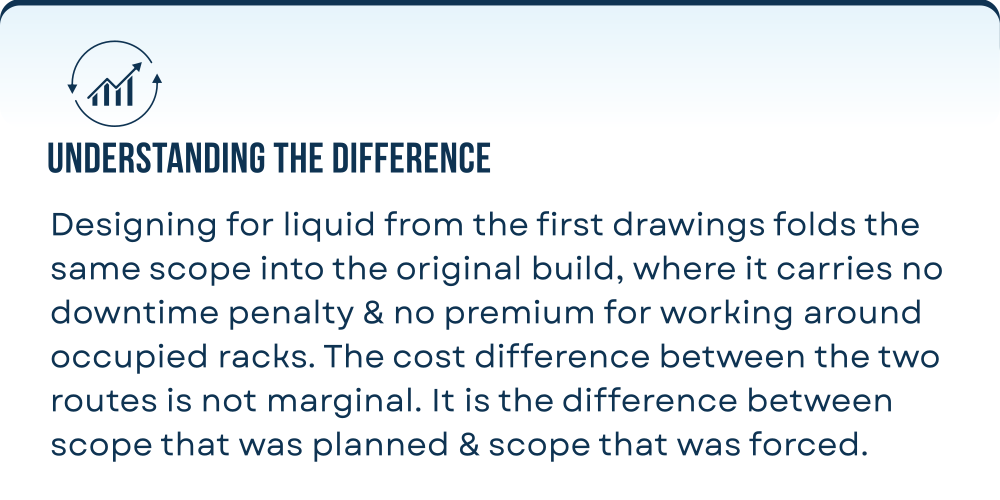
There is also a transitional middle ground. Hybrid designs that combine liquid cooling for the densest racks with air handling for lower-density zones let a facility match the cooling method to the load rather than committing the entire hall to one approach. For operators with mixed workloads, that flexibility can be a sensible way to adopt liquid where it earns its keep while leaving room to extend it as densities climb.
What this means for facility teams
The technical direction is not in dispute: densities are rising, and a facility designed today for air will face a retrofit within a few years. But the practitioners closest to the work add two conditions the numbers alone do not show.
-
First, liquid cooling requires a higher standard of design completeness before construction begins — not as a bureaucratic step, but because the coordination margin is narrower, and a late disagreement costs more to fix.
-
Second, the supply chain for specialized liquid cooling components is still scaling toward the capacity the market will eventually need; lead times for cooling distribution units and manifolds should be verified and procurement started early, not assumed to follow the same rhythm as standard HVAC.
Neither condition negates the case for liquid. Together they define the specific preparation that makes the transition succeed rather than substitute one set of problems for another. Teams that design for it thoroughly and procure for it early will realize the gains the physics promises. Those who treat it as a drop-in swap for air will find the density problem solved and a different execution challenge waiting.

Andrea Gutiérrez Modamio is an Industrial Engineer who holds a bachelor's degree in industrial technologies and economic analysis from Universitat Politècnica de Catalunya (UPC) and Universitat Pompeu Fabra (UPF), in Spain. She is completing her master's degree in industrial engineering, having conducted her final research at the Illinois Institute of Technology. Her work focuses on optimizing data center construction through a 70/30 standardization fast-track model.

Dr. Gurram Gopal, Ph.D., is the department chair and professor of information technology and management at the Illinois Institute of Technology with a keen interest in technology driven sustainable logistics and facilities management. He has published extensively and has presented at academic and industry conferences. He received a Fulbright Scholar Award to teach and conduct research at Galway Mayo Institute of Technology in Ireland in 2011-2012 and recently completed another Fulbright Scholar Award teaching and conducting research at ISM University, Lithuania. Dr. Gopal developed marketing strategies for some of the world’s largest pharmaceutical companies as a strategy consultant and manager for ZS Associates and worked in strategic marketing, supply chain management and strategic quality at Tellabs Inc. He holds a bachelor’s degree in chemical engineering from the Indian Institute of Technology, Madras and master’s and doctorate degrees in industrial engineering from Northwestern University.
References
ASHRAE. (2016). Data center power equipment thermal guidelines.
Datacenters.com. (2025). PUE performance in liquid versus air-cooled data centers.
Dore, J. (2025). Liquid cooling adoption in high-density data centers.
gbc. (2025). Advanced cooling architectures for high-density computing.
Rebarber, M. (2023). Direct-to-chip cooling integration: performance and energy results.\
Top image via Getty Images.
Read more on Facility Operations , Sustainability and Facility Technology & Data Management or related topics Operations and Maintenance Planning , Operational and Capital Budgeting , Sustainable Facility and Operational Technology
Explore All FMJ Topics