 Membership
 Network
 Regional Sites & Affiliates


 Events
 Participate
 Resources

 Training
 Credentials
 Government


 Content Channels
 Tools
Tools


 Business Overview





The New Goalpost
Meeting ASHRAE Standard 241 in existing buildings

Facility managers are balancing demands that extend well beyond traditional building operations. Occupants expect healthier indoor environments, organizations are pursuing ambitious sustainability goals, and building owners want to reduce operating costs while extending the life of mechanical systems. In existing buildings, meeting all of those objectives simultaneously is difficult. Many commercial HVAC systems were designed around very different assumptions about ventilation, occupancy and indoor air quality (IAQ) than those shaping today’s buildings.
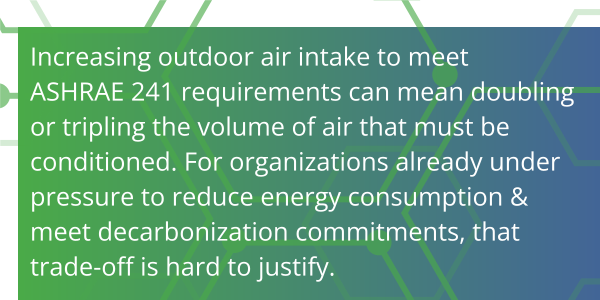
The gap between existing building infrastructure and today’s demands became more visible with the publication of ASHRAE Standard 241 in 2023. Developed to reduce occupant exposure to airborne infectious aerosols during periods of elevated risk, the standard introduced equivalent clean airflow (ECAi) requirements that, in many commercial spaces, are four to six times higher than the outdoor air required under ASHRAE 62.1.
The challenges of a ventilation-only approach
The most common response to higher clean air requirements is to increase outdoor air intake. That approach, however, quickly runs into limitations in existing buildings.
Conditioning outdoor air is one of the largest energy expenses in commercial HVAC operations as buildings account for approximately 40 percent of total energy use, HVAC systems consume roughly 40 percent of a building’s energy, and ventilation alone represents about 40 percent of HVAC energy consumption. As a result, decisions about outdoor air have an outsized impact on both operating costs and energy performance. In cold climates, incoming air must be heated. In hot and humid regions, it must be cooled and dehumidified
 Mechanical infrastructure adds another constraint. Existing air handling units and ductwork were sized for ASHRAE 62.1 airflow rates. Moving significantly more air through these systems can exceed capacity, creating pressure imbalances across zones and accelerating equipment wear. Expanding ductwork or replacing air handlers in occupied buildings means disrupting operations and adding capital costs.
Then there is the quality of the outdoor air itself. The Ventilation Rate Procedure (VRP), the most commonly utilized compliance pathway under ASHRAE 62.1, assumes that the outdoor air is cleaner than indoor air. In many locations and seasons, that assumption does not always hold true. Wildfire smoke events, which are increasingly common in many countries, can push outdoor particulate matter concentrations well above safe indoor levels. Urban pollution and high pollen counts regularly present that same problem. Increasing outdoor air intake during these periods can degrade IAQ rather than improve it.
For FM teams working within real-world budgets and existing infrastructure, relying on ventilation alone to ensure ASHRAE 241 compliance creates a set of conflicts that become harder to resolve as clean air requirements increase.
The performance-based alternative
 In addition to VRP, ASHRAE 62.1 offers a second compliance pathway: the Indoor Air Quality Procedure (IAQP), which is performance-based. Rather than prescribing a fixed volume of outdoor air, IAQP sets acceptable concentration limits for specific contaminants and allows ventilation, advanced filtration and air cleaning systems to work together to achieve acceptable IAQ, measuring outcomes rather than airflow volumes alone.
That approach aligns well with how ASHRAE 241 is structured. The standard sets specific clean air delivery requirements per person but allows flexibility in how buildings achieve them. When a public health authority or building management activates a period of elevated infection risk — Infection Risk Management Mode (IRMM) — ventilation, filtration and air cleaning can all be used to meet the requirement, if their performance is independently validated.
IAQP adoption has been limited, historically, primarily because its calculations are more complex than VRP, and the tools to simplify it have been slow to develop. That is beginning to change, however, as tools come online that allow engineers to run side-by-side VRP and IAQP comparisons on the same project, evaluating outdoor air requirements, equipment sizing and energy impact before committing to a design path.
Evaluating the gap
For most existing buildings, there is a measurable difference between the clean air requirements the HVAC system currently delivers under ASHRAE 62.1 and those required when ASHRAE 241’s IRMM is activated. That gap varies by space type, but generally, spaces with higher occupancy face the largest shortfalls.
ASHRAE publishes the requirements for both standards, and when compared side-by-side, the clean air requirements under Standard 241’s IRMM are four to six times higher than the baseline Standard 62.1 requirements across offices, classrooms and retail spaces. In a typical office with 25 occupants, the difference can exceed 300 cubic feet per minute (CFM) of additional clean air that the HVAC system was not designed to deliver. In a classroom with 20 students, that gap can approach 500 CFM.
For many buildings, closing that gap through ventilation alone may not be practical with the current HVAC infrastructure. As a result, FM teams are evaluating how ventilation, filtration and supplemental air cleaning can work together to increase equivalent clean air delivery more efficiently and effectively.
ASHRAE 241 also places an emphasis on verification and monitoring. Carbon dioxide and particulate matter measurements can help facility teams better understand how spaces are performing during IRMM activation and where additional clean air strategies may be needed.
Bridging the gap
There are generally three approaches to closing a clean air gap, each with different cost, timeline and operational implications.
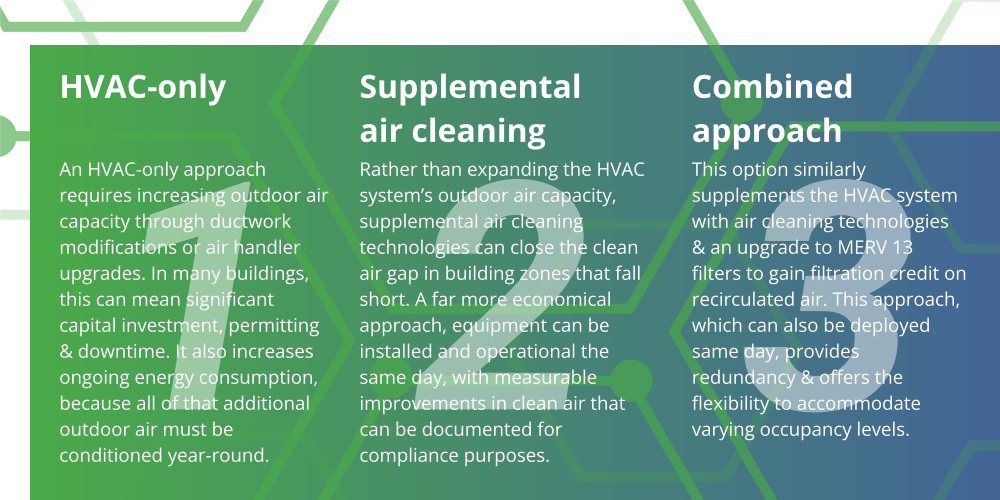 The trade-offs between these approaches often come down to timeline, budget and tolerance for disruption. HVAC-only solutions may make sense when major renovations are planned. In existing buildings with functioning infrastructure, however, the supplemental and combined approaches can achieve the same clean air requirements faster, more efficiently, at lower cost and with less operational disruption.
Documentation & readiness
ASHRAE 241 requires buildings to adopt a building readiness plan (BRP) — a documented plan tailored to a building’s operation and design that outlines how the facility will respond during periods of elevated infection risk. The BRP covers HVAC system adjustments, maintenance protocols and the integration of any supplemental air cleaning systems used to meet clean air requirements during IRMM.
For any air cleaning equipment contributing toward compliance, the standard requires specific documentation, including third-party performance test reports, clean air delivery rate values, installation and placement guidelines, and maintenance schedules. This documentation supports verification during inspections and audits.
Preparing for what comes next
ASHRAE 241 is voluntary in most jurisdictions, but adoption is accelerating, particularly in health care, education and high-occupancy environments where infection control is a priority. ASHRAE 62.1, which is already required by most building codes, is a prerequisite for meeting Standard 241 requirements. As the standards continue to evolve together, the distance from compliance today to ASHRAE 241 readiness becomes shorter.
The shift from area-based ventilation rates to person-based clean airflow requirements for infection control is significant but does not require facility teams to abandon their current systems or commit to costly overhauls. Performance-based strategies that combine ventilation with validated filtration and air cleaning technologies make it possible to meet higher clean air targets within existing infrastructure, while also supporting energy efficiency and sustainability goals.
For FMs already under pressure to improve building health, reduce costs and extend the life of aging mechanical systems, ASHRAE 241 may feel like one more competing demand. However, in practice, the performance-based approach it supports may help resolve some of those challenges, rather than add to them.

Jason Jones is Director of Air Quality Management at Fellowes, where he works with engineers, facility professionals, building owners and HVAC distributors to implement air quality strategies and solve real-world challenges for today’s commercial and institutional spaces.
References
Top image via Getty Images.
Read more on Facility Operations and Standards or related topics Standards , Operations and Maintenance Processes
Explore All FMJ Topics