
 Membership
 Network
 Regional Sites & Affiliates


 Events
 Participate
 Resources

 Training
 Credentials
 Government


 Content Channels
 Tools
Tools


 Business Overview





The People Factor
Crafting successful AI strategy that keeps humans in the mix

AI is not about replacing people, but helping teams work smarter. It is a powerful and reliable shoulder that teams can lean on so they can take a proactive, not reactive, approach to strategic management.
In the dead of night, an AI-powered HVAC system notices abnormal pressure readings in a hot water pipe, flagging a risk of a pump failure in the hydronic system. When the facility management crew clocks in the next day, they receive this information through the centralized dashboard, prompting them to book in an earlier maintenance call than initially scheduled. A seemingly minute signal that could otherwise have gone unnoticed reveals that the hydronic pump is indeed on its last legs, saving maintenance costs and other issues.
 This all happens with AI working quickly, yet quietly, in the background. Thanks to AI, teams are slashing operational costs by 17.6 percent. These solutions provide facility managers with useful predictive maintenance insights, energy-saving recommendations and more for stronger building performance outcomes. It is unsurprising that this technology continues to grow in popularity within the facility management industry.
But in the rush to integrate AI and maximize efficiency, FMs must remember how to balance these tools with the teams working beside them. Forging a successful partnership between humans and AI means recognizing limits, ingraining guardrails and building on key skills.
Human capabilities balance out AI limitations
There is no doubt that AI has its proven strengths. Highly sophisticated algorithms and models can shave countless hours of manual labor off teams’ shoulders. They can monitor multiple building systems in real time, reveal crucial yet easily missed patterns, flag anomalies and even provide predictive analytics to prevent mishaps ahead of time. It takes a massive load of the guesswork out of day-to-day facility and operations management.
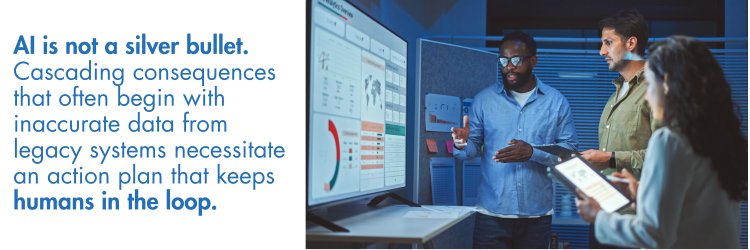
But AI is not a silver bullet. Cascading consequences that often begin with inaccurate data from legacy systems necessitate an action plan that keeps humans in the loop. These tools are designed to support decision-making, but they can never contextualize decisions in the real world to the same extent that people can. That is why AI can never be left completely unchecked by human experience and observation.
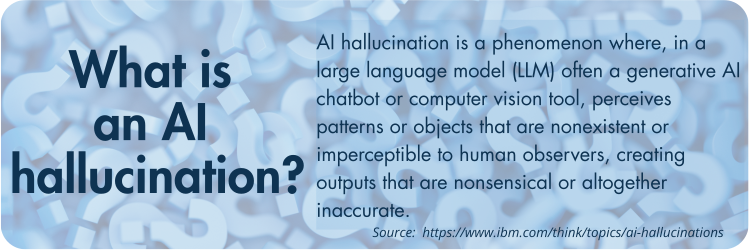
An AI dashboard can relay an issue with a building’s HVAC system, such as heating unoccupied floors on a warm evening. It suggests likely causes, but it is the team behind the dashboard that should use the information provided to make the final decision. This helps them minimize the legwork to reach a solution, while maximizing resource and time efficiency. AI, left to its own devices, can hallucinate, meaning wasted human resources, time, and costs on pointless maintenance callouts.
An FM supervisor, on the other hand, possesses that contextual experience and knowledge. They can prioritize actions, such as maintenance checkups, according to different operational considerations. Humans also possess the ability to think strategically and analytically. For instance, it might not be worth calling out an engineer for repairs if the FM overseer knows that the organization plans to upgrade entire heating system.
The partnership between AI and humans sits on balancing automated reporting and responsible oversight. Organizations must perform their due diligence on both sides of the proverbial coin while remembering that responsibility always sits with the teams, never the tools.
Building the groundwork for success
Humans are the custodians of AI. When FMs rush to blindly automate and embed AI without considering potential malfunctions, their AI strategies are doomed to failure. Risks such as hallucinations and bias are always present and are guaranteed to happen without strong groundwork to mitigate them.
Before proceeding, keep in mind a vital rule: organizations must prioritize accountability and transparency when building any AI framework and governance plan. Without them, FMs take a gamble on these tools, falling down a slippery slope where nothing is closely monitored, privacy laws are broken, hallucinations are accepted and data spins out of control. When these issues arise, it is never the tools that are blamed, but the teams that oversee them. Regaining command, once lost, is far more difficult than pursuing an AI strategy that ensures it is never lost in the first place.
With accountability and transparency as the compass to embedding guardrails, consider these factors before deploying AI:
-
How will each solution be used, and in which workflows will AI be embedded?
-
How will data origins, destinations, and handling be monitored?
-
What information must be encrypted in accordance with GDPR and other data privacy laws?
From the outset of AI implementation, people are responsible for ensuring the digital ecosystem is prepared to host these tools. The natural starting point is data, given the universal principle of garbage in, garbage out.
Additionally, map how and where system overrides and escalations to humans can take place. Sometimes threats or failures arise that are so acute that a total override or shutdown is required. Regardless of risks, every single pathway should lead back to a human making the final decision.
With the rise of autonomous AI, more of these tools are configured to automate workflows and trigger actions. However, these permissions should only be granted within a framework that allows supervising teams to understand why and how AI tools facilitated an outcome.
For continuous success and to ensure transparency and compliance, regularly audit any AI tools deployed within a building’s digital ecosystem. This is also an excellent way for FMs to ensure that they are on track to achieve KPIs, such as improved energy efficiency, fewer equipment failures and greater productivity among teams. Audits can also ensure organizations adhere to relevant regulations like the Building Safety Act and the GDPR, as they can uncover any issues that compromise data integrity or mishandling.
 Nurturing key skills
People cannot just hop into the role of AI custodian. These tools are still very new for most of its users, and FM staff do not tend to feature data scientists or computer engineers. This is not an overnight metamorphosis, but one that requires careful training and familiarization with algorithms and models behaviors, as well as technical best practices.
Technology is constantly evolving, and what defines relevant skills today may look vastly different tomorrow. An AI-driven digital future calls for a culture of continuous learning and improvement. No industry is exempt from this, including FM.
People are willing to welcome AI into the professional space if it means they can dedicate more time to higher-value work by taking on more repetitive tasks. But, as per a Stanford report, many organizations are inserting AI into the least ideal tasks, such as creating content or planning meeting agendas.
Therefore, FMs strategizing AI deployment must think carefully about where implementation makes sense, from an operational perspective and an ROI standpoint. That means crafting a partnership that fully accounts for human presence. That same report from Stanford finds that as AI becomes increasingly more capable, the valued skills of the future will shift. Crucially, that shift gravitates toward skills that “require human interaction and coordination.”
These look like effective communication, the ability to prioritize and think critically and analytically. AI and data literacy will also be important, as overseers of AI tools must understand how they function, but the pendulum will swing so that these innately ‘human’ skills are emphasized.
For instance, critical thinking will grow in importance as staff working with AI must assess its outputs, not simply blindly follow these tools’ recommendations. The teams which are best prepared to partner with AI are the ones that do not just focus on building data literacy but come with a set of skills that ensure the technology boosts both efficiency and ROI.
The best way to build a versatile skillset is through a hands-on approach to training. FM leadership should expose staff to potential scenarios where AI fails or hallucinates in the form of simulations. The closer to reality, the better, as a practical, not theoretical, approach will ground staff in how to responsibly oversee this technology. Short, digestible courses designed to propel targeted knowledge, such as a GDPR-compliant approach to AI, are strongly encouraged.
On top of this, be sure to assess staff’s performance by using these tools. Is AI integration in a collaborative human-technology partnership driving tangible results, like lower energy consumption and better cost efficiency? Has occupant comfort improved because of operational decisions with the help of AI-powered insights? What is the response and resolution speed of staff when issues arise? These are important indicators of AI success that leaders must keep in mind when deploying AI in facility management.
These three steps can help FMs create and maintain a viable partnership between humans and AI. They also keep deployment strategies in check to drive operational and profitability gains. Understanding where both AI and humans fit into the bigger picture and ensuring a strong collaborative framework is vital.

Read more on Facility Technology & Data Management and Leadership & Strategy or related topics Training , Facility Technology and Operations
Explore All FMJ TopicsRelated articles
-

Artificial Intelligence in FM
The stakeholder’s perspectiveBy Dr. Jake Smithwick & Dr. Kenneth Sullivan & Nneka Ubi05.01.2024 -

Don’t Drop the Ball
How a CMMS can make or break an FM organization’s successBy Michael Carmean09.17.2024 -

Beware of Growing Cyberthreats
Why it’s time for stronger facility cybersecurityBy Andrew Harris & Eric Headington10.30.2024