Membership
 Network
 Regional Sites & Affiliates


 Events
 Participate
 Resources

 Training
 Credentials
 Government


 Content Channels
 Tools
Tools


 Business Overview





The Predictive Edge
A roadmap for smarter FM

Facility managers are being asked to do more with less: extend the life of aging infrastructure, maintain safety, comply with increasingly complex standards and still control costs. For decades, the default response to equipment breakdowns has been reactive —repairs made only after something has already failed. While familiar, this approach exposes organizations to mounting risks: unplanned downtime, costly emergency interventions, energy inefficiencies and compliance violations that can threaten accreditation.
The emerging alternative is predictive maintenance, built on the principle of early warning. By identifying risks before they escalate into failures, predictive strategies transform maintenance from a burden into a proactive tool for efficiency, resilience and competitive advantage.
Why predictive maintenance matters
Risk mitigation & compliance: Predictive automation ensures continuous monitoring aligned with industry standards such as OSHA, ASHRAE, WELL Building and The Joint Commission. By documenting performance and alerts, organizations strengthen their facilities’ compliance while reducing the risk of penalties and failed audits.
Labor efficiency: With shrinking workforces, many organizations cannot afford round‑the‑clock manual inspections. Automation allows lean teams to cover more ground, eliminating repetitive walk‑throughs and focusing attention on tasks that require human judgment and skill.
Energy & sustainability goals: Predictive systems keep HVAC and lighting systems optimized, reducing wasted energy. Organizations pursuing sustainability certifications for their facilities or environmental, social and governance (also known as ESG) reporting benefit from quantifiable reductions in energy consumption and emissions.
The benefits of predictive maintenance are not theoretical — they are measurable. Studies have shown that it can reduce downtime by more than a third and cut maintenance costs by nearly a third as well. Facilities that adopt predictive practices also report significant energy savings, with some achieving reductions of more than 30 percent by optimizing HVAC systems and preventing leaks.
Beyond savings, predictive tools strengthen compliance. For hospitals, proactive monitoring supports Joint Commission requirements for equipment reliability. For commercial and educational buildings, predictive systems align with WELL Building standards, contributing to healthier and more sustainable environments. Perhaps most importantly, predictive approaches extend the life of critical assets, reducing the need for premature replacements and capital expenditures.
 Data‑driven decision-making: The historical data generated by automated monitoring provides a powerful basis for capital planning. Instead of relying on anecdotal evidence, facility leaders can point to trends and patterns that justify investments in upgrades or replacements.
Occupant comfort & satisfaction: Predictive monitoring reduces the discomfort caused by poor indoor air quality (IAQ), temperature swings or noisy failing equipment. Healthy and comfortable spaces contribute directly to productivity, patient recovery, student focus and guest satisfaction.
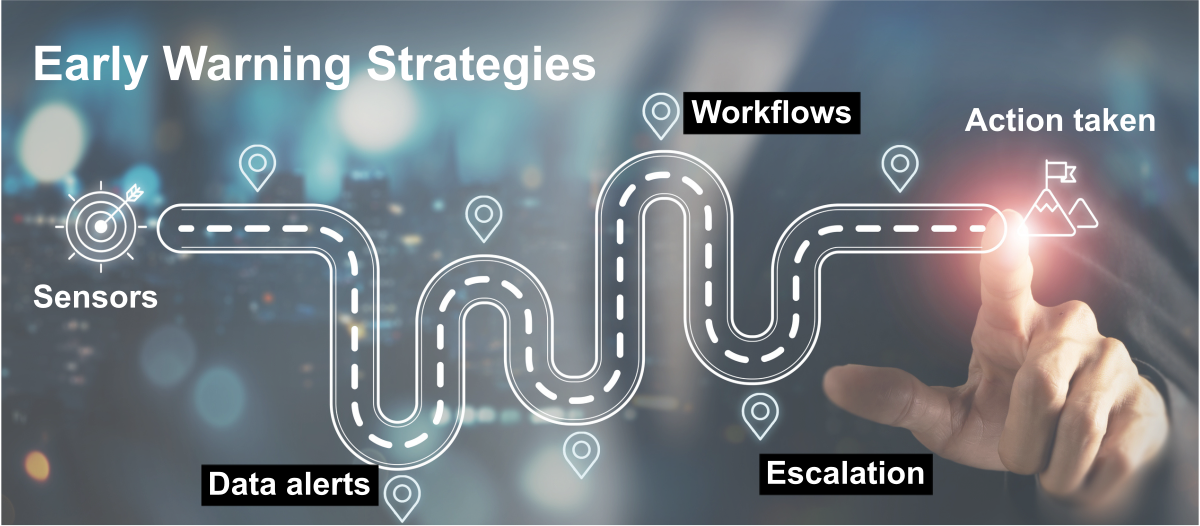
At the core of predictive maintenance is the ability to see problems before they happen. Wireless sensors make this possible by monitoring real-time conditions of high-risk assets. HVAC systems, for instance, can be tracked for shifts in temperature, humidity or pressure that signal declining performance. Water infrastructure can be equipped with leak detection devices to prevent costly damage and health risks. Rotating machinery and electrical systems can be fitted with vibration, current and temperature monitors to reveal subtle patterns that often precede failure.
These smart sensors deliver continuous data, alerting FMs the moment anomalies appear. This early intervention prevents unplanned disruptions and protects both safety and compliance.
Building practical workflows
Business continuity & resilience: Mission‑critical environments cannot afford interruptions. Automated alerts allow teams to address issues before they affect operations, protecting patient care, education delivery or government services from unexpected disruptions.
The true value of predictive strategies lies not just in the data, but in how teams use what they learn. Fortunately, effective workflows do not require advanced technical expertise. Many organizations begin with simple checklists identifying which assets should be prioritized. Automated alerts — delivered via text, email or call 24/7 — ensure that the right staff are notified, in real time. Escalation protocols define what happens when thresholds are crossed, ensuring small issues are contained before they grow into major disruptions and unnecessary costs.
In practice, these workflows create confidence and consistency. Facility teams move from firefighting to prevention, empowered by a system that supports decisions with evidence rather than guesswork.
Verification & accountability through audit trails: Smart sensors do more than generate alerts — they create an electronic audit trail that documents every reading, notification and response. This verifiable record strengthens accountability by showing when issues were detected, who was notified and how quickly the team responded. Audit logs can be used to demonstrate compliance during inspections, support insurance claims and validate service-level agreements. By integrating audit trails into predictive maintenance workflows, facility managers ensure not only faster resolution of issues but also transparent accountability across staff, contractors and leadership.
Multibuilding & scalable management
Scalability & future‑readiness: Wireless, modular systems enable facilities to start small and expand. This scalability supports multibuilding portfolios and prepares organizations for integration with digital twins, AI‑driven analytics and broader smart‑building strategies.
Financial transparency & ROI: Predictive maintenance translates into fewer emergency expenses and clearer budgeting. By shifting from unpredictable repair costs to planned interventions, managers provide leadership with reliable financial projections.
Understanding ROI in predictive maintenance also means quantifying the cost of inaction. When critical equipment goes down, the damages extend far beyond repair bills. Hospitals may be forced to reschedule procedures, resulting in lost revenue and reduced patient trust. In schools, HVAC failures can close classrooms and interrupt learning. For hospitality venues, outages affect guest experiences, leading to negative reviews and reputational damage. Government facilities and data centers risk security breaches or service interruptions with national implications.
A 2016 Ponemon Institute report cited that health care downtime costs could be as high as US$9,000 per minute, a figure still considered relevant for large enterprises in 2025 industry, adding up to tens of thousands of dollars, while in manufacturing it may exceed hundreds of thousands. By tracking avoided outages and documenting faster recovery times, facility managers can demonstrate ROI not only in dollars saved but also in business continuity preserved.
A comprehensive ROI analysis should therefore account for:
-
Direct repair and replacement costs avoided
-
Labor hours saved from emergency interventions
-
Revenue protected from uninterrupted services
-
Reputational value and stakeholder confidence maintained
-
Compliance fines or penalties avoided
By framing ROI in these broader terms, facility managers elevate the conversation from maintenance expense to strategic value creation.
Predictive maintenance is not confined to a single facility. It scales seamlessly across entire portfolios. A university can begin by monitoring HVAC systems in one building, then extend the program campus-wide. A hospital network can deploy predictive strategies in a flagship facility, then roll them out across all locations to ensure consistent standards of safety and efficiency. Manufacturing companies and government agencies can adopt centralized monitoring platforms, applying the same predictive rules across dozens or even hundreds of sites.
This scalability makes predictive tools globally relevant. Whether overseeing a single office complex in Europe, a manufacturing plant in Asia or a health care system in North America, FMs can adopt the same principles with measurable results.
Real-world takeaways
Hospitals: Beyond regulatory compliance, hospitals gain measurable savings by preventing outages in imaging suites, surgical theaters and pharmacy refrigeration. For example, preventing a single MRI cooling failure can avoid not only the six‑figure repair bill but also days of lost patient scheduling worth hundreds of thousands in revenue. Leak detection in patient care areas prevents costly remediation and protects infection control standards.
Schools: In educational settings, equipment failures disrupt learning and create unsafe environments. Predictive monitoring ensures HVAC stability during hot summers and cold winters, reducing absenteeism linked to poor IAQ or thermal discomfort. By extending HVAC lifespan, schools also defer capital expenditures, stretching scarce budgets further.
Hospitality: Hotels and resorts rely on seamless guest experiences. A leaking pipe in a ballroom or failed chiller during peak occupancy can damage reputation and drive guests to competitors. Automated monitoring enables property managers to correct small issues discreetly before they affect guests, preserving both brand reputation and revenue.
Government & critical infrastructure: Federal, state and municipal buildings, along with data centers, must ensure continuity of service. Predictive systems reduce vulnerability to outages that could compromise public services or national security. When coupled with escalation protocols, predictive alerts form a key component of resilience planning.
The path forward is clear. FMs can begin by identifying their most critical assets and piloting remote predictive monitoring where the risks are highest. From there, they can build straightforward workflows, linking sensor data to existing systems and staff protocols. Documented results not only demonstrate return on investment but also provide evidence of compliance during audits.
Predictive maintenance represents more than a tactical improvement. It is a strategic approach that strengthens resilience, supports sustainability and positions facilities for the future. By embracing the remote early warning predictive edge, FMs gain not just visibility into what is happening now, but foresight into what will happen next — a capability that transforms maintenance from a reactive cost center into a proactive driver of organizational success.

Angela Cabrera is the Founder and CEO of Alegna Technologies, Inc., a U.S.-based company specializing in IoT-AI enabled predictive maintenance solutions for healthcare, government, education, and critical infrastructure. She leads initiatives that combine smart sensors with hundreds of smart solutions, IoT platforms, and 80+ different types of smart sensors AI-driven for advanced data strategies to reduce critical equipment downtime, extend equipment life, improve compliance and daily operational efficiency. Cabrera collaborates with research institutions such as Georgia Tech and Georgia Southern University to accelerate innovation in FM. She has been recognized by Engineers Outlook, IAOTP and Marquis Who’s Who for her leadership in advancing smart infrastructure.
Read more on Facility Operations , Risk Management and Leadership & Strategy or related topics Risk Management , Operations and Maintenance Planning and Business Continuity
Explore All FMJ Topics