 Membership
 Network
 Regional Sites & Affiliates


 Events
 Participate
 Resources

 Training
 Credentials
 Government


 Content Channels
 Tools
Tools


 Business Overview





The Truth About Infrastructure Upgrades
Why “make it last” actually costs more
For facility and operations managers, the greatest threat to long-term efficiency is underinvesting. Short-term budget cuts that defer critical infrastructure upgrades often create a dangerous cycle of inefficiency, mounting maintenance costs and constrained capacity. What seems like a cost-saving decision today can lock a facility into higher future expenses and operational risks.
To break this pattern, it is vital for facility leaders to approach capital projects as continuous, strategic investments rather than isolated expenditures. This approach requires designing systems for scalability and integrating phased upgrades to aging infrastructure into each new project budget. By embedding these practices into approval and funding processes, organizations can control capital costs, enhance flexibility, sustain operational resilience and transform facilities into assets that grow in value rather than liabilities.
 The escalating price of deferring upgrades
Research found that the average U.S. facility carries 12 percent of its asset value in deferred repairs. Yet, the financial consequences of deferring infrastructure upgrades rarely surface all at once. Instead, they accumulate across multiple fronts, compounding operational and financial risks.
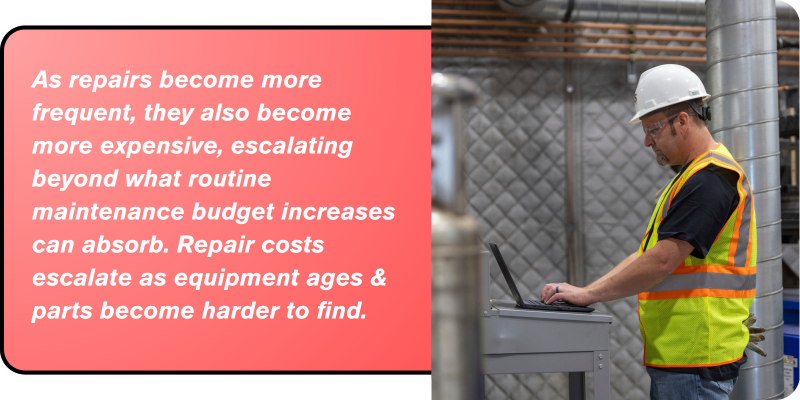
As repairs become more frequent, they also become more expensive, escalating beyond what routine maintenance budget increases can absorb. Repair costs escalate as equipment ages and parts become harder to find. For example, annual electrical maintenance and breaker rebuilds can keep a switchgear lineup operating for 25 or 30 years, but at some point, suppliers begin flagging extended lead times and limited parts availability.
Once manufacturers discontinue components, facilities move from original equipment manufacturer (OEM) suppliers to third-party vendors and then to salvage sources, paying a premium at each step. These signals indicate that the equipment is approaching the end of its supportable life. Vendor communication regarding parts availability is a serious red flag that warrants immediate attention.
Eventually, switchgear lineup failure cannot be resolved with another repair call. It will force a full gear replacement on its own schedule. An unplanned full gear replacement may have lead times of several months, and extended outages will affect the entire building that relies on that switchgear.
Even before that catastrophic failure, another red-flag pattern often emerges: each outage takes longer to resolve than the last. Systems that were once restored quickly now require extended diagnostics and longer procurement lead times, increasing downtime. The costs of lost production time during unplanned outages typically exceed the repair cost itself, particularly when central systems support multiple active operations. Emergency workarounds, such as temporary systems, expedited procurement and contract labor mobilized on short notice, carry costs that are disproportionate to those of a planned upgrade.
 It is the infrastructure equivalent of keeping an old car that is constantly in the shop. At some point, the money spent on repairs and rental cars while the old car is being worked on would cover the cost of a new vehicle.
 High-risk systems: Where to focus attention
Infrastructure risk is not evenly distributed across a facility. The systems that warrant the greatest scrutiny are those that support multiple test cells or areas of the facility, such as electrical distribution, mechanical, electrical and plumbing (MEP) systems, process water and ventilation. When any of these central systems fail, the impact extends to every operation they support, making the cost of operational failure significantly higher than the repair cost of the system itself.
Deciding when to replace these systems is often challenging, necessitating negotiation between facility and operations managers. For operations, the question is whether the critical system can hold out for another six months. Under budget pressure, the facility manager often says, “yes.” This back-and-forth continues until those red-flag costs become undeniable, increasing the probability and severity of eventual failure.
Revisiting the aging car analogy, a driver can drive with worn tires for a while, but a failed coolant system will ruin the engine. While replacing the tires can be delayed longer than ideal, ignoring the coolant light is a high-risk decision. Applying this logic to facility infrastructure requires identifying which systems, if they fail, would shut down revenue-generating operations for days or weeks. When FMs map systems to specific operational consequences and quantify unplanned downtime costs, the business case for capital investment becomes substantially harder for operations leadership to defer.
The capital planning window: FM’s best opportunity
Aging infrastructure also limits an organization’s ability to compete for new work. In organizations that allocate projects across multiple sites, facility conditions directly influence which one is selected. A site that requires significant upgrades to support a new program will incur a higher activation cost than one that is already capable of supporting it. In competitive internal evaluations, that difference can determine where the work goes.
The practical implication is that early-stage capital planning discussions represent the best, and often the only, opportunity to secure funding for infrastructure improvements. Once a project's scope and budget are established, adding infrastructure line items requires adding funds, which typically face a significantly higher approval threshold than items incorporated while the project is still being scoped. These needs raised after budget approval are typically evaluated as overruns.
 As they map how the new project will tie into existing utilities, such as power and ventilation, they can identify where upgrading a shared system to support the new project will become a de facto upgrade to the facility operations that use it. This perspective presents a fundamentally different business case for the system upgrade than when the work is framed as a single-test-cell upgrade.
Making the case: from generic allocation to needs-based assessment
Some organizations require a certain percentage of a new project’s budget to be allocated to infrastructure upgrades. For example, the U.S. state of Utah requires state facilities to allocate 1.1 percent of their current replacement value (CRV) to capital upgrades before approving new capital projects, establishing infrastructure upgrade investment as a prerequisite for growth investment rather than a competing priority.
There is no universally applicable set-aside percentage for infrastructure upgrades, and this set-aside approach is not widely used. A more practical approach is to systematically evaluate an existing system’s capacity against the specific demands of each proposed project. If a new program requires 50 percent more chilled water capacity than the current system provides, that upgrade should be scoped, priced and included in the capital project budget, not carried forward as a standalone request that may never be funded.
This needs-based assessment also provides a legitimate basis for advocating for the phased replacement of aging systems. If a project necessitates piping changes, the case can be made to remove and replace obsolete piping back to its source rather than cutting and capping, which leaves aging infrastructure in place and inflates replacement costs later. Completing that work during a planned capital project, with mobilized contractors and an active budget, is generally less expensive than addressing it as an emergency or as a standalone project that must compete for approval. Requests framed around accumulated liability rather than incremental project needs are harder to ignore than a vague contingency line on a single project.
The choice between central and unitary systems is one of the most consequential infrastructure decisions an organization makes, shaping facility economics for years. Neither architecture is universally superior. The right answer depends on the facility age, the condition of existing infrastructure, project criticality and the long-term operational strategy.
 Understanding the trade-offs
Central systems are more cost-efficient at scale but introduce a single point of failure and make capacity expansion more disruptive. A central ventilation distribution system serving an entire facility operates efficiently when fully utilized, but a failure affects every connected operation simultaneously. Expanding a central system in an existing facility is also rarely straightforward. It typically requires integrating new equipment with aging infrastructure that was not originally designed to support it.
Unitary systems isolate project risk; a failure in one system does not propagate across the facility. They have higher per-unit operating costs and can leave existing central system capacity underutilized. This visible inefficiency invites scrutiny from operations and finance leadership, particularly in facilities that have invested significantly in central infrastructure.
Applying the framework in practice
For new facility design, it is vital to engineer scalability into the original system architecture. Scalability is not overbuilding. It is sizing the infrastructure and physical layout so that adding capacity is a low-cost, low-disruption operation. Designing a chilled water system for the current load while structuring the plant to accommodate a second chiller as demand grows is different from sizing to the edge of current capacity and forcing an ad hoc expansion later.
For existing facilities, options are more limited. Central systems that are functional but approaching capacity leave facility managers to choose between piecemeal additions that integrate awkwardly with aging infrastructure and shifting new projects to unitary design to avoid disturbing systems that are expensive to modify. Project criticality is often the deciding factor. When a program cannot accept downtime risk, the calculus frequently favors a unitary system, regardless of what the central system can support.
The pattern worth naming directly is the capacity paradox: organizations consistently upgrade central systems only to meet the demands of the current project, which means each subsequent project inherits the same capacity constraints. A more durable strategy is to treat each capital project as one phase in a longer-range infrastructure plan, using funded work to meet today’s load while also retiring brittle systems and replacing them with architectures that can accommodate the next round of increased demand without requiring major rework.
Infrastructure upgrades as a catalyst for operational transformation
Infrastructure upgrades create opportunities for operational breakthroughs that extend far beyond replacing aging equipment.
 For example, when an R&D facility brought infrastructure upgrade discussions into early project planning, conversations among project partners revealed an alternative to their two-hour engine changeover process, which used crane swaps, spreader bars and carts. A redesigned approach could cut that process to 15 minutes.
These transformative improvements typically surface when capital planning incorporates knowledge of what is working at other facilities and exposure to current industry practices. The key is to apply capital planning advocacy practices early, quantify operational impacts and connect upgrades to project needs to achieve more than preventing deferred maintenance crises. This can spark conversations that lead to insights FMs can use to reshape operations and shift facilities from cost centers to competitive advantages.

Matt Jorgensen, director, facility engineering and site management, ACS has an extensive background in the testing and production industry. He brings valuable experience in white paper conception, detailed engineering and project management across a diverse range of projects, including individual small-scale test equipment and the establishment of entire technical centers. His expertise spans a wide array of products, encompassing components, engines, vehicles and batteries. While still actively involved in project management, Jorgensen directs his focus toward aiding clients in planning and defining new projects. In collaboration with both new and existing clients, he plays a key role in scoping, concepting and estimating potential projects, ensuring a strategic setup for success once awarded.
References
Images courtesy of ACS.
Read more on Facility Operations and Finance & Business or related topics Operational and Capital Budgeting , Operations and Maintenance Planning and Maintenance Processes
Explore All FMJ Topics