
 Membership
 Network
 Regional Sites & Affiliates


 Events
 Participate
 Resources

 Training
 Credentials
 Government


 Content Channels
 Tools
Tools


 Business Overview




The Warranty is Still Valid
Why is the organization still paying?

A modernization project can remain under warranty and still create unexpected operating burdens for the organization.
Consider a lighting retrofit installed across an occupied building or operating site. The equipment has been accepted, the warranty remains valid, and replacement parts may still be available from the manufacturer. Several years later, drivers, sensors or control modules fail. Even when the failed components are covered and replacement parts are supplied at no charge, the work required to diagnose, access, replace, test and document the failure and claim is not.
The FM team must identify the failure, confirm eligibility, coordinate the claim, arrange access, protect occupants or operations, schedule labor and restore the required service condition. Work may need to occur outside normal hours, adding to the operating burden. Temporary lighting, cooling, ventilation or control measures may be required. Repeated failures may also raise a more serious question: is the facility dealing with isolated events or a systemic problem across the installed population?
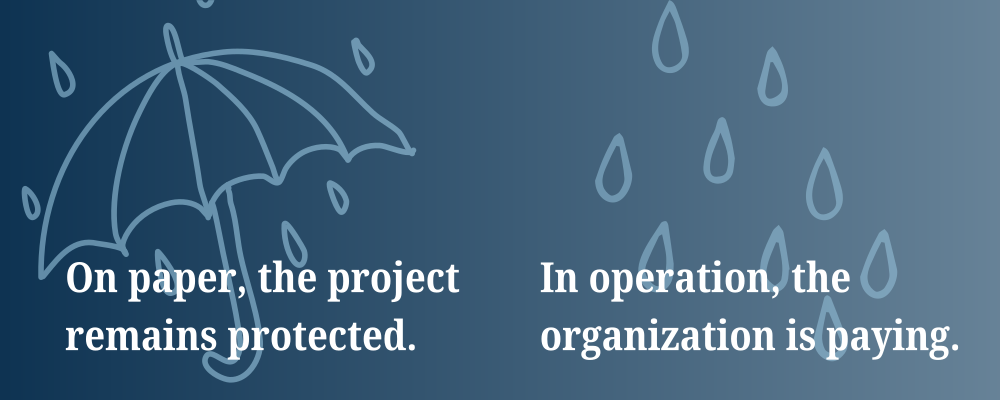 The distinction matters because a warranty answers a narrower question than the one FM must manage. A warranty normally defines whether a component qualifies for repair or replacement under specified conditions. It does not necessarily define the total burden created when that component fails.
 Warranty coverage is not life cycle protection
FM teams do not inherit warranty documents alone. They inherit the operating result.
That result includes service quality, maintainability, access requirements, failure response, interruption risk, replacement coordination, evidence retention and life cycle cost. A project can satisfy its formal warranty terms while performing poorly against several of these operating requirements.
The problem is not always defective equipment or an unreasonable supplier. It often arises because the project treated component coverage as complete protection against life cycle exposure. Those are different things.
A warranty may cover the physical item while excluding labor for diagnosis and replacement, lifts or scaffolding, work outside normal hours, temporary service, disruption to occupants or production, administrative coordination, recommissioning, repeated service visits, consequential damage or related components outside the warranty scope.
These exclusions may be commercially reasonable. The FM problem begins when they are not made visible in the project economics, operating plan or handover package.
The mismatch between expected and actual results can also create friction between teams. Responsibility is difficult to assign when the causes span multiple functions or were obscured during implementation. FMs often inherit a system configuration they did not design and cannot fully control.
Compare the contract record with the operating record
A practical way to expose the gap is to maintain two linked records: what the contract says and what the organization and asset actually experiences.
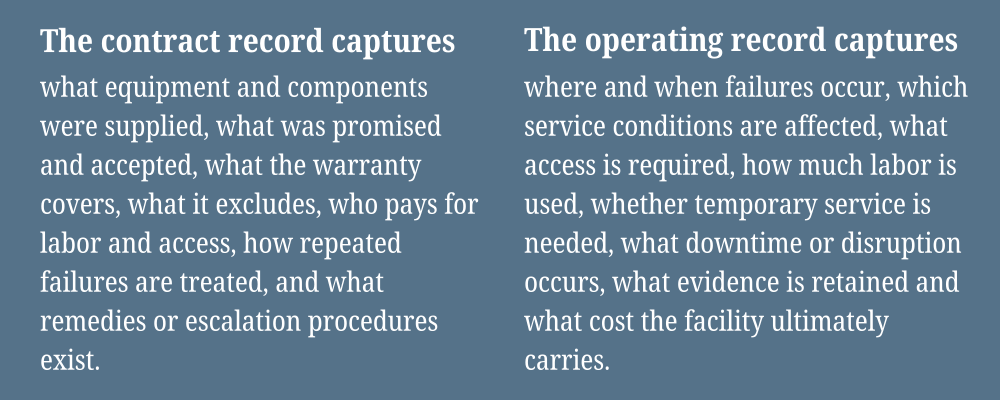
These records do not require two new accounting systems. Most of the information already exists across contract schedules, warranty files, commissioning reports, work orders, computer-aided facility management (CAFM) or integrated workplace management system (IWMS) fields, maintenance logs and capital-planning documents.
The important point is that the records remain comparable.
When the contract record says, “covered under warranty,” the operating record should show what that coverage meant in practice. Did the supplier provide a component while the organization absorbed labor, access equipment, disruption and coordination? Did the event close quickly or remain unresolved for months? Was it isolated or does a recurring pattern indicate a broader reliability or specification problem?
Without that comparison, the organization may count warranty coverage as protection while repeatedly absorbing costs that were not visible at approval.
Component life is not always system life
 Modernization projects are often presented through the expected life of the primary asset. Yet many systems depend on components with shorter operating horizons.
A luminaire may have a long-expected service life while its driver, sensor or control module has a shorter one. An HVAC system may depend on sensors, actuators, controls, filters, calibration and periodic recommissioning. Drives and automation systems may require replacement of electronic modules, cooling components or control devices well before the primary equipment reaches the end of its life.
These shorter component horizons create predictable midcycle burdens.
They are not necessarily failures. Some are normal life cycle events. But when they are absent from the original economic model and operating budget, they arrive as surprises and create unplanned cash outflows. The FM is then left to explain why a project expected to reduce maintenance has created a new replacement program — or why the FM is paying to maintain equipment that remains under warranty.
A life cycle view therefore must identify which components are likely to require replacement before the main system does, whether those replacements are covered, who pays for labor and access, how temporary service will be maintained, and whether expected replacement events were included in the approved business case.
What FM should receive at handover
A box of manuals and warranty certificates is not a complete handover.
For systems with material warranty or component-horizon risk, the facility team should receive a usable operating package that identifies component horizons, warranty scope and exclusions, labor and access responsibilities, claim procedures, response times, repeated-failure rules, temporary-service requirements, evidence needed to preserve warranty rights, commissioning and configuration records, and the method for recording the operational cost of warranty events.
The same information is still useful when the original handover was incomplete. Facility teams can reconstruct the record from contracts, submittals, closeout documents, work orders and supplier correspondence, then use later events to evaluate whether the original assumptions remain credible.
A practical warranty-exposure register
A compact register can convert scattered warranty events into usable FM evidence. The objective is not to create another administrative system. It is to connect claims, operating burden and repeated events in a form that supports action.
|
Register field |
What it should capture |
|
Asset or component |
The affected item and system. |
|
Location |
Building, floor, room, zone or equipment area. |
|
Installation date |
Age of the component when the event occurred. |
|
Failure date |
When the event was first observed. |
|
Service impact |
Effect on lighting, comfort, ventilation, control, safety or operations. |
|
Warranty status |
Covered, excluded, disputed, expired or not confirmed. |
|
Claim status/resolution date |
Open, approved, denied, fulfilled and time to closure. |
|
Parts covered |
What the supplier or manufacturer actually provided. |
|
Facility labor and access cost |
Internal or external labor, lifts, scaffolding and access arrangements. |
|
Downtime or temporary-service impact |
Interruption, tenant or occupant effect, temporary equipment and after-hours work. |
|
Attribution and evidence note |
Likely cause, responsible or controlling party, and records supporting the conclusion. |
|
Corrective action/repeat-failure flag |
Action taken and whether the event indicates a broader pattern. |
Facility teams can also define a simple escalation rule so repeated failures of the same component move from routine work-order handling to supplier review, engineering assessment or capital-plan revision.
The register creates the evidence needed to distinguish among manufacturer defects, installation defects, customer-controlled operating conditions, inadequate maintenance, changed usage, normal component replacement and systemic project underperformance.
That distinction protects the organization as well as the responsible suppliers and contractors. Not every operating problem should become a general accusation that the project failed, nor should a replacement part supplied at no charge be counted as proof that the organization was fully protected.
The FM test
 Before handover, FM should ask not only how long the warranty lasts, but also what the organization will still have to do, pay for and manage when a covered component fails.
If that answer is unclear, the project has not been fully transferred as a manageable operating asset.
The contract may remain valid. The warranty may remain valid. The equipment may even continue producing energy or operating savings. But if the facility repeatedly absorbs access, labor, disruption and replacement burdens that were never visible in the project case, the modernization is contractually protected and operationally exposed.
FM makes that difference visible by comparing the contract record with the operating record, tracking component horizons and treating warranty events as life cycle evidence rather than isolated service calls.

Dr. Sergey Kyunttsel, Ph.D., is an economist and independent researcher with more than 15 years of experience in investment evaluation, corporate finance and industrial modernization. His work examines how approved capital cases translate into operating outcomes, with a focus on life cycle costs, performance verification and post-handover governance in energy and facility projects. He previously led strategic development and financial planning and analysis functions and has worked with energy-efficiency, lighting and distributed-generation projects in industrial and built-environment settings.
References
Top image via Getty Images.
Read more on Facility Operations , Risk Management , Project Management and Finance & Business or related topics Operational and Capital Budgeting , Supplier or Vendor Management , Risk Management and Project Management
Explore All FMJ Topics