
 Membership
 Network
 Regional Sites & Affiliates


 Events
 Participate
 Resources

 Training
 Credentials
 Government


 Content Channels
 Tools
Tools


 Business Overview





Unifying the FM Ecosystem
A guide to seamless system integration
The built environment exemplifies rapid technological advancement and evolving business needs. Despite this progress, a critical barrier persists: disjointed digital systems hinder effective collaboration and communication.
Facility management teams are charged with delivering operational efficiency, championing sustainability and enhancing occupant experiences, while simultaneously remaining agile amid shifting priorities. To achieve these various (and at times competing) goals, FM teams must be equipped with integrated digital platforms.
A brief history of the patchwork challenge
As new FM solutions became available, FM teams added them on top of their existing technology stack. While this approach was necessary at the time, it left teams with a haphazard, patchwork IT infrastructure, inhibiting the full potential of each solution and synchronicities across different tools.
Decades ago, building management systems (BMS) introduced a revolutionary capability: the automation of heating, ventilation, air conditioning and lighting. Subsequently, computer-aided facility management (CAFM) and computerized maintenance management systems (CMMS) enabled FM teams to digitize asset management and maintenance scheduling processes.
The emergence of Internet of Things (IoT) devices allowed real-time tracking of critical metrics like occupancy, temperature, air quality and space utilization. These advancements, while individually transformative, have created a landscape wherein systems rarely interoperate seamlessly.
Further compounding this issue is the fact that different departments within a single organization may select their own platforms to manage assets, maintenance, bookings and energy data. As a result, data becomes siloed, integration points are rare and key processes — like worker dispatch, issue tracking and reporting — become plagued by duplicated entries or incomplete information. The lack of a holistic ecosystem complicates even basic consolidation tasks and makes it nearly impossible for FM teams to see a comprehensive view of building or workforce health.
While this technological patchwork once sufficed for specialized needs, it now inhibits efficiency. Today’s facilities are dynamic, multipurpose and must meet digital-native expectations.
Why integration is a strategic imperative
Integration is no longer an option; it is a necessity. Multiple strategic imperatives underscore this reality.
Operational efficiency depends on unified systems that automate end-to-end workflows. For instance, a fault detected by a BMS sensor should instantly trigger a work order in the CMMS, with updates reflected in real time across both platforms. Manual operation leaves the door open for inconsistency and decreases overall productivity.
Moreover, capitalizing on the full potential of facility data is a prerequisite for advanced analytics. Without integrated data streams, organizations cannot identify energy waste, predict equipment failures or optimize space allocation. Data-driven decision-making requires comprehensive, accurate and timely information.
 Modern occupants expect and deserve superior workplace experiences, including seamless access to real-time information about space availability, indoor air quality and support services. All these services require underlying systems to communicate freely and consistently.
Resilience and compliance also depend on interconnected platforms. Fragmented systems expose global organizations to unnecessary cybersecurity risks, make regulatory compliance (like GDPR or energy reporting) more difficult, and jeopardize business continuity due to vendor transitions.
As smart buildings, digital twins and AI-powered maintenance become more commonplace, FM teams will need a strong, connected digital foundation. Systems must be able to exchange data fluidly if such innovations are to be adopted efficiently and at scale.
Common integration challenges
While the benefits of integration are undeniable, the path to attain those benefits is not as well defined.
Legacy systems, such as chillers, lifts or lighting controllers, are rarely designed with open connectivity in mind. Replacing or upgrading these legacy systems requires significant cost and risk, especially when business-critical operations cannot afford to be interrupted.
Proprietary systems and vendor contracts further complicate integration because they limit access to data. They may even penalize third-party interoperability. Even when integration protocols do exist, variations across platforms like BACnet, Modbus, MQTT and REST APIs require either middleware solutions or custom-built solutions to bridge the gaps.
As such, successful integration projects demand comprehensive, organized and strategic change management. Facilities teams may need to acquire new skills, sharpen workflows and manage the inevitable resistance that comes with disrupting established processes.
Best practices for creating unified platforms
Many industry-leading organizations are pursuing pragmatic strategies to overcome integration obstacles and create unified FM ecosystems.
A cornerstone for these strategies is to use modern middleware platforms as a “universal translator.” Instead of opting for the expensive approach of replacing all legacy systems, middleware can connect existing OT (like BMS, sensors and meters) to new IT platforms (such as CAFM, HR and ERP), streamlining data flows and exposing secure, open APIs for additional innovation. As FM teams evaluate potential middleware platforms, it is important to consider criteria like support for broadly used industry protocols, robust security features (including encryption and identity management), and a vendor-agnostic design to preserve future flexibility.
As FM teams begin their integration journey, it is vital to map a clear data architecture at the outset. Effective and successful integrations begin with detailed planning, such as defining what information must flow where, which teams require access to that data and establishing governance mechanisms for data quality. The adoption of industry data standards such as the Brick Schema for building metadata or openBIM for asset information significantly improves interoperability and eliminates the need for expensive, custom development.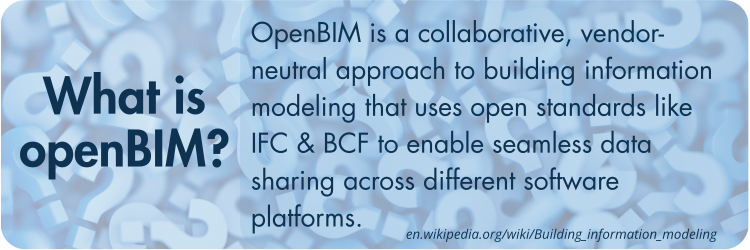
In most cases, a phased integration approach will yield the most sustainable results. Instead of attempting a sweeping overhaul, the most successful integrations often prioritize high-value use cases, such as integrating critical alarms from BMS into the CMMS or linking occupancy data with cleaning schedules. An incremental approach minimizes disruptions, enabling teams to gain confidence and deliverable measurable outcomes before expanding the integration.
Partnering with experienced, trusted technology providers and system integrators is another best practice. These trained experts can help FM teams navigate both the technical challenges and contractual complexities that might otherwise hinder integration efforts, ensuring alignment with existing vendor agreements and reducing operational risk.
Critically, an integration effort’s value is ultimately measured by its practicality on the frontlines. Simplified user interfaces, mobile accessibility and seamlessly embedded alerts (via tools like Microsoft Teams or WhatsApp) not only accelerate adoption but optimize impact. Integrations should always be strategically designed to enhance end-user experiences and fit within established workflows.
Security and compliance are the final, non-negotiable aspects of integrated platforms. Given that wider connectivity increases risk exposure, organizations must adhere to rigorous cybersecurity standards: updating firmware, segmenting networks, enforcing least-privilege access and working in lockstep with IT security teams to ensure every integration meets enterprise requirements as well as regulatory mandates.
The result: A smarter, stronger FM ecosystem
Organizations that invest in integrated platforms now will position themselves to confidently embrace the future of FM. Unified systems support new innovations, automated energy optimization, digital twins, AI-powered predictive maintenance and occupancy-based services. When information can flow seamlessly from field devices to cloud-based analytics, FM teams gain actionable intelligence, enabling them to respond to evolving needs faster. As a result, both the organizations and its occupants benefit.
The road to unified operations is complex; it requires careful change management, technical expertise and respect for existing investments. Despite the challenges, the rewards for integration — organizational agility, operational efficiency, sustainability and resilience — are worthwhile. With the support of the right partners, these rewards are not only worth the effort but readily attainable.
FM leaders considering an integration project should seek guidance from solutions partners with proven experience in facility technology integration. Additionally, engaging with industry forums and peer networks can illuminate valuable insights into best practices and lessons learned. By unifying today’s fragmented systems, the FM community will lay the digital foundation necessary for the smart, resilient buildings of tomorrow.

Rogier Roelvink is an Industry and Customer Value Director at Oracle. He supports clients in digital transformation throughout Asia-Pacific. Rogier has extensive asset and facilities management advisory experience and a passion for informed decision-making. He is actively advancing the facilities management industry as chair of the FMA’s Digital Technology & Innovation Special Interest Group.
References
Top image by Getty Images.
Read more on Facility Technology & Data Management or related topics Data strategy and information management
Explore All FMJ TopicsRelated articles
-

Artificial Intelligence in FM
The stakeholder’s perspectiveBy Dr. Jake Smithwick & Dr. Kenneth Sullivan & Nneka Ubi05.01.2024 -

Don’t Drop the Ball
How a CMMS can make or break an FM organization’s successBy Michael Carmean09.17.2024 -

Beware of Growing Cyberthreats
Why it’s time for stronger facility cybersecurityBy Andrew Harris & Eric Headington10.30.2024