
 Membership
 Network
 Regional Sites & Affiliates


 Events
 Participate
 Resources

 Training
 Credentials
 Government


 Content Channels
 Tools
Tools


 Business Overview





When AI Fails
Rebuilding a successful foundation

AI projects in facility management are becoming easier to start but much harder to scale successfully. Pilot programs often produce encouraging results: sensors provide clean data, models generate useful predictions, and dashboards reveal insights that appear valuable under controlled conditions. In most cases, the technology performs as expected. However, challenges arise when AI moves into live operations.
Real-world environments introduce variables that pilot programs typically overlook, such as building management systems that were never designed to exchange data seamlessly, inconsistent maintenance records across sites, and workforce pressures that hinder consistent execution. The operational infrastructure and organizational culture on which AI depends for value creation often prove to be more consequential than many organizations anticipate. Ultimately, it is these foundations — not just the AI itself — that determine whether the technology delivers consistent value.
A study conducted by Censuswide for Fluke Corporation involved more than 600 senior decision-makers and maintenance professionals across the United States, the United Kingdom and Germany. The research suggests expectations are already becoming more pragmatic. As businesses move from experimentation to implementation, the focus is shifting from what AI might achieve to the conditions necessary for it to deliver measurable results. For FM leaders responsible for building performance, operational continuity and asset reliability, that distinction is critical.
The biggest investments are happening behind the scenes
One of the clearest indicators of this shift is where organizations are choosing to invest. The research found that two-thirds of organizations now allocate between 16 and 30 percent of their maintenance budgets to new technologies. Yet the most significant investments are not necessarily going toward the latest applications.
Instead, areas such as cybersecurity, data management, generative AI and industrial AI are attracting a growing share of spending because they are closely tied to operational performance. Cybersecurity ensures business continuity, data management improves the quality of operational decisions, and industrial AI supports reliability and uptime. Together, these areas help create the conditions needed for better asset management and more reliable operations.
The pattern extends beyond facilities management. Organizations are becoming less interested in experimentation for its own sake and more focused on measurable operational outcomes. Whether the goal is to improve asset performance, reduce maintenance costs or lower energy consumption, technology investments are expected to demonstrate tangible value.
For FM teams, this sense of accountability is especially important.
If AI cannot be trusted in environments where compliance, occupant comfort and business continuity are at stake, initial enthusiasm will quickly give way to scrutiny.
Why historical data is harder for AI to interpret than people expect
FM has always depended on human judgment. A maintenance note stating that a chiller was inspected and is operating normally may be perfectly meaningful to the engineer who recorded it. An unusual vibration reading might immediately trigger concerns for a technician who remembers seeing similar behavior months earlier. Similarly, a recurring HVAC issue may only make sense to someone who understands a building’s specific operational history.
FM teams have successfully relied on experienced professionals to supply the context that operational records often lack. However, AI does not automatically offer that context. A model reading the same maintenance note sees only the information recorded; it cannot draw on years of experience or site-specific knowledge. It cannot determine whether a reading indicates a recurring problem, a known exception or the onset of a new issue. The data is not necessarily wrong. It often lacks the context that experienced technicians take for granted.
This challenge only becomes more apparent as AI initiatives scale. Most facility teams already have vast amounts of information across CMMS platforms, building management systems, energy monitoring software and asset databases. The issue is rarely the volume of data available. More often, it is whether that information is consistent, contextualized and accessible enough to support reliable decisions. As a result, many organizations find that scaling AI requires significant work on data quality, governance and standardization before the technology itself becomes the primary concern.
Technology isn’t the biggest barrier to progress
It is clear that AI's success depends on more than technology alone. For many organizations, the critical issue is whether their operational processes and workforce capabilities are sufficiently mature to support consistent decision-making.
Maturity is evident in the routines that surround technology, such as how maintenance priorities are established, how information is shared between sites, and how exceptions are managed. Fluke’s recent research on digital maturity found that around 78 percent of reported barriers to progress are related to workforce and capability issues, rather than technology or budget constraints. The constraint sits within the organization itself, in what people know and how teams work.
Many organizations now have access to more technology than they have people prepared to use it effectively. FM teams that derive the most value from AI tend to be those that invest as much in workforce development, process maturity and knowledge transfer as they do in technology implementation. While new technology can create opportunities, organizations still need the right processes, skills and experience to transform those opportunities into measurable results.
Understanding the difference between generative AI & industrial AI
As the adoption of AI accelerates, facilities leaders are increasingly evaluating different types of AI to address various operational challenges.
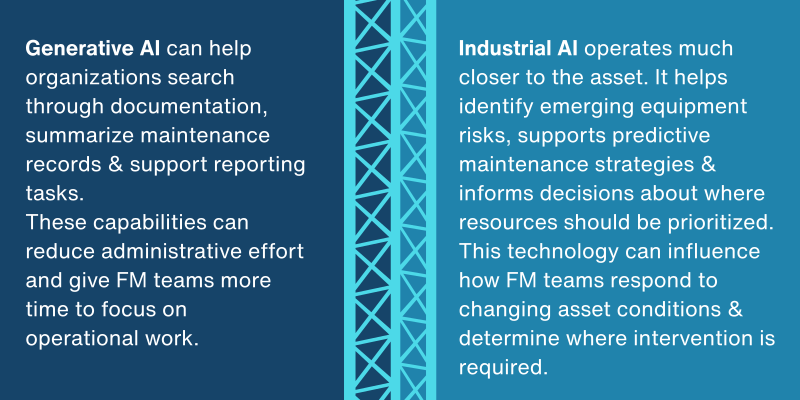
This distinction matters because the operational consequences are different. An incorrect summary in a report may cause inconvenience, whereas a missed warning signal related to critical electrical infrastructure, HVAC systems or building controls can significantly impact operational continuity.
The distinction also affects how FM teams think about productivity. In FM, inefficiencies often arise from variability, such as technicians searching for the correct procedures, planners dealing with incomplete maintenance histories, or critical knowledge being concentrated among a few experienced individuals. AI can reduce these inefficiencies, but only when the information it provides is trusted and directly linked to the tasks at hand.
The most valuable AI is often invisible
 The strongest evidence that AI delivers value in an industrial environment rarely is a matter of just showing up on a dashboard. It appears in the problems that never happen: a critical asset failure avoided, an HVAC issue identified before it affects occupants, or an electrical fault addressed before it causes disruption.
These outcomes may not always attract attention, but they are often where the greatest value is created. This is why connected reliability is becoming such an important priority for FM leaders. Visibility alone has limited value. What matters is whether information leads to actions that prevent problems from impacting operations. In that environment, AI has something meaningful to work with: accurate information, consistent processes and the ability to support better decisions before problems occur.
According to the survey, nearly half of the respondents plan to advance their reliability initiatives over the next 12 months. However, as AI moves beyond the pilot phase, FM leaders are frequently asking practical questions about resilience, continuity and risk. These are the measures that matter most, as they determine whether technology truly creates value in the environments where operational performance is critical.
AI will not succeed simply because the technology improves. It will succeed when organizations improve the quality of their data, strengthen operational processes, and equip people to act on the information available to them. The technology is proven. The question now is whether organizations have the data, processes and workforce capabilities needed to realize its value.

Vineet Thuvara, is chief product officer at Fluke, a global leader in compact, professional electronic test tools and integrated software. Thuvara leads the company’s solutions and strategy organization, focusing on enhancing the customer experience through innovations in hardware, software, analytics and services. He previously held leadership roles at Amazon, overseeing the Alexa Echo product organization, and Microsoft, where he spent 15 years in various leadership roles across Surface, Xbox and Server and Cloud product organizations. He was also co-founder and CEO of 5th Quadrant, an Industrial Design company based out of New Delhi, India.
References
Top image via Getty Images.
Read more on Facility Technology & Data Management , Facility Operations and Project Management or related topics Operational Technology , Operations , Project Management and Facility Technology
Explore All FMJ TopicsRelated articles
-

Artificial Intelligence in FM
The stakeholder’s perspectiveBy Dr. Jake Smithwick & Dr. Kenneth Sullivan & Nneka Ubi05.01.2024 -

Don’t Drop the Ball
How a CMMS can make or break an FM organization’s successBy Michael Carmean09.17.2024 -

Beware of Growing Cyberthreats
Why it’s time for stronger facility cybersecurityBy Andrew Harris & Eric Headington10.30.2024
