Membership
 Network
 Regional Sites & Affiliates


 Events
 Participate
 Resources

 Training
 Credentials
 Government


 Content Channels
 Tools
Tools


 Business Overview





Working Together
What do FMs wish AV specialists knew?
Editor’s note: This article originally appeared on AVIXA.org. Its inclusion in IFMA’s FMJ is part of a strategic partnership between IFMA and AVIXA.
While AV specialists build for precision and performance, facility managers live with the outcome every day. Systems that work flawlessly during commissioning can become daily challenges for facilities teams once in operation. The issue is not due to a difference in technical skill but to a difference in goals and perspective. Read on to see how AV specialists can better understand what FMs need and create installations that are reliable, intuitive and sustainable long after commissioning.
Key challenges faced by FMs
FMs oversee a complex array of systems, including HVAC, lighting, security, electrical and AV, each competing for resources and attention. For them, the AV system is just one part of a larger infrastructure that must function seamlessly every day. FMs are challenged by overlapping technologies, ongoing infrastructure issues, staff training and tight budgets, all of which shape how they experience technology in practice.
Overlapping building systems
AV systems share networks, power and automation platforms with other critical systems, so an issue in one system can ripple across other systems. In addition, most facilities combine technology installed years apart by different vendors, forcing teams to support legacy components alongside newer technology. FMs must balance priorities, deciding which upgrades can wait, which are mission-critical, as well as how to coordinate across IT, facilities and end users.
AV-related pain points
AV systems often demand specialized expertise that many FMs do not have. When a conference room display malfunctions minutes before a board meeting, they are left scrambling to troubleshoot without understanding the root cause. Over time, software licensing renewals, firmware updates and maintenance contracts add up, straining budgets that can leave them off guard.
Staff turnover issues
Staff turnover makes AV training a never-ending process. Frequent departures impact operational efficiency and create retraining cycles that consume time and resources. Adding to this, manuals written for engineers can leave FMs without the simple instructions they need. When meeting rooms use different platforms or control interfaces, the lack of standardization multiplies these already steep training demands.
Budget constraints & long-term cost planning
When AV operations compete with structural repairs or safety systems, they often lose priority because their system benefits are harder to quantify. Unlike upgrades that show measurable savings, AV investments deliver benefits such as improved collaboration that are difficult to express in financial terms. In addition, FMs plan in longer time spans, but AV technology changes rapidly. When funds run low, AV maintenance may be deferred, creating compounding problems that end up costing more than proactive upkeep.
SLA development
While service-level agreements specify how systems are supported post-installation, FMs often lack the technical background to know what realistic performance targets look like. FMs must also weigh how much downtime affects their operations and align contract levels accordingly, as well as identify what maintenance can be handled in-house versus as opposed to needing vendor intervention. AV specialists can help craft SLAs that reflect real-world performance.
AV technology knowledge gap
Rapid advances in AV technology can leave FMs playing catch-up. Many have experienced several major technology shifts within a single career, each introducing unfamiliar concepts that were not part of their original training. Discussions filled with technical buzzwords can make FMs hesitant to ask clarifying questions, leading to misaligned expectations or unnecessary complexity in system design.
Real-life examples of AV & FM team collaboration
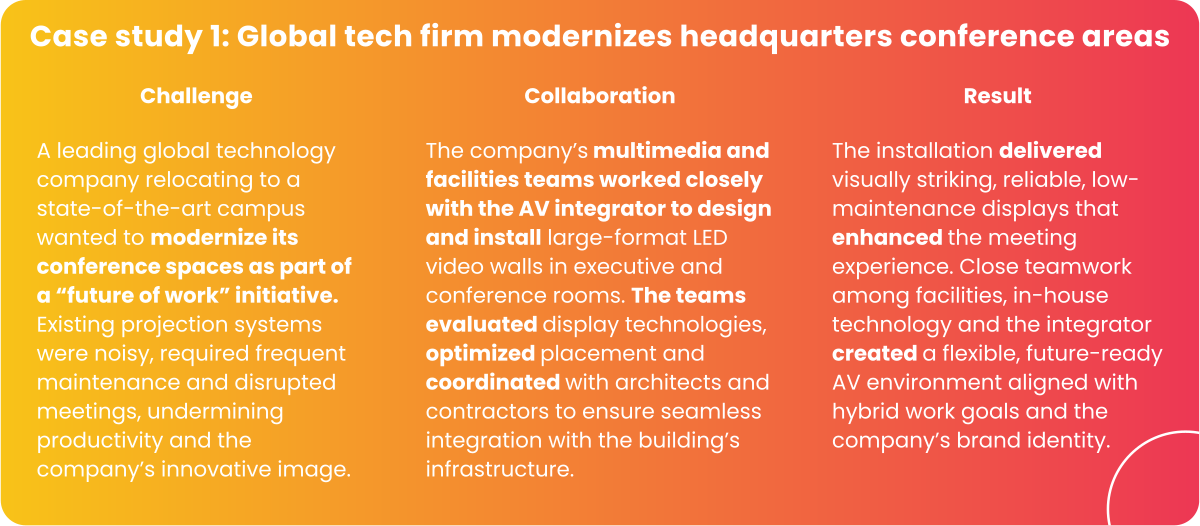
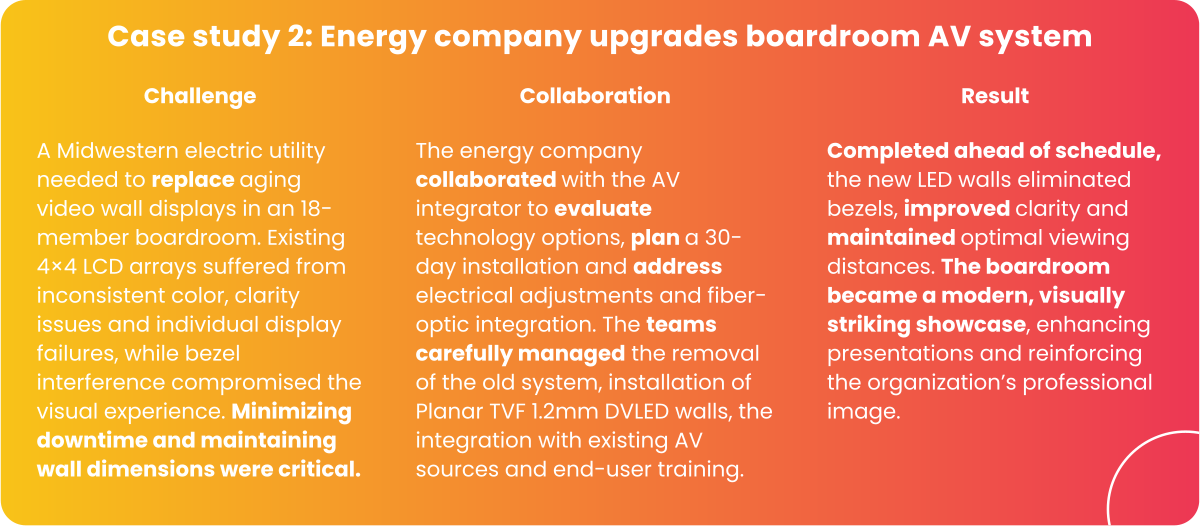
Successful AV installations rarely come down to the technology alone, instead hinging on collaboration. When facilities teams and AV integrators work in sync from the start, projects run smoothly and deliver lasting impact. But when coordination falters, even the best designs can lead to delays, cost overruns and systems that frustrate end users instead of supporting them. The following case studies show how strong collaboration between facilities teams and AV integrators can lead to high-performing, future-ready installations and what can happen when that teamwork is missing.
Potential pitfalls without collaboration
Even well-planned initiatives risk delays, technical issues and frustrated users if facilities, IT and integrators are not aligned from the start. Both case studies illustrate the critical importance of alignment between internal teams and AV integrators. Without collaboration:
-
The global tech firm’s project could have faced improperly sized or placed displays, insufficient electrical or network infrastructure and technology that conflicted with room layouts, leading to unreliable systems, ongoing maintenance headaches and disrupted meetings.
-
The energy company’s project could have suffered installation delays, poor display placement, connectivity problems and readability issues. Even minor miscommunication could have compromised the boardroom’s functionality, leaving a high-profile space outdated and inefficient.
These cases demonstrate the power of teamwork and suggest that even well-funded AV projects can fail to deliver if collaboration between facilities, IT and integrators is not prioritized. Strong coordination, by contrast, produces systems that are reliable, intuitive and aligned with operational needs and organizational goals.
Actionable strategies for AV specialists
The most successful AV specialists recognize that their job does not end at commissioning; it extends to ensuring systems remain valuable throughout their operational life. This requires AV specialists to align with FM’s goals, asking questions during planning sessions, simplifying training and structuring support relationships that acknowledge facilities teams' capabilities and constraints.
Aligning with FM goals
The following strategies do not require dumbing down technology; they require applying technical expertise in service of operational success rather than technical sophistication for its own sake:

Understand success metrics: Begin every project by clarifying how the FM’s performance is evaluated. Are they measured on system uptime? Budget adherence? User satisfaction scores? Maintenance efficiency? All of these elements? Design solutions that support these metrics rather than leading with technology capabilities that may not align with actual organizational priorities.

Speak operational language: Translate technical specifications into operational implications that FMs can evaluate. Instead of discussing technical specifications, explain how different options affect troubleshooting complexity or ongoing licensing costs.
 Acknowledge budget realities: Recognize that AV systems compete for resources with all other building needs. Present options at multiple price points with assessments of what capabilities each level delivers, allowing FMs to make informed tradeoffs.
 Think life cycle, not just installation: Consider the full ownership experience, including training requirements, maintenance burden, replacement part availability and upgrade paths. Systems that excel at commissioning but create operational headaches damage client relationships and industry reputation.
Questions to ask during initial planning sessions:
 AV specialists should also meet with facilities management in a discovery session and ask the following questions:
-
Who is responsible for day-to-day troubleshooting? Understanding who is responsible for maintaining the systems and the support team's capabilities shapes appropriate complexity levels. Systems designed for IT professionals create problems when maintained by general facilities staff without the technical background.
-
What is your typical staff turnover timeline? High-turnover environments require more intuitive systems with simpler training requirements. Building institutional knowledge becomes impossible when staff changes frequently.
-
Which building systems does the AV installation need to integrate with? Uncovering integration requirements early prevents expensive retrofitting later. Network security policies, room scheduling platforms, power management systems and building automation all affect AV system design.
-
What's your planned upgrade timeline for the equipment? Understanding the expected lifecycle helps specify appropriate quality levels. Equipment that will be replaced in five years doesn't need the same durability as installations planned for 15-year lifecycles.
-
Who handles after-hours emergency support? Knowing existing support structures reveals whether systems need remote diagnostic capability, what documentation format works for their team and whether your support model aligns with their operational reality.
-
How do you evaluate AV vendor performance? Understanding how you will be measured allows you to deliver what actually matters to the client rather than what you assume creates value.
Tips for simplifying system training for end users
Even the best-designed system fails if users cannot operate it confidently. Training should empower rather than overwhelm and provide practical tools that simplify use and reinforce consistency, such as the following:
 Create visual quick-reference guides: Visual guides use photos and diagrams to walk users through everyday tasks step-by-step, showing exactly what buttons to press and which cables to connect. Unlike lengthy manuals, these laminated single-page documents posted directly in meeting rooms provide immediate answers when users need them most.
 Develop troubleshooting flowcharts: Visual decision trees guide users through logical sequences of questions with each answer leading to the next diagnostic step or solution. These flowcharts empower staff to resolve common problems independently, reducing service calls for simple fixes like reconnecting cables or restarting equipment.
 Record video walkthroughs: Short videos of a few minutes each help demonstrate specific tasks in real time, showing exactly what users will see and do when operating the AV systems. These recordings are ideal for onboarding new hires who can view them and revisit confusing sections without feeling pressured. Organize them by task and store them in easily accessible locations like company intranets or QR codes posted in meeting rooms.
 Build feedback loops: Create ongoing channels for users to share confusing procedures, recurring issues, or workarounds they have developed. This kind of feedback reveals design flaws and missing features that expert analysis cannot uncover because it comes from daily system users. When users see their suggestions implemented, they become invested in reporting issues and helping refine systems.
 Organize documentation by task: Structure manuals around user goals like “Starting a Videoconference" or "Sharing Your Laptop Screen" rather than technical components like "DSP Configuration" or "Display Settings." A task-based approach matches how users think about their work and can dramatically reduce time spent searching for answers. Each section should be self-contained with all the relevant steps from setup through completion.
 Simplify labeling: Use intuitive, function-based labels like "Laptop Connection" or "Guest Presentation" instead of technical designations like "HDMI 2" or "Input C" to make systems self-explanatory and allow users to make confident decisions without consulting documentation or remembering which technical port corresponds to which function.
 Create maintenance checklists: Provide simple lists that guide staff through routine checks of cables, displays and connectivity to prevent small issues from escalating. Design them for non-technical staff and focus on conditions such as loose connections, physical damage and error messages, rather than requiring diagnostic expertise. Regular use of these checklists catches problems early, extends equipment life and reduces emergency service calls that disrupt operations and strain budgets.
Conclusion
When AV specialists design for long-term performance and FMs engage early in the process, AV technology becomes a dependable, sustainable asset. The most effective outcomes combine technical precision with operational understanding and result in systems that are intuitive, maintainable and built to adapt over time.
True success is measured not at installation but through years of consistent performance and user confidence. By collaborating as partners, AV specialists and FMs can ensure that the installed technology continues to deliver reliability, value and ease of use well into the future.

Ted Ritter, IFMA Fellow has worked and travelled extensively throughout North America, Europe and Asia. He is the Principal of LMI360, a company that solely supports organizations that support the built environment. He is the global chair of the IFMA Technology Community, past president of the Greater Phoenix Chapter and a past chair of IFMA Americas’ Advisory Board. He has more than 30 years of experience in facility operations and project management. He is a co-author of “The Facility Manager’s Guide to Information Technology,” author of multiple articles and has contributed to more than 100 presentations on best practices regarding the use of FM technology, sustainability and brand management.
Read more on Facility Operations and Communication or related topics Collaboration and Strategy
Explore All FMJ Topics