
 Membership
 Network
 Regional Sites & Affiliates


 Events
 Participate
 Resources

 Training
 Credentials
 Government


 Content Channels
 Tools
Tools


 Business Overview





From Fragmentation to Control
Reinventing incident response in FM

The role of the facility manager is undergoing a significant transformation. Traditionally, FM focused on the operation and maintenance of physical assets where responsibilities centered on ensuring buildings remain functional, compliant, efficient and safety. Success was typically measured through metrics such as maintenance performance, energy efficiency, and cost control.
Today, organizations place growing emphasis on a different set of outcomes. Safety, security, resilience, and incident management are viewed as core strategic responsibilities. When a security breach occurs, an alarm is triggered or an emergency unfolds, stakeholders expect not only a swift response, but also clear accountability for the outcome. FMs hold greater responsibility for how safety incidents are managed and resolved, regardless of how many external parties are involved in delivering the response.
This shift is creating new challenges for FMs, particularly those responsible for large or geographically dispersed property portfolios. While accountability for safety outcomes is becoming more centralized, the systems responsible for delivering incident response often remain fragmented. Indeed, between 2017 and 2022, outsourced FM services grew by 48 percent, demonstrating the extent to which responsibility for a range of operations has been increasingly distributed across external providers rather than consolidated in-house.
When it comes to security response, across many organizations, response capabilities are spread across a patchwork of alarm monitoring providers, guarding companies, emergency contractors, and local service providers, each operating with different standards, technologies and reporting practices.
IFMA’s inaugural Facility Management Workload Index, released this year, indicated that a significant majority of professionals expect their workloads to continue increasing. Yet as expectations rise, the gap between responsibility and operational control is becoming increasingly difficult to ignore.
More complex risk environment
The challenge reflects broader changes taking place across the FM landscape. Organizations today manage more complex portfolios than ever before. A single FM team may oversee offices, warehouses, retail locations, manufacturing facilities, health care sites, educational campuses or critical infrastructure spread across multiple cities, countries or even continents.
At the same time, security risks have become more varied and less predictable. FMs are expected to prepare for incidents ranging from break-ins and vandalism to workplace violence, environmental hazards and operational disruptions. The growth of hybrid working patterns has added another layer of complexity, with many buildings experiencing fluctuating occupancy levels that create shifting patterns of vulnerability throughout the day and week.
In this environment, the traditional approach to incident response is revealing its limitations. For decades, organizations relied heavily on local service providers to manage security and emergency response requirements. While this model offered flexibility and local expertise, it also resulted in a highly fragmented operating environment. Different facilities often developed their own relationships with security providers, adopted different procedures and measured performance in different ways.
Global pressures on public infrastructure
Public authorities have placed higher focus on reducing the burden that false alarms place on emergency services. Globally, public safety resources are under pressure and where policymakers are re-evaluating how emergency response systems are triggered and verified.
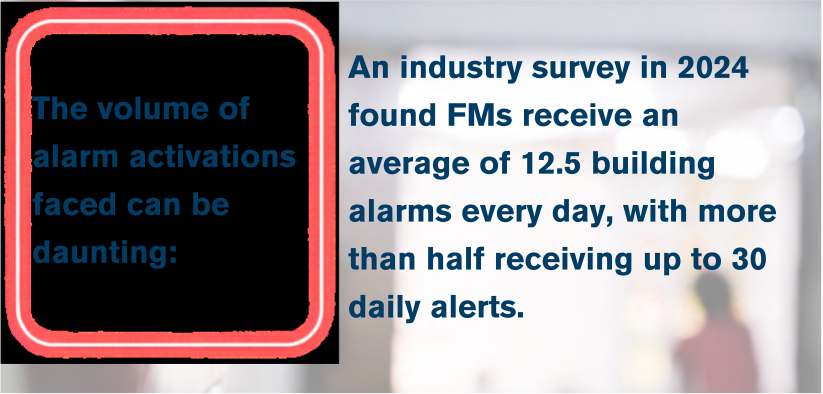
These regulatory shifts reflect a broader concern: that unverified or poorly managed alerts can divert emergency resources away from genuine incidents. As a result, organizations are being pushed toward more reliable verification processes before escalation to public responders.
At the same time, labor shortages are affecting private security sectors across multiple regions. Security companies in several key markets have reported persistent recruitment and retention challenges, with some industry estimates suggesting that a large proportion of providers are struggling to fully staff operations.
In the U.S., for example, 76 percent of security firms report difficulty filling roles, contributing to uneven coverage and variability in response times. Similar pressures are visible across parts of Europe and other developed markets where demand for security services continues to grow faster than available labor supply. Across global markets, security industry staff turnover rates often exceed 50 percent annually.
For FMs, these trends create a difficult operational challenge. Expectations for rapid, consistent response are increasing at the same time as the underlying capacity of local response networks is becoming more constrained and less predictable.
The accountability gap
When a security incident occurs, senior leadership rarely distinguishes between the various contractors and service providers involved in the response process. The organization itself is judged on the outcome. Attention is focused on whether occupants were protected, whether the response was effective, and whether the incident could have been managed more efficiently.
Yet many FMs have limited visibility into the full response chain. Information may be distributed across multiple systems, reporting formats may differ between providers, and performance data may be difficult to compare across locations. In many cases, organizations only receive detailed insight after an incident has already been resolved, long after decisions were made in real time.
This lack of visibility creates challenges that extend beyond operational management. Without a clear understanding of response performance across an entire portfolio, it becomes difficult to identify recurring issues, benchmark effectiveness, or improve resilience over time. Incident response remains reactive rather than systematically optimized.
As a result, many organizations are rethinking how incident response is coordinated.
The shift toward tech
 Technology is playing a central role in this transition, but not in the sense of replacing human responders. Physical security incidents remain inherently local. They depend on proximity, local regulations, and real-world presence.
What is changing is the coordination layer that sits above these local resources. Rather than relying on static, site-by-site arrangements with individual providers, a growing number of organizations are moving toward platform-based models that connect multiple response resources through a centralized operational system. In these models, alarms, sensor data, video feeds and incident reports are routed into a central environment where events can be verified, prioritized and escalated in real time.
A key defining feature is dynamic resource allocation. Rather than depending on a single local contractor’s availability, platform-based models can draw from broader networks of responders, identifying the nearest available and appropriately qualified resource in real time. This introduces a level of flexibility that traditional single-provider arrangements often struggle to match, particularly in regions experiencing labor shortages or uneven coverage.
Centralized coordination also enables more consistent reporting and governance. Incident data, response times, and outcomes can be captured within a single system of record, allowing organizations to compare performance across sites and providers using standardized metrics. Over time, this creates a more coherent understanding of how risk is being managed across an entire portfolio.
Aggregated response ecosystems
The value of these models lies in the shift from fragmented service delivery to connected networks.
In traditional arrangements, alarm monitoring, security dispatch, guarding, and reporting often exist as separate processes managed by different vendors. Communication between them is frequently manual, relying on phone calls, emails or disconnected software systems. This creates delays, inconsistencies and limited transparency during critical incidents.
By contrast, integrated coordination models bring these elements into a single workflow. Incident detection, verification, dispatch, response tracking and reporting are treated as interconnected stages within one continuous process rather than isolated handoffs between providers.
In many respects, technology is becoming the connective tissue that links previously disconnected elements of incident response, enabling a more coherent flow of information and action across distributed environments.
The future of FM
The future of FM is likely to involve a broader conception of responsibility than has traditionally been the case.
Buildings will continue to require maintenance, energy management, compliance oversight and operational support. However, expectations surrounding safety and resilience are expanding rapidly. Stakeholders expect organizations not only to manage risks, but also to demonstrate that their incident response capabilities are effective, measurable and continuously improving.
This evolution is transforming FMs into coordinators of more complex operational ecosystems. Success will depend not only on maintaining physical assets but also on ensuring that people, processes, and technology work together effectively when incidents occur.
As organizations expand their portfolios across multiple locations and jurisdictions, fragmented response models are likely to face increasing scrutiny. Greater emphasis will be placed on visibility, consistency, verification and accountability across entire portfolios.
In this environment, the most effective approaches are likely to be those that treat incident response as a coordinated operational function rather than a collection of disconnected services.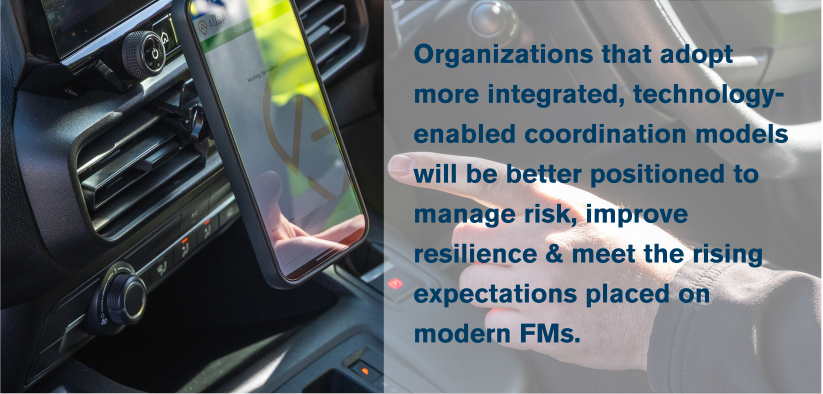

Tim Garrett serves as president of AURA’s US Division, where he leads the expansion of the infrastructure connecting digital security systems to real-world response, including in the facility management space. His mission is simple: ensure that when an incident occurs, the right help arrives fast.
References
The Global FM Impact Report 2023
Facility Management Pulse Report
Top image via Getty Images. Bottom image courtesy of AURA.
Read more on Facility Technology & Data Management and Leadership & Strategy or related topics Strategic Planning , Data strategy and information management and Facility Technology
Explore All FMJ TopicsRelated articles
-

Artificial Intelligence in FM
The stakeholder’s perspectiveBy Dr. Jake Smithwick & Dr. Kenneth Sullivan & Nneka Ubi05.01.2024 -

Don’t Drop the Ball
How a CMMS can make or break an FM organization’s successBy Michael Carmean09.17.2024 -

Beware of Growing Cyberthreats
Why it’s time for stronger facility cybersecurityBy Andrew Harris & Eric Headington10.30.2024