
 Membership
 Network
 Regional Sites & Affiliates


 Events
 Participate
 Resources

 Training
 Credentials
 Government


 Content Channels
 Tools
Tools


 Business Overview





Signed, Sealed, Delivered
Building envelope performance takes center stage

IFMA is an organizer of the Better Buildings Building Envelope Campaign, alongside the American Institute of Architects (AIA) and the International Institute of Building Enclosure Consultants (IIBEC). The U.S. Department of Energy’s Building Envelope Campaign is one of the latest in the series of Better Buildings Alliance technology campaigns and is designed to help building owners and facility managers create more energy-efficient buildings. This will be achieved by targeting the building envelope thermal performance, determining available energy savings, and providing technical support to building owners and FMs.
The building envelope consists of walls, windows, roof and foundation, and is one of the most overlooked areas of available energy savings in commercial buildings. Envelope technologies account for approximately 30 percent of the primary energy consumed in residential and commercial buildings, and therefore, play a key role in determining levels of comfort, natural lighting, ventilation, and how much energy is required to heat and cool a building. The Building Envelope Campaign provides momentum for FMs to invest in high-performance building envelope technologies for both new and existing commercial buildings.
The BEC website & tool
The Building Envelope Campaign evaluates the thermal performance of the building envelope for existing and new buildings, using a new metric called the BEP-value. Any commercial building owner in the U.S. is eligible to join the campaign as a participant, and buildings built or retrofitted since January 2019 are eligible to be submitted for recognition. The Building Envelope Campaign website (ec.ornl.gov) allows participants to enter information about their buildings, such as type of building, location, building geometries, thermal characteristics and building airtightness. For retrofit projects, the participant must enter information about the building both pre- and post-retrofit.
For new construction, the performance will be evaluated against present code requirements. For both cases, the BEP-value will serve as an indicator of performance and is calculated in real time. In addition to calculating the BEP-value, the tool performs a sensitivity analysis to determine, based on the user entries, which components of the building envelope can most significantly improve performance. For example, the tool may determine that increasing the R-value of the roof insulation is the most strategic measure to improve the overall building envelope’s thermal performance. In addition, the website provides resources, case studies and information about building envelope systems to improve the building energy efficiency.
Participants can be recognized in various ways. For retrofit projects, the building owner can be recognized if the building envelope performance, thus BEP-value, is improved by either 30 percent or 50 percent compared to pre-retrofit. For new construction, 20 percent and 40 percent improvement compared to code applies. These awards are Retro 30, Retro 50, Novel 20 and Novel 40, respectively. Projects may also be designated as Role Models for going above and beyond these awards or Honorable Mentions if those lower tiers are barely out of reach.
The thermal performance of the building envelope
In many cases, engineers, architects, consultants and building owners use prescriptive measures to quantify the thermal performance of the building enclosure. For example, steady state measurements such as material R-values or U-values are used to calculate the composite thermal resistance or transmittance of the building envelope. These values are then used to determine the overall thermal performance of the building envelope in the absence of dynamic effects. Unfortunately, R-value alone does not account for the building envelope’s response to energy transfer. Other factors, such as thermal mass, the thermal properties of fenestrations, air infiltration, occupant behavior and climate, especially solar loads, all play a role in determining the overall performance of the building envelope. It is these properties and the relationships between them that make quantifying or developing a metric (or a more representative metric) of the building envelope’s thermal performance complicated. For example, whole building energy simulations account for these properties separately rather than using a single metric to account for the thermal performance of the building envelope. The result of the energy simulation is often used to compute metrics that describe the performance of the entire building, including heating, ventilating and air conditioning (HVAC) system, plug loads and lighting. One such metric is the energy use intensity (EUI), which is the energy use of the building per conditioned floor unit area. The properties and performance of the building envelope, good or bad, are just one part of these results.
As part of the Building Envelope Campaign, a simplified methodology and performance metric was developed accounting for mechanisms relevant to the heat loss and gains through the building envelope and its impact on interior loads. Using a single metric, the methodology attempts to characterize the building envelope thermal performance as a system that includes the geometry of the building, thermal resistance and inertia of the opaque portion of the wall, fenestrations and even air infiltration. More importantly, the metric tries to capture all the complexity associated with the thermal performance of the building envelope into a single value. The introduced metric is referred to as the building envelope performance (BEP)-value.
The BEP-value
As complex as the energy performance of a building may seem, it typically comes down to a simple relationship (see Fig. 1). Whatever acts as a load on the HVAC system is basically a result of two variables: the heat loss or gains through the building envelope components including any solar induced load and the heat loads generated inside the building. For the Building Envelope Campaign, the focus lies on the building envelope thermal performance, and how it can be improved to reduce the HVAC peak and overall energy demand.
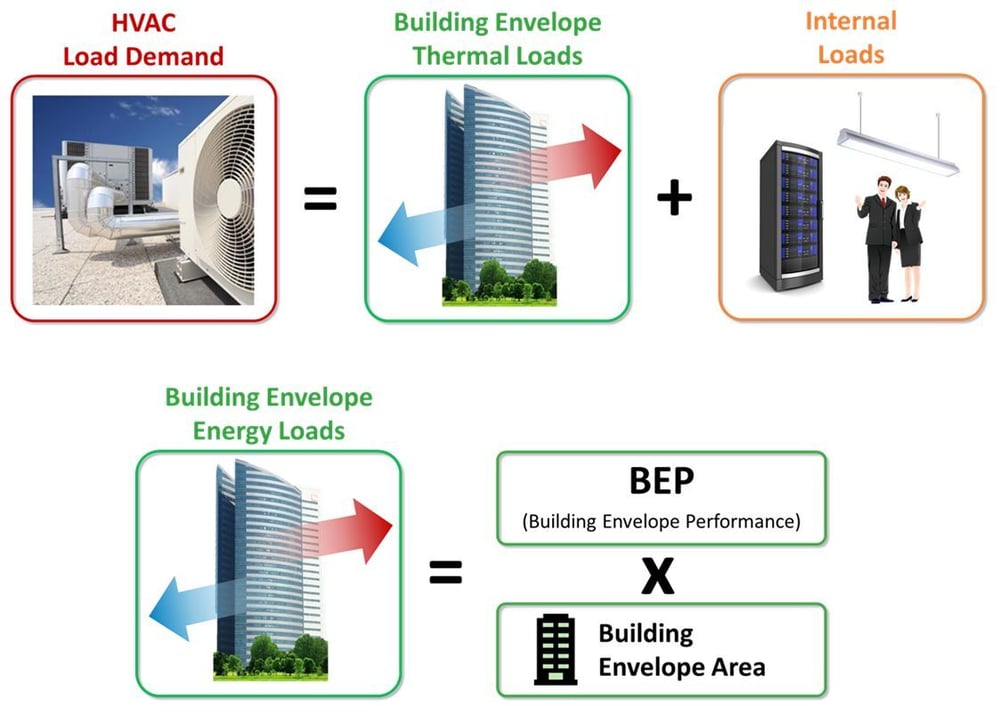
Figure 1: The energy balance of a building comes down to whatever heat load (or sink) that is generated inside the building, such as building envelope related loads and internal loads from lighting, people, plug-loads, etc., including the HVAC System, which needs to compensate for these loads to maintain a comfortable indoor climate.
To evaluate the thermal performance of the building envelope, the BEP-value was defined. Instead of using a wide range of metrics, such as R-value, air exchange rate per hour (ACH), solar heat gain coefficient (SHGC) of windows and U-factor, the thermal performance of the building envelope can be described through the BEP-value. As seen in Fig. 1, the BEP-value represents the annual energy load associated with all heat transfer mechanisms through the opaque building envelope and windows. This load is then divided over the total building envelope area and thus expressed in annual energy gain/loss per square foot of building envelope area (kBtu/ft2 year). The unit is comparable to the EUI with two exceptions, the BEP-value is given over the total building envelope area instead of conditioned floor area and only includes loads related to the building envelope.
Participants
The Building Envelope Campaign was launched in the summer of 2020 by the Better Building Alliance. During the first year of the campaign, 75 building owners signed up as participants and just as many signed up as supporters. Of the 75 participants, about 20 percent will be awarded in the year 2021. Altogether, these buildings have a conditioned floor area of about 1.5 million square feet and an expected annual energy savings of 9 million kBtu compared to pre-retrofit or if the buildings were built according to present code requirements.
The first building is the Station 51 Solar EMS in Athens County, Ohio, USA. The 8,726 square-foot building is designed to be virtually a net zero energy building. The building envelope has an astonishing 50+ R-value for the roof and R-38 for the exterior walls. The airtightness of the building has an impressive value of 0.13 cfm/sq. Ft. at 0.3 in water gauge (75 Pa), which is three times better than the present code requirement. According to the campaign tool and building envelope performance assessment tool, the BEP-value of this building is 5.0 kBtu/sq.ft. per year. With an expected 52 percent reduction in energy consumption from building envelope loads, Station 51 of Athens County is awarded Novel 40.
The second building is the retrofitted American Society of Heating, Refrigerating and Air-Conditioning Engineers (ASHRAE) headquarters in Atlanta, Georgia, USA. This three-story building has 53,600 square feet of conditioned floor area and more than 90,000 square feet of building envelope surface area. Originally built in 1978, the new R-value of the cool roof and exterior walls are 35 and 17, respectively. The BEP-value of the retrofitted building is 7.4, which is a 51 percent improvement compared to pre-retrofit. Because of a remarkably improved overall building envelope energy performance, the ASHRAE Headquarters is awarded Retro 50.
The Building Envelope Campaign is anticipated to continue for another year and will recognize buildings in 2022 for their envelope performance beyond common practice.

Dr. Simon Pallin serves as Building Envelope Technical Lead. He is an R&D staff member in the Building Envelope Materials Research Group at ORNL. Dr. Pallin has worked in the building industry since 2005 and is responsible for the Building Science Advisor, an online tool that helps the building industry design durable and energy-efficient wall assemblies. He holds a Ph.D. in building technology from Chalmers University in Sweden. Dr. Pallin is a member of the ASHRAE Pandemic Task Force–Residences; a voting member of ANSI/ASHRAE/IES Standard 90.2-2018, Energy-Efficient Design of Low-Rise Residential Buildings; handbook chair and voting Member of ASHRAE Technical Committee (TC) 1.12 on Moisture Management in Buildings; a voting member of ASHRAE SSPC 160, Criteria for Moisture-Control Design Analysis in Buildings; a corresponding member of ASHRAE TC 4.4, Building Materials and Building Envelope Performance; and a Certified Energy Manager with the Association of Energy Engineers.
References
Read more on Research & Benchmarking , Sustainability and Facility Operations or related topics Building Life Cycle , Energy and Operations and Maintenance Planning
Explore All FMJ TopicsRelated articles
-

The Global FM Impact Report 2023
A critical reviewBy Dr. Matthew Tucker05.22.2024 -

Evolving With Excellence
Comprehensive updates in IFMA’s benchmarks & targeted trainingBy Dr. Jake Smithwick & Nickalos Rocha01.30.2024 -

MEASUR UP
Identifying opportunities in a facilityBy Kristina Armstrong & Alex Botts & Thomas Wenning03.10.2023